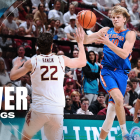
About a week ago, it was announced that UConn players Daniel Hamilton, Amida Brimah and Rodney Purvis would declare for the NBA Draft, but do so without an agent and keep their eligibility intact.
Unfortunately for the Huskies, it looks like the biggest of those names has made a decision.
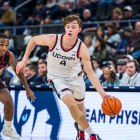
Hamilton has apparently decided to hire an agent and keep his name in the draft, according to a report from the Hartford Courant.
"I'm not testing the waters or anything like that," Hamilton told The Courant on Tuesday afternoon. "I'm all in."
Hamilton said he is still in the process of hiring an agent, but has decided he will. And when he does, he will no longer have the option of returning.
"I had a great experience at UConn," Hamilton said. "It was a great ride. I'm glad we won the AAC tournament and played in the NCAA Tournament. But after talking it over with my family, I just feel this is the best thing, to provide for my family, help my family out."
More than anything, this now affects Connecticut and its chances of success next season. Prior to news of this decision, we ranked Connecticut No. 16 in our Ridiculously Early Preseason Top 25 (and one). That came with us projecting Hamilton to stay, meaning they will not be that highly ranked when we update the new list.
Hamilton is doing this at a time when his stock is not necessarily in the best place. While he did have a solid season, earning second-team All-AAC honors and winning the most outstanding player award at the AAC tournament, there are some significant negatives to his stock currently that he could genuinely return to improve upon and place his stock into better shape.
Hamilton is currently the No. 95 overall player on the CBS Sports NBA Draft Big Board, meaning he is not projected to be drafted (which, as I'll get to momentarily, might not be the worst thing for him). Here's a quick breakdown of his game, and what he can expect his stock to look like.
Strengths
Hamilton has a really strange, versatile toolset that will intrigue NBA teams. Currently, at 6-foot-8 with a 6-8 wingspan (per DraftExpress' measurements database), Hamilton has good height but below-average length for a wing. He's a very quick player with a solid first step and good lateral quickness.
Within his game, that quickness shows up in the way he attacks the ball and can make plays for others. Hamilton finished first in the AAC in defensive rebounding rate at 27 percent, and also finished second in assist rate at 29.2 percent. If you think that's a strange combination of skills, it is. Hamilton is the first player since at least 2009-10 to post those rate-based numbers in conjunction with each other. If you lower the threshold to a 25 percent assist rate and 25 percent defensive rebounding rate, Hamilton is one of only three players to pull that off. The other two were Ben Simmons and Kyle Anderson, each of whom either were or project to be first round picks.
So yeah, that's really good. Hamilton is aggressive on the glass, attacking the ball well and really having a knack for high-pointing it against bigger opponents. Offensively, Hamilton does a really good job of utilizing his quickness to get into the paint along with solid ball-handling ability. Then, once he gets there, he has elite court vision for a wing player and really can create plays for his teammates.
Basically, there are skills here that other players really don't have in their repertoire, and that makes him fascinting in a way. However, the weaknesses are equally as frustrating as the skill.
Weaknesses
Hamilton is not a threat to score the basketball efficiently at this stage from any level. Over his two years at Connecticut, Hamilton had a 48.1 true-shooting percentage on 777 field-goal attempts. Out of the 82 NCAA players to take at least 777 shots over the last two seasons, Hamilton finished 81st when measured by true-shooting percentage. So yeah, the problems with his scoring are significant.
The biggest problem? They're the exact same problems as he had last year. Hamilton still struggles to shoot the ball from distance, and he also struggles to convert around the rim because of his lack of athleticism explosiveness, his slight frame, and his short length. Despite that inefficiency, Hamilton still had a tendency to make the poor decision to do things himself, leading to either turnovers or contested shots. If Hamilton can't score consistently, it's hard to see how he can take advantage of his playmaking skill in the NBA.
Another issue for Hamilton is his inconsistent effort on defense. When Hamilton is locked in on the ball, he can do an excellent job of stifling penetration because of his quickness. That effort just doesn't extend at all times, and it is nearly never there in off-ball settings. It's not uncommon for him to lose his man or give him too much space coming off of screens. There's at least a bit of potential here, but the room for error is much smaller.
Overall Stock Report
Hamilton has some glaring strengths as well as some significant weaknesses. If he had a more interesting frame, such as possessing a 7-foot wingspan or maybe a bit more bulk in his upper and lower body, he'd be a much stronger prospect because a team might be able to project him more easily as a finisher at the rim or as a defender.
But without that, Hamilton will likely need to pick up a jump shot at some point in the next few months and really shoot the lights out in workouts if he wants to find a place in this draft. If that doesn't happen, it's relatively difficult to see him being selected and given a guaranteed contract in the draft
That's why it would be a bit more beneficial to him, at least in my mind, to take the entire summer to work on his jump shot, come back to UConn and really see if he can make that work. A jump shot would really open up the rest of the game for him and his teammates, both in terms of his team's floor spacing and in terms of creating better angles for his own already-strong playmaking ability. Basically, there's relatively real room for growth in his game. A Daniel Hamilton that can shoot as well as pass and rebound like that would have a much better chance of getting into the first round. Without the jumper he's just a bit too one-dimensional offensively and not quite good enough defensively.
Maybe he goes undrafted, maybe he gets picked in the second round. If that's the case it would benefit him to go undrafted. There is potential here for a good, NBA level player if he can shoot it a bit better and prove that he can make better decisions. That could mean a smart, forward-thinking organization could give him a nice, sizable guarantee in the offseason when the salary cap explodes, bring him in for training camp and stash him in the D-League as an affiliate player to work with him and see if he can pan out if they don't have the NBA roster space. If he goes in the second round, that guarantee would not be available to him, as the team that drafts him would probably stash him in the D-League without signing him, thus forcing him to play for low D-League wages (a la Dakari Johnson and Andrew Harrison this season, who are making less on the whole than guys like Treveon Graham and J.J. O'Brien).
It's commendable that Hamilton wants to help out his family. There is absolutely money out there for him to make, and he has a right to it. But given the legitimately projectable parts of his game that could lead to a much better chance of a guaranteed contract next season, this might be a bit of a regrettable decision if things don't totally go his way.