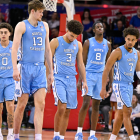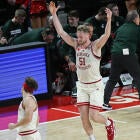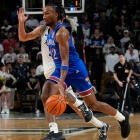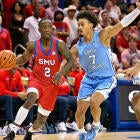
Inside why Kentucky is struggling with an expensive roster and what coach Mark Pope can do to fix the issues
Armed with players earning big money, Kentucky is off to a disappointing 7-4 start

•
9 min read
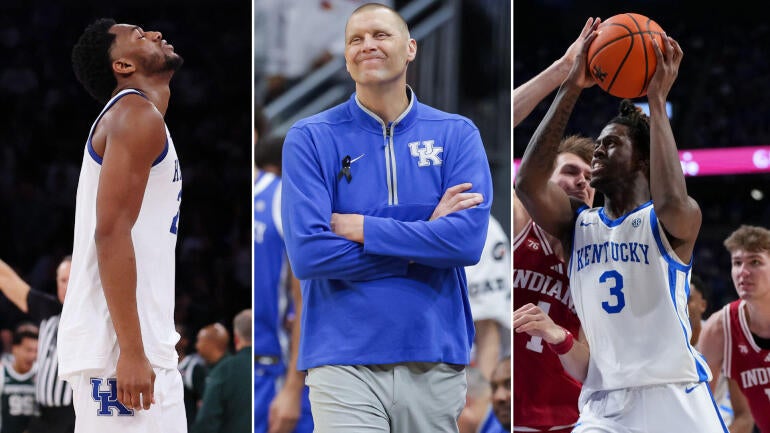
Do a deep dive on the current state of Kentucky basketball and one of the first things you'll see is that the headlines are far worse than the analytics. The Wildcats are 7-4 and have been booed off the floor at times, but they actually are the 19th best program in the country according to KenPom.com. They have a top-20 defense and a top-40 offense, all while playing without Jaland Lowe for stretches and without Jayden Quaintance at all.
Still, that is not what the expectations were coming into the season. Kentucky reportedly had the highest payroll in college basketball. There was no debating it had one of the deepest rosters with 13 legitimate rotation-caliber talents. That came after assembling the No. 5 transfer class and No. 6 high school recruiting class in the country while simultaneously retaining the likes of Otega Oweh, Collin Chandler, Brandon Garrison and Noah Trent.
So, where is the disconnect between the money spent, talent assembled and the product that BBN is seeing on the floor?
Injuries are certainly a factor, but this was a roster that was supposedly built to overcome adversity of that kind.
Ironically, I actually don't even have complaints with the staffs' individual evaluations. Jasper Johnson and Malachi Moreno, their top two recruits, were both local Kentucky natives. UK coach Mark Pope had to have them, even if it meant overspending. Quaintance may have had just torn his ACL, but he was still widely coveted in the transfer portal. Lowe came after they pursued other lead guards including Donovan Dent, Dedan Thomas, and Silas Demary. Denzel Aberdeen, Mouhamed Dioubate, and Kam Williams all had the makings of valuable contributors.
My issue isn't with the individual pieces. It's the way those pieces fit together. More specifically, it's the way those pieces fit together in Pope's system heading into Kentucky's game vs. No. 22 St. John's in the CBS Sports Classic in Atlanta (12 p.m. ET on CBS, CBSSports.com, CBS Sports App, Paramount+ Premium)
Lack of shooters: UK missing the mark
It is no secret that Pope values 3-point shooting and the floor-spacing that is provides. His final team at BYU took over half of their shots from behind the arc. His first team at Kentucky set a program record by connecting on 341 made 3-pointers on the season, even though their average of 25 attempts per game was notably less than the 35 he previously stated he wanted them to shoot. The vast majority of those attempts came down to four players – Koby Brea, Kerr Kriisa, Jaxon Robinson and Ansley Almonor. None of them returned to Lexington this season though, and many of the players Kentucky allocated the most resources to had questionable shooting histories.
It begins with Oweh, who had seen his percentages consistently tick up, but was often surrounded by good shooters and thus had the luxury to be very selective with his looks. Add Lowe and Aberdeen to your potential backcourt and you have 27% and 35% shooters from last season. Then it's Mouhamed Dioubate, who went 12 of 26 from behind the arc last season, but has been known as a nonshooter for virtually his entire career. Even if the coaching staff hoped that group could all make incremental progress, they had to know they weren't going to be the same caliber of shooters. Theoretically though, Johnson, Kam Williams, and Andrija Jelavic were supposed to help, along with the return of Noah and Chandler. The returners have proven up to that challenge. However, that trio of newcomers is shooting a combined 26 of 97 from deep. That's 27% from a group that was supposed to specialize in floor-spacing.
Questions about the shooting were actually a talking point this summer.
"This group might not have come in with the reputation as being as prolific shooters as some of the guys we brought in last year, but the progress they made every single week during the summer was remarkable," Pope said, further claiming that the team had seven players shooting 70% or better from beyond the arc during the summer. "That translates to games. It always has for us."
Unfortunately, it hasn't yet.
Lack of playmaking: Recruiting guards not a priority
Kentucky had a point guard problem a year ago as injuries to Kriisa and Lamont Butler left them with Travis Perry as the only true point guard on the active roster in the heart of conference play. Yet, when it came to building up their depth this season, they emphasized virtually everything but primary ball-handlers and playmakers. There's multiple bigs, forwards, wings, and even some guards, but Jaland Lowe is the only player on the roster who has ever been a team's primary initiator before. So, as he's battled injuries, and been less than 100% even when he's been in the line-up, it has left Kentucky without a real orchestrator.
Unfortunately, when you lack shooting and playmaking, those problems compound each other. When you don't have shooting, opposing defenders can help off their man that much more, thus creating fewer driving lanes. When you don't have great playmakers to begin with, and the lane is clogged, it's not the foundation of a productive offense.
To their credit, Kentucky has figured out ways to take care of the ball, but the cohesiveness of their normal offensive actions has not been the same, nor has their ability to get opposing defenses into long rotations.
Lack of fit in system: Players struggle with Pope's schemes
Let me be clear, Pope knows basketball, specifically offensive basketball. He runs good actions with modern principals. The problem is that he doesn't necessarily have a modern-type of roster. His current frontcourt of Moreno, Garrison, Dioubate, and Jelavic is shooting a combined 9-47 (19%) from three. Dioubate and Jelavic are also not passers. They have a combined 10 assists through 11 games.
There are ways to win with this type of roster. In fact, it's not uncommon at the top of college basketball. But there's a reason why you don't see teams like Houston, Purdue, and Arizona running 5-out concepts or zoom actions. It's because they understand they're playing with two bigs and their success is instead going to rely on points in the paint, rebounding, and ball security.
To put it another way, it's a different kind of math. The oversimplified version is that teams that prioritize 3-point shooting are trying to win on points per possession (think Alabama). Teams that prioritize size are trying to win on total field-goal attempts. Kentucky needs to do math differently than they have before, and if recent weeks are any indication, they are starting to figure it out.
In a 67-64 loss to North Carolina this month, Kentucky attempted only 13 3-pointers, the lowest in Pope's time in Lexington. In Saturday's 72-60 win over Indiana, the Wildcats attempted only 15 shots from behind the arc, the second lowest of his tenure. They also had 58 field goal attempts to just 44 for Indiana. They did that through taking care of the basketball (UK had four turnovers to Indiana's 18) and winning the glass — the Wildcats had an offensive rebounding rate of 33% while Indiana's was 28%.
Pope acknowledged the evolution after the game, but simultaneously expressed optimism that the shooting can improve.
"We're making some adjustments where the game's a little more mucked up, which I don't love aesthetically, but I love it in a very spiritual way," Pope said. "It's really physical and intense and combative, and I think we can exist in that type of game.
"By the end of the year, I think we're going to be really dangerous shooting the ball. I do," he said.
Lack of leadership: Oweh should set standard
The area where Kentucky's personnel is built to be most effective is on the defensive end of the floor. Oweh, Dioubate and Quaintance should theoretically be a dominant trio eventually. Even now, for whatever challenges the Wildcats have faced, they're still a top-15 rated defense. They've guarded the paint well and been a good rebounding team. Beyond the arc though, the numbers say they may actually be getting lucky. Teams have attempted roughly 42% of their shots from 3-point range and yet made just under 29% of them. Typically, there is a correlation between the number of 3-pointers attempted and the number made, but thus far Kentucky has defied that.
Beyond the numbers, there have clearly been times when Kentucky hasn't fully competed on the defensive end of the floor. That's unacceptable, particularly when two of the returning players have been the biggest culprits. Garrison and Oweh have been lackadaisical at times. They're not the only ones, but as returners, they should be building the culture, not deteriorating it. Garrison was recently benched because of it, but it's Oweh who needs to set the standard, both for the benefit of the team and himself.
He explored entering last June's NBA Draft before electing to return, reportedly for a significant payday. That type of investment comes with an inherent responsibility and, quite frankly, there have been times he hasn't lived up to it. He has all the tools to be one of the elite perimeter defenders in the country. That niche is also critical to his long-term NBA aspirations. But when he's botching rotations, giving up straight-line drives and isn't getting back in transition, he hurts both his team right now and his long-term draft stock.
Pope has spoken plainly about the "harsh truth" that the team doesn't "know what it means to compete." He's taken a lot of responsibility on himself and recently credited Oweh for "really trying to rally the guys" and "trying to show some leadership."
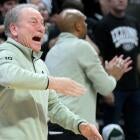
Simultaneously though, we've seen a more firey version of Pope on the sidelines, which could be an indication that he feels he needs to fill that leadership void himself. Whether Oweh can be a verbal leader or not is one thing. What is critical though is that he practice what the coach preaches, particularly on the defensive end of the floor.
Bottom line: UK's issues can be fixed
Kentucky's problems through the first six weeks of the season have been multi-faceted and there are lessons to learn for future off-seasons. They can better prioritize shooting, floor-spacing, and build in contingency plans at the point. That will allow them to play the way Pope wants to play, which does have proof of concept.
Those are solutions for subsequent seasons though. Right now, it may come down to the coach to fill some of the voids as best he can, whether that be through altering the style of play or his personal demeanor.
This weekend, he'll do it about 20 yards from his former college coach, as Rick Pitino and St. John's are up next.
CatsPause is the go-to source for all of the latest Kentucky basketball, recruiting and football scoop. Sign up for a VIP membership now and join the conversation to experience the power of the CatsPause community where Kentucky fans connect and get even more insider information from our experts on staff.