2021 Fantasy Baseball Draft Prep: The players you should target instead of higher-priced stars
These players may lack optics appeal, but they will bring you value on draft day

By
Chris Towers
•
11 min read
Here's one of the best pieces of advice I can give you as you prepare for your Fantasy draft: Forget about names. Names don't matter, production does. Names are associated with a level of production, of course, and given how hard it is to accurately project production, names are what we often fall back on.
Names you know you can trust. Names everyone is talking about. Names you saw at the top of last year's leaderboards. Names who have let you down in the past. Names, names, names. But what you want at the end of the season is more numbers than the people you're going up against in your league, and it doesn't matter if you can't spell anyone in your lineup's name.
Sometimes, we fall in love with certain names, when other names going later in drafts might produce just as much, and this is where projections can help us out. We can identify certain types of profiles from the early rounds and see whether we can find similar production later on in drafts.
One example is Trent Grisham. Grisham's is a trendy name in Fantasy baseball drafts for 2021; he's a former top prospect in a great offense with a potentially rare skill set in Fantasy -- the ability to hit 20 homers and steal 20 bases is more valued than ever before. He's also a bust candidate for me, and it's not just because of the platoon split concerns (33.9% K rate, 7.7% BB rate against LHP) or batted-ball issues (10th highest infield fly-ball rate in baseball in 2020); it's also because there are very similar players being drafted later than him right now.
And Grisham isn't alone. I've got nine other players in similar situations, going early in drafts with potential statistical doppelgangers with less hype going later in drafts. That doesn't mean I don't like Grisham or any of these other nine players. I just have a hard time justifying paying the sticker price for the name brand when the generic option may not be much worse. Here's what I mean, with the help of the ATC projection system from SportsLine.com:
Trent Grisham/Cavan Biggio vs. Austin Meadows/Byron Buxton/Ramon Laureano/Aaron Hicks/Tommy Edman
Name | ADP | G | AVG | R | HR | RBI | SB |
66.1 | 144 | 0.241 | 92 | 22 | 72 | 17 | |
Trent Grisham | 68.5 | 147 | 0.250 | 92 | 24 | 73 | 18 |
96.3 | 135 | 0.259 | 78 | 26 | 76 | 10 | |
113.0 | 126 | 0.255 | 68 | 23 | 70 | 15 | |
131.5 | 131 | 0.266 | 73 | 12 | 57 | 12 | |
146.7 | 143 | 0.248 | 82 | 22 | 70 | 10 | |
278.9 | 129 | 0.237 | 76 | 20 | 65 | 8 |
Ultimately, what you're paying for with both Grisham and Biggio is that power-speed combo, plus the hope that they'll score a lot of runs at the top of their lineups. While it is true that it is hard to find players projected for homer totals in the 20s with steal totals in the high-teens, the fact that both are likely to be batting average liabilities does make them stand out a bit less.
Obviously, Biggio and Grisham have better projections than anyone else here, though playing time gaps explain some of that across the board. And I'll also note that the actual production from this group over the last few seasons isn't tilted in favor of Biggio or Grisham nearly as much -- or at all (per-150-game averages for 2019 and 2020 included):
G | R | HR | RBI | SB | BA | |
Cavan Biggio | 150 | 91 | 20 | 64 | 17 | 0.240 |
Trent Grisham | 150 | 90 | 22 | 68 | 15 | 0.243 |
Austin Meadows | 150 | 88 | 32 | 88 | 12 | 0.273 |
Byron Buxton | 150 | 80 | 27 | 87 | 19 | 0.259 |
Tommy Edman | 150 | 90 | 16 | 63 | 17 | 0.283 |
Ramon Laureano | 150 | 90 | 25 | 78 | 13 | 0.266 |
Aaron Hicks | 150 | 92 | 24 | 76 | 7 | 0.231 |
Last season wasn't the first for any of these players, but the two months we saw in 2020 is what is driving the gap in price. Hicks and Buxton have injury histories that are driving their prices down too, but all of the alternatives here stand as pretty excellent bounce-back candidates, each with as much or more upside as Grisham and Biggio. I'm content to wait until after pick 100 for this kind of profile.
Walker Buehler vs. Kenta Maeda/Hyun-Jin Ryu/Zack Greinke
Name | ADP | IP | W | ERA | SO | WHIP |
Walker Buehler | 19.0 | 168 | 12 | 3.45 | 191 | 1.09 |
50.3 | 170 | 12 | 4.11 | 182 | 1.19 | |
70.2 | 176 | 12 | 3.70 | 166 | 1.21 | |
106.7 | 180 | 12 | 4.00 | 165 | 1.18 |
Here's another example of one where the projections clearly side with Buehler, though I'll note that they also have him with the lower innings total of this group. Anything can happen over the course of a full season, but if all four of these pitchers stay healthy, I'd bet on Buehler finishing last in innings. That matters.
And it also matters that Maeda, Ryu, and Greinke are all being significantly dinged for their age by the projections. That's not unreasonable -- Father Time is undefeated, after all -- but I'll take the under on all three for ERA and WHIP. Especially Ryu, who has a 2.30 ERA and 1.036 WHIP over the last three seasons. For his part, Greinke has a 3.20 ERA and 1.045 WHIP over his last three seasons; Buehler is at 3.03 and 1.002. Better, but not that much better, especially with concerns about how many innings the Dodgers will let him throw after he threw just 61.2 over 13 starts including a World Series run.
D.J. LeMahieu vs. Whit Merrifield/Ketel Marte/Jeff McNeil
Name | ADP | G | AVG | R | HR | RBI | SB |
26.6 | 144 | 0.304 | 98 | 19 | 75 | 6 | |
41.8 | 149 | 0.283 | 89 | 15 | 68 | 25 | |
82.9 | 143 | 0.290 | 82 | 20 | 75 | 6 | |
89.5 | 147 | 0.293 | 81 | 18 | 74 | 4 |
The profile here is "very high-average, with enough power and run production," and LeMahieu is certainly the king of that profile right now. Given his spot in the Yankees lineup, the upside here for LeMahieu is probably higher than anyone else's -- with the exception of Merrifield, who could very well steal 30-plus bases. However, there's one pesky little concern to keep in mind: The potential de-juiced ball.
We likely won't know what the impact of the new will be until the season starts unfortunately, but LeMahieu could be one of the players most impacted. He had the third-shortest average home run distance in 2020, at a meager 361 feet. He had the seventh-shortest in 2019, though his 386-foot distance was certainly more impressive. The short porch in right field at Yankee Stadium helps get the most out of LeMahieu's opposite-field heavy approach, but given the number of wall scrapers LeMahieu hits, even a pretty small change in how far the ball travels could have an outsized impact on his production.
LeMahieu will still hit for a high average, of course, but so will Marte and McNeil. If LeMahieu is more like a high-teens home runs guy, does he really deserve to go 60 spots ahead of those guys?
Bo Bichette vs. Starling Marte/Javier Baez/Dansby Swanson
Name | ADP | G | AVG | R | HR | RBI | SB |
Bo Bichette | 24.6 | 142 | 0.286 | 91 | 23 | 84 | 21 |
50.3 | 145 | 0.277 | 87 | 19 | 72 | 25 | |
75.5 | 148 | 0.259 | 82 | 28 | 86 | 11 | |
109.4 | 144 | 0.257 | 91 | 22 | 77 | 12 |
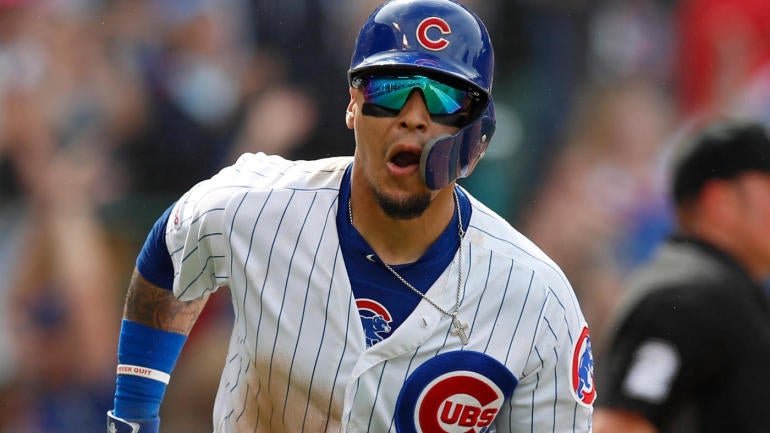
The projections don't back this one up, and it's impossible to argue with what Bichette has done so far in his MLB career: .307/.347/.549 line with a 30-homer, 17-steal pace. Except, of course, we're talking about just a 75-game sample size, which makes a borderline second-round ADP pretty hard to stomach. Sure, Bichette has been awesome, but Baez just had a .286/.321/.544 line with a 35-homer, 18-steal pace between 2018 and 2019, and his came across 298 games. Swanson has had similarly productive stretches, including a .274/.345/.464 line with a full-season pace of 27 homers and 14 steals in 2020.
Bichette will probably be better than this trio, but there's a lot of volatility baked into his profile that isn't being accounted for. He could be a superstar, sure, but the chances he underperforms this cost are higher than the chances that he blows it away.
Eloy Jimenez vs. Rafael Devers/George Springer/Yordan Alvarez/Nelson Cruz
Name | ADP | G | AVG | R | HR | RBI | SB |
Eloy Jimenez | 32.3 | 144 | 0.287 | 80 | 36 | 103 | 1 |
42.1 | 148 | 0.281 | 96 | 31 | 100 | 4 | |
49.0 | 141 | 0.274 | 100 | 33 | 91 | 4 | |
77.7 | 124 | 0.276 | 76 | 32 | 90 | 1 | |
92.2 | 125 | 0.273 | 73 | 32 | 86 | 0 |
Eloy figures to be a high-level contributor in average, HR, and RBI, but the thing is, he's likely only going to be a contributor in those three categories. He's a low-OBP guy and a poor baserunner, so runs could be tough to come by, and he hasn't stolen a base in a game since 2017. That puts a lot of pressure on him to stand out in those three categories -- and two of those categories are the easiest to find in the game. I have Devers and Springer ranked ahead of Jimenez, and I would rather have Alvarez and Cruz at their respective prices, even though they are Utility only.
Nolan Arenado vs. Luke Voit/Eugenio Suarez/Lourdes Gurriel/Eddie Rosario
Name | ADP | G | AVG | R | HR | RBI | SB |
Nolan Arenado | 38.6 | 147 | 0.271 | 84 | 30 | 95 | 1 |
59.9 | 141 | 0.262 | 86 | 34 | 92 | 0 | |
74.4 | 149 | 0.246 | 86 | 37 | 101 | 3 | |
Lourdes Gurriel Jr. | 88.9 | 143 | 0.274 | 77 | 28 | 86 | 7 |
104.7 | 137 | 0.271 | 79 | 29 | 91 | 5 |
Arenado's is an obvious case of name brand pushing a player's price up. He's been an elite Fantasy option for a long time, and while I won't hold 2020 against him, the simple fact is, he doesn't have Coors Field backing him up anymore. I don't think he'll just collapse as a hitter, but this projection seems pretty reasonable to me. I expect he'll be a good, but not great hitter, and you're paying for pretty close to great. Suarez in particular is one of my favorite Arenado alternatives -- I have them separated by just two spots in my overall rankings -- while Gurriel has been even better than this projection in his career to date.
Tyler Glasnow vs. Corbin Burnes/Sonny Gray/Dinelson Lamet
Name | ADP | IP | W | ERA | SO | WHIP |
Tyler Glasnow | 47.8 | 160 | 13 | 3.67 | 213 | 1.14 |
60.8 | 151 | 10 | 3.68 | 182 | 1.21 | |
68.3 | 173 | 12 | 3.83 | 193 | 1.27 | |
91.6 | 133 | 9 | 3.59 | 168 | 1.16 |
150 elite innings may be more valuable than ever in 2021, given how few pitchers we expect to throw big innings. However, when you're spending a fourth-round pick on a pitcher who is no sure thing for even 150 innings, you need that pitcher to be a slam dunk for the elite production side of the equation, and I'm not sure Glasnow is that. I have him as a bust for this season, and as I noted in that column, Glasnow has a 4.61 ERA and 1.23 WHIP over his last 23 starts. That isn't just an arbitrary endpoint, either; it marks his return from a four-month absence in September 2019 due to a forearm strain.
Burnes' 2020 was a massive outlier from his 2019, but there's never been a question about his talent. Plus, the sample size for that outlier is actually slightly bigger than Glasnow's own outlier season in 2019 -- 240 batters faced to 230. Lamet comes with even bigger injury concerns, due to his ongoing arm issues, but the upside is similar -- he had a 2.09 ERA and 0.855 WHIP over 267 batters faced in 2020. I don't mind paying for the kind of high-volatility profile Glasnow represents, but I need it at a discount.
Max Fried vs. Kyle Hendricks/Jose Berrios/Zack Wheeler/David Price
Name | ADP | IP | W | ERA | SO | WHIP |
Max Fried | 68.8 | 166 | 13 | 3.79 | 158 | 1.31 |
82.2 | 191 | 12 | 3.86 | 156 | 1.20 | |
83.5 | 185 | 13 | 3.97 | 189 | 1.23 | |
96.2 | 185 | 11 | 3.95 | 168 | 1.26 | |
187.1 | 115 | 8 | 4.12 | 117 | 1.27 |
We're still trying to figure out who, exactly, Max Fried is, but this projection fits in with what I'm expecting. That's a pretty good pitcher, but it's not a profile we typically get excited about for Fantasy. He was roughly an average strikeout pitcher in 2020, but excelled by limiting damage on contact. That's been Hendricks' M.O. for years, and he does it better than anyone; Berrios and Wheeler also fit the bill, except they've also shown the ability to consistently pitch deep into games. Price is a bit of a wild card here, but he had a 3.38 and 3.58 ERA before 2019's 4.28 mark, and even that number was inflated by 20 runs allowed in his final 17 innings before a cyst in his wrist shut his season down. If he returns from taking the year off in 2020, he could be every bit as good as Fried at a fraction of the cost.
Zach Plesac vs. Jesus Luzardo/Joe Musgrove/John Means
Name | ADP | IP | W | ERA | SO | WHIP |
Zach Plesac | 73.6 | 164 | 10 | 4.19 | 154 | 1.22 |
105.8 | 151 | 9 | 3.82 | 153 | 1.23 | |
126.7 | 166 | 10 | 3.99 | 169 | 1.21 | |
211.6 | 157 | 9 | 4.46 | 141 | 1.24 |
I'll admit, even as a noted Plesac skeptic, I think this projection might be unfair to him. But then again, maybe not: He has a 4.44 FIP, 4.55 xFIP, and 4.58 SIERA over the course of his full 171 innings of work in the majors and he gets hit pretty hard. In his 2020 he looked like an all-new pitcher, as he re-worked his pitch mix and saw his strikeout rate spike from 18.5% to 27.7%. However, that came in just eight starts against five teams, so what we don't know is what Plesac looks like when the league adjusts to him.
Plesac has upside to outperform this projection, but so do the other three pitchers here. Luzardo has legitimate ace upside, while Musgrove has flashed a ton of potential in the past. I can't bring myself to bet on Plesac's eight starts from 2020 with a top-75 pick, but I'm fine looking for upside when it presents itself later.
Matt Olson vs. Jorge Soler/Franmil Reyes/Joey Gallo Miguel Sano
Name | ADP | G | AVG | R | HR | RBI | SB |
Matt Olson | 88.5 | 146 | 0.237 | 79 | 38 | 97 | 1 |
141.9 | 140 | 0.248 | 75 | 32 | 89 | 2 | |
151.0 | 149 | 0.260 | 78 | 35 | 92 | 0 | |
163.9 | 146 | 0.215 | 84 | 39 | 90 | 5 | |
Miguel Sano | 193.5 | 138 | 0.226 | 81 | 36 | 85 | 0 |
I'll admit, I've found the fascination with Olson a bit baffling in an era where power is easier to find than ever. Olson has rare power, but that's relative to the league as a whole; relative to this group, it's pretty run of the mill. Finding someone who can muscle out a bunch of homers and drive in 90-100 runs while being a batting average drain just isn't that hard to do -- it's also why I'm not overly excited to draft Pete Alonso.
You can see why I'm not beating the door down to draft Olson in their 150-game paces over the last two seasons:
R | HR | RBI | SB | BA | OBP | SLG | OPS | |
Matt Olson | 81 | 40 | 107 | 1 | 0.245 | 0.338 | 0.508 | 0.846 |
Jorge Soler | 82 | 41 | 103 | 2 | 0.257 | 0.348 | 0.543 | 0.891 |
Franmil Reyes | 69 | 33 | 83 | 0 | 0.257 | 0.321 | 0.494 | 0.814 |
Joey Gallo | 91 | 38 | 89 | 7 | 0.221 | 0.351 | 0.500 | 0.851 |
Miguel Sano | 102 | 45 | 99 | 0 | 0.233 | 0.325 | 0.544 | 0.869 |
Olson doesn't look bad here, but he doesn't look special. Soler has been a little better overall, and Olson doesn't really stand out from the pack anywhere. Which makes it hard to make sense of the ADP gap. Olson is a very good power hitter, but he's still being drafted at a premium that isn't justified by the projections or his production.
So which Fantasy baseball sleepers should you snatch in your draft? And which undervalued first baseman can help you win a championship? Visit SportsLine now to get Fantasy baseball rankings for every single position, all from the model that called Will Smith's huge breakout last season, and find out.