Fantasy Football 2023 Draft Prep: Why wide receiver prioritization has become the new normal in Fantasy drafts
From our upcoming magazine, we dive into the ascension of the position

•
10 min read
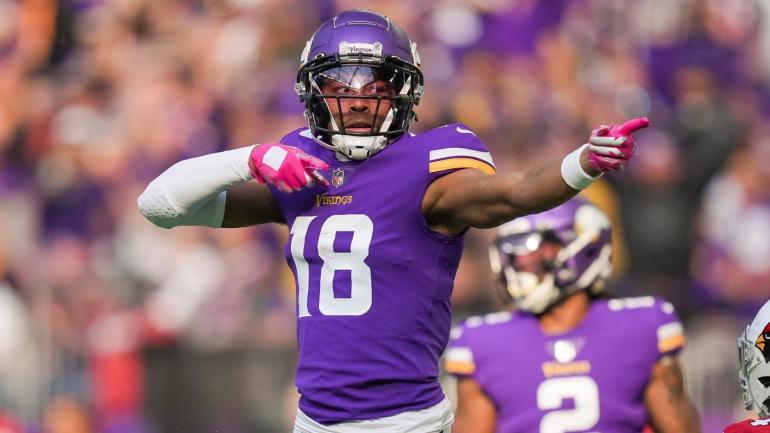
I started playing Fantasy Football in earnest in the early 2000s. The oldest draft I still have results from is 2008, which is probably five-to-eight years after I started, but also close enough to illustrate the change in the game since then. In that draft, the first 11 picks were either quarterbacks or running backs. Terrell Owens was the first wide receiver taken, at pick No. 12. Reggie Wayne and Steve Smith were the only other receivers taken in the first 22 picks. No tight end came off the board until Tony Gonzalez at pick No. 30, and this was in a draft full of Kansas City Chiefs fans.
In contrast, in the two mock drafts you see in our upcoming magazine, five wide receivers and one tight end were taken in Round 1, with another six-to-seven pass catchers taken in Round 2. The game has clearly changed, and it is not showing signs of going back any time soon. There are many reasons for that, starting with the changes to Fantasy Football in general.
The ways our game has changed
When I started at CBS in 2015, we were still calling non-PPR leagues "standard." They are clearly not the standard now. The vast majority of leagues on our platform now reward something for a catch, whether it be half a point, a full point, or something different. And it is a fair bet that CBS has more non-PPR leagues than other sites, who all swapped their "standard" setting to some version of PPR long ago.
This change explains a lot of the shift to wide receiver. As Dave Richard illustrates in his tiers piece, wide receivers outscored running backs across the board in PPR scoring in 2021 and 2022, but the difference between the two positions was just as stark, in running backs' favor, in non-PPR. While that explains a lot of it, it doesn't come close to entirely explaining the rise of the receivers, not even in terms of how Fantasy Football scoring has impacted it.
Other changes in our game include the way we value yards and the decline in the number of yardage bonuses, and the increase in flex spots in lineups. In terms of yardage, many leagues in the early days of Fantasy only rewarded touchdowns, and running backs did, and mostly still do, score more touchdowns than wide receivers. When leagues did reward yards even that was done in favor of the top running backs, with bonuses for 100-yard games but little reward for 50 to 60-yard performances. Finally, flex spots benefitted WRs because they created more lineup spots, and there are a lot more roster-worthy WRs than running backs by nature of more of them being on the field.
The ways the game has changed
While changes to Fantasy Football can explain a lot of the rise of the wide receivers, it's certainly not the whole story. One way to illustrate the change in usage and scoring is to look at the greatest PPR seasons of all time by position.
At running back, Christian McCaffrey is the only back with a top-10 all-time Fantasy season since 2006. Alvin Kamara is the only other active back with a top-30 season. The top 10 is littered with names of guys like Marshall Faulk, LaDainian Tomlinson, and Priest Holmes. A big part of the reason is that running backs share a lot more than in the past. In 2022, we had five running backs top 300 touches in a season for the first time since 2017 and the second time since 2006. From 1999 through 2006, there were at least five backs with that many touches every year, most years more than that. And remember, they just started playing 17 games per season last year.
The specialization of running backs shows up in the touchdowns as well. There have been 32 instances of a player scoring 20 touchdowns in the NFL, 30 of them by a running back. Five of those happened in the last decade. It happened 10 times in the decade before that.
There are not as many bell-cow running backs and there are not as many elite touchdown seasons from backs. That is a part of the story, but this is called the Rise of the Receiver, not the Fall of the Running Back, so it isn't all of the story. The recent story is far more exciting than that.
The recent level-up
The truth is, we've had an invasion of elite receiving talent over the past three seasons. It starts at the top with guys like Justin Jefferson and Ja'Marr Chase, but it goes much deeper than that. Last year, half of the top 12 wide receivers in total PPR Fantasy points were in their first three years in the league and 14 of the top 24 were in their first four seasons.
Running back, which is supposed to be the position with the shorter shelf life, was almost the opposite. Rhamondre Stevenson was the only running back in his first three years to finish in the top 12 and he wasn't even the first Patriots running back we drafted last year. Only eight of the top 24 were in their first four years in the league.


It doesn't just show up in the Fantasy points. There were eight seasons from 2000 to 2010 where a receiver topped 900 receiving yards and averaged 60 yards per game before his 23rd birthday. There have been 10 of those seasons in the last four seasons. Jefferson and Chase gave us two of the greatest seasons ever by a 21-year-old wide receiver and both have improved since then.
A good mark for projecting a future elite receiver used to be 900 yards as a rookie. With the 17th game, 956 would be the mark. Over the past three seasons Garrett Wilson, Chris Olave, Jaylen Waddle, CeeDee Lamb, Tee Higgins, Jefferson, and Chase have all hit the mark. That has only happened once before, and there has never been a time in NFL history when more than seven rookies hit that mark in a three-year span.
All of this, and I didn't even mention Davante Adams, Cooper Kupp, Tyreek Hill, and Stefon Diggs. They're all approaching the age we would expect a dropoff, but even with this young talent surging, they all managed top-12 finishes last season, Kupp on a per-game basis.
Who's next?
As you can see from our rankings and breakout candidates discussed throughout the offseason, this is not a trend we expect to go away any time soon. There are a handful of rookies from 2022, not named Wilson or Olave, who we expect to break out in 2023.
Christian Watson is the most obvious. He wasn't healthy enough to hit the 956-yard mark last year, but his 2.27 yards per route run was flat-out elite and his 24.5% target per route number was pretty great as well. For reference, DeAndre Hopkins' career marks are 2.05 and 24.8%, respectively. Watson's efficiency will regress with more volume, but he's shown the elite upside.
Drake London, who was the first wide receiver drafted in last year's phenomenal class, was even better at earning targets with a 28.2% rate and pretty fantastic at gaining yards, at 2.09 per route. The only reason his counting stats weren't better was because he was playing in an offense run by Arthur Smith with Marcus Mariota playing quarterback most of the year. We're hoping for more this year, but we may need to wait two years for a complete breakout.
Jahan Dotson is a guy I am personally higher on breaking out than consensus. His per-route data isn't as impressive, but that's at least partially because he was playing with Carson Wentz at quarterback and Terry McLaurin drawing targets on the other side. Still, Dotson established himself as a red-zone threat with eight end-zone targets (six of which he converted) in 12 games.


You have to squint a little harder to see it with Treylon Burks and George Pickens. Burks, because he struggled to get and stay on the field last year, and also because he's on Mike Vrabel's team, which could mean fewer than 500 total pass attempts. Pickens, because even though he played 17 games, he was essentially a one-trick pony, with an absurd 38.2% of his routes being go routes. Still, Burks is particularly enticing because he accounted for 39.7% of Arkansas' receiving yards in 2021 and 50% of their receiving touchdowns. If anyone can dominate targets on a run-heavy team, it's him, and there's no one on the roster close to his talent level.
Speaking of college stats, we would be remiss if we didn't quickly discuss the 2023 class. They aren't as good as last year's, but here's a short blurb on the guys who could join the elite in the next year or two.
- Jaxon Smith-Njigba caught 95 passes for 1,606 yards and nine TDs as a 19-year-old playing alongside Garrett Wilson and Chris Olave. His 4.05 yards per route run figure was a better mark than Jefferson or Chase ever hit.
- That same season, Jordan Addison, also at 19, caught 100 passes for 1,593 yards and 10 touchdowns on a Pitt team quarterbacked by Kenny Pickett.
- Zay Flowers never reached those heights, but he did account for 36.3% of Boston College's receiving yards and 57.1% of their receiving touchdowns in his final year there.
- Quentin Johnston, the most prototypical No. 1 in the class, averaged an incredible 19 yards per catch across 115 catches in his college career. You may remember his six-catch, 163-yard performance in the national semifinal against Michigan last year.
So what do we do about it?
Hopefully, at this point, you understand the reasons behind the rise of wide receivers in Fantasy Football and the fact that as things stand right now, the rise does not look to be slowing down. With all of the elite young receivers coming, with a majority of the true workhorse backs aging out, it may even accelerate. How should that shape our approach to the game of Fantasy Football?
As a commissioner, I would not overreact. We have seen shifts in the landscape before that reversed. While I think we are a ways away from receivers becoming less valuable in Fantasy Football, it may happen in the future. One thing I would strongly consider if you went full PPR to try to boost WR value in the past is to consider 0.5 PPR; this should keep things more balanced and perhaps even boost the running backs a bit. My preferred setting is 0.5 PPR and half a point for a first down, but it may be tough convincing your league to incorporate first downs.
One other thing I would consider if you do that is going with two running backs, two wide receivers, and two flexes for a starting lineup. This gives Fantasy managers more options when it comes to Draft Day strategy.
As a player, it is really going to come down to ADP. If Best Ball ADP is any indication, we may finally see running backs fall far enough to where the optimal strategy, even in PPR, is to load up on everything but running backs because there are multiple starters available in Round 10. More likely, in many home leagues we'll continue to see running backs and quarterbacks go earlier than they should, leaving you the opportunity to draft four or five top 25 wide receivers. In that scenario, in full PPR, I would not be afraid to draft wide receivers until I had one more than I was allowed to start.
I am particularly interested in stockpiling second-year wide receivers in redraft this year. They won't all hit, but if you draft four or five of the guys listed above, I'd bet you have three top-25 wide receivers this year. I'd also be planning on trading for the rookie wide receivers after a month or two. Specifically Smith-Njigba, Flowers, and Johnston may start the year off slow due to adjustment period or target competition, but I would bet on their talent winning out in the second half.
In Dynasty, the answer is the same as it has always been. Your team is ready to compete when you are beyond stacked at wide receiver. You can add the running backs when you get into your win-now window, but as fast as they are falling off, I wouldn't add them a second earlier.
This article appears in the CBS Sports/Beckett Sports 2023 Fantasy Football Magazine. Pick up your copy at newsstands in mid-August.