
If Angels and Ohtani can find right fit, Mike Trout will finally have a shot
There is still a lot to be figured out in Anaheim, but it seems the Angels finally have hope

By
Jonah Keri
•
4 min read
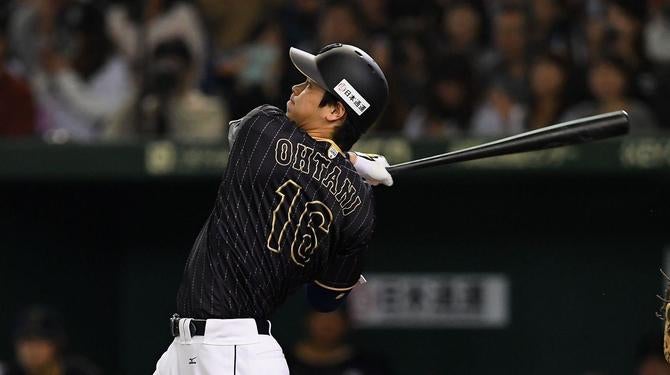
The fever-pitch sweepstakes for Shohei Ohtani's services ended Friday, as the Japanese two-way star signed with the Los Angeles Angels.
Ohtani, 23, will pair with Mike Trout on a roster that has ample big-name star power, but lacks depth on the major league roster, as well as in the high minors.
Ohtani's combination of youth and talent makes him a potential difference maker from day one. According to Dan Szymborski's ZiPS projection system, Ohtani grades out as a pitcher who could deliver ERA numbers about 25 percent better than league average in his age 25-27 seasons. His combination of triple-digit fastball velocity and excellent secondary stuff could deliver an avalanche of strikeouts in particular. ZiPS pegs Ohtani's strikeout upside as close to 11 punchouts per nine innings at his peak.
The truest test of Ohtani's value will likely come in the form of workload. He's only topped 150 innings twice in his professional career. Part of that lighter workload is due to shorter seasons in Nippon Professional Baseball. But Ohtani's health is no guarantee either; he made just five starts last season and had ankle surgery in October.
As a pitcher alone, Ohtani would be a huge get in this year's free-agent market, one that features a decent quantity of useful players, but lacks elite commodities. But Ohtani can also rake. He projects as a good-power, so-so OBP guy, with ZiPS' peak projection placing him at .257/.336/.497 in his age-27 season.
This makes him a far more intriguing player, both in terms of his current value, and historical impact. If the Angels give Ohtani even semi-regular at-bats -- most likely at DH, with maybe a few in one of the corner outfield slots -- he'd become the first major league player since Babe Ruth to hold down that kind of dual role on a regular basis.
On the pitching side, Ohtani's role is obvious. The Angels' most talented pitchers, 20-something arms like Garrett Richards, Tyler Skaggs, and Andrew Heaney, all missed most of the 2017 season with injuries. By Wins Above Replacement, the Halos' most productive starter was J.C. Ramirez, a journeyman right-hander who made 24 starts, posted one of the lowest strikeout rates in the league, and graded out as a 1-win pitcher -- the equivalent of a back-of-the-rotation guy. If Ohtani comes anywhere close to projections and delivers around 150 innings, he'll likely be the team's most valuable starter by a substantial margin.
On the hitting side, Ohtani's role also seems obvious... assuming Angels brass recognizes the meaning of a sunk cost. Albert Pujols has four years left on a 10-year, $240 million deal that's the worst in all of baseball. By Wins Above Replacement, Pujols was by far the worst everyday player in the majors last season, batting a meager .241/.286/.386 while offering no value elsewhere as a DH who's one of the slowest baserunners in the league. The going-forward cost of all that microscopic production? $114 million over the next four years.
If the Angels can bring themselves to bench a massively-paid future Hall of Famer who's been run down by Father Time, Ohtani could easily DH most days when he's not pitching. The Angels could also have him fill that role when he pitches. To do that, though, they'd have to accept losing the DH spot as soon as Ohtani gets pulled off the mound, meaning they'd likely need to carry at least one capable pinch-hitter on the bench, or else risk having a legion of banjo hitters come up in big spots whenever the lineup flips back to Ohtani's place in the lineup.
That's not all. To succeed at high levels in the majors both on the mound and at bat, Ohtani will need to train all of his skills rigorously. The Angels' trainers and strength and conditioning coaches will thus need to figure out the best way to hone Ohtani's skills, without burning him out. If too much batting practice causes Ohtani to start throwing batting practice-quality fastballs in live games, that would defeat the entire purpose of carrying a two-way star on the roster.
Even with Ohtani on board, the Angels still have plenty of work to do. Only three players -- Trout, standout shortstop Andrelton Simmons, and playable outfielder Kole Calhoun -- rated as better-than-average position players on the 2017 team, with only long reliever Yusmeiro Petit reaching that level among pitchers. The Angels are in dire need of help at second base, and would be well served by grabbing one of the many low-priced power bats on the open market this winter as an alternative to C.J. Cron at first base.
Still, Ohtani's arrival strikes a positive chord for a team that has the best player alive on the roster, but not much else, as it hopes to run down the defending champion Astros. The division-rival Mariners and Rangers were two of the most interested other teams that lost out in the Ohtani bidding, so the phenom's arrival in Orange County counts as a double win.
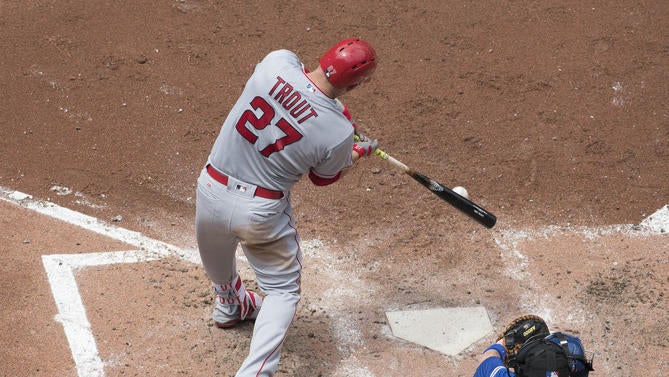
More broadly, Trout has three years left on his own megadeal, and the Angels wasting his stratospheric talent due to a weak supporting cast would be a massive letdown, given Trout's Willie Mays-esque abilities.
The wildly talented free-agent class of Manny Machado, Bryce Harper, Josh Donaldson, and maybe Clayton Kershaw is still a year away from driving the Hot Stove to historical levels of madness. In this year's market, Ohtani was the only player who could remotely be considered anywhere near that class in terms of raw ability. Trout won't be Trout forever, and he might not be an Angel forever. The time to strike was now, and the Angels got it done.