It is time to worry about Paul Goldschmidt and Anthony Rizzo struggling, but are these cold starts or a 'lost' season?
Rizzo and Goldschmidt are in the midst of 'lost' seasons, but there are reasons for hope

By
Matt Snyder
•
5 min read
Heading into the season, perhaps the most loaded position by league -- think about trying to narrow the field for All-Star selections, for example -- was National League first base.
Think about it, last year Eric Thames hit 31 home runs with a .359 on-base percentage and the following first baseman in the NL were much better: Joey Votto, Paul Goldschmidt, Freddie Freeman, Cody Bellinger, Anthony Rizzo and Ryan Zimmerman. Wil Myers also had 30 homers, Matt Carpenter has been a stud in the recent past and Jose Martinez is now. Josh Bell looked like a good breakout candidate. Plus, the Phillies signed Carlos Santana, the Padres signed Eric Hosmer and Brandon Belt is an All-Star. It was just a loaded position.
And yet, in looking at the expected elite-tier guys (Votto, Freeman, Goldschmidt, Rizzo, Bellinger), I can't help but wander over to Mr. Goldschmidt and Mr. Rizzo while thinking a bit about old friends Paul Konerko and Mark Teixeira. Because, heading into Friday ...
Goldschmidt career before 2018: .299/.399/.532; 146 OPS+
Goldschmidt in 2018: .208/.333/.364; 85 OPS+
Rizzo last four years: .282/.387/.522; 143 OPS+
Rizzo in 2018: .195/.301/.358; 77 OPS+
There are five top-five finishes in MVP between the two of them. Rizzo is in his age-28 season while Goldy is in his age-30 season. Sure, 30 isn't young and it's a young man's game, but neither of these guys should be in age-related decline. Rizzo's right in the middle of what should be his prime and Goldschmidt is toward the tail-end of what should be his prime.
Sure, it's still relatively early and it's entirely possible both of these guys gets really hot and end up around where we're used to seeing them, but it's also not an overly small sample. We've banked more than a quarter of the season and they are both far off where they've been in the recent past.
Basically, it feels like we're getting close to "lost season" territory and that's what makes me think about Mr. Konerko.
Heading into 2003, Konerko's previous four seasons yielded just one All-Star appearance, but he slashed .294/.356/.499 (118 OPS+). He was a good to very good hitter. In 2003, nearly inexplicably, Konerko hit .234/.305/.399, good for an 83 OPS+ while leading the majors in grounding into double plays. The next three seasons, he'd post an OPS+ of 132 while making two All-Star Games and finishing sixth in AL MVP voting in 2005, when he was one of the anchors to a World Series champion White Sox team.
The 2003 season was his age-27 season. It simply made zero sense for him to have a lost season smack in the middle of his prime like that, but it happened because being good at baseball is really, really hard.
Konerko isn't a Hall of Famer, but he's a quintessential "Hall of the Very Good" guy, if there were such a thing. He had an amazing career with one odd lost season stuck in the middle.
Is Rizzo at risk?
Perhaps the most concerning thing with Rizzo is his 21 strikeouts compared to 11 walks. Last season, he walked 91 times compared to 90 strikeouts.
The most encouraging? Rizzo's career batting average on balls in play is .283 and this season so far it's .186. He faces shifting, though, so the fact that he's pulling the ball more often (47.6 percent compared to 44.9 percent last year) and hitting it the other way less (16.5 percent compared to 21.8 percent last year) is likely contributing some to that.
In watching him regularly, he does seem to be hitting the ball hard right at defenders a lot. Sure enough, his hard hit percentage (34 percent, compared to 34.4 percent last year) isn't much different than the recent past and his medium hit percentage is up (52.4 percent, compared to 45.9 percent), at the expense of soft hit percentage (13.6 percent, compared to 19.8 percent last year). He is hitting more flies and fewer line drives and that's part of the issue.
In terms of swing data, Rizzo is actually swinging at fewer outside-the-zone pitches than in the recent past.
Basically, in terms of the numbers and watching him, it feels like a matter of time until things start to break for him. Let's also keep in mind he dealt with a back injury earlier in the season and the Cubs played some games in some awful weather. These are all pieces of the puzzle. The only real concern is the increased fly-ball rate and reduced line drive rate, but those aren't drastic enough for panic in my opinion.
Then again, he's a human being and seeing your batting average on the scoreboard with a "1" in front of it come June is a good way to mess with the psyche of a player and head toward the Konerko zone. He starts pressing an all bets are off. This isn't a computer simulation.
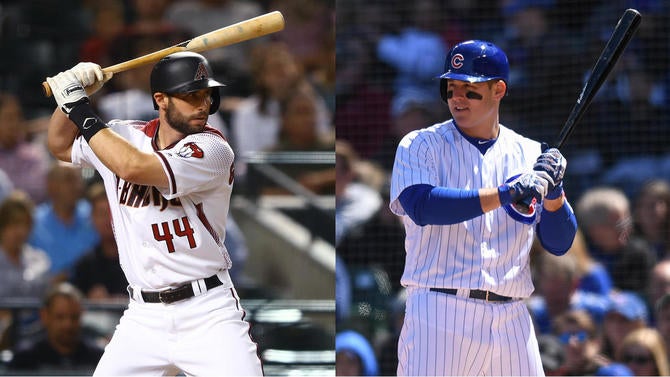
Is Goldschmidt at risk?
That same last paragraph applies to Goldschmidt, too, of course, should he drop below the Mendoza line.
At first glance, Goldy's BABIP doesn't look askew at .295, but his career mark is .352 because he crushes baseballs. Herein lies the issue so far this year.
Unlike Rizzo, Goldschmidt isn't really hitting the ball as hard as he has in the past. It's evident to the eye test and the numbers bear it out. His hard hit percentage is down a tick (41.4 percent compared to 44.3 percent in 2017), but it's the soft hit percentage that is alarming (21.2 percent compared to 11.3 percent last season). Over 1/5 of the balls he touches are hit softly. Oh, and he's striking out a lot more, too, at a 30.1 percent clip compared to a career rate of 22.4 percent. He's on pace for 207 strikeouts and his previous career high is 151.
There are more issues. Last September, Goldschmidt hit .171/.250/.305. Was this the actual start of his decline? We can't be sure just yet, but we do have to wonder about the humidor effect in Chase Field this season. I noted earlier this week that offense was drastically down at the Diamondbacks' home yard and Goldschmidt is hitting just .140/.321/.209 with zero home runs at home. Last year in Chase Field, Goldschmidt hit .321/.443/.639 with 20 homers.
With the increased strikeout rate and the increase in softly struck balls, possibly in large part due to the humidor in Chase Field, there's legitimate reason for concern here -- at least more than there is with Rizzo, especially when we factor in age.
There's always the possibility that Rizzo and/or Goldschmidt avoid the Konerko route and instead go the Teixeira route, too. That's right, I didn't forget about him from the intro. What's the Teixeira route?
Well, Yankees first baseman Mark Teixeira was hitting .191/.328/.418 through May 12 in 2009. He would end up that season .292/.383/.565 with a 141 OPS+. He led the AL with 39 homers and 122 RBI. He also led in total bases, won a Silver Slugger, finished second in AL MVP voting and won a World Series ring.
So that's the goal for Rizzo and Goldschmidt. Don't be the Lost Season Konerko. Be the Cold Start Teixeira.