
Mookie Betts at shortstop: How Dodgers star is upping already-immense value with rare position change
Betts is opening the season as the Dodgers' starting shortstop, a major infield switch

By
Dayn Perry
•
4 min read
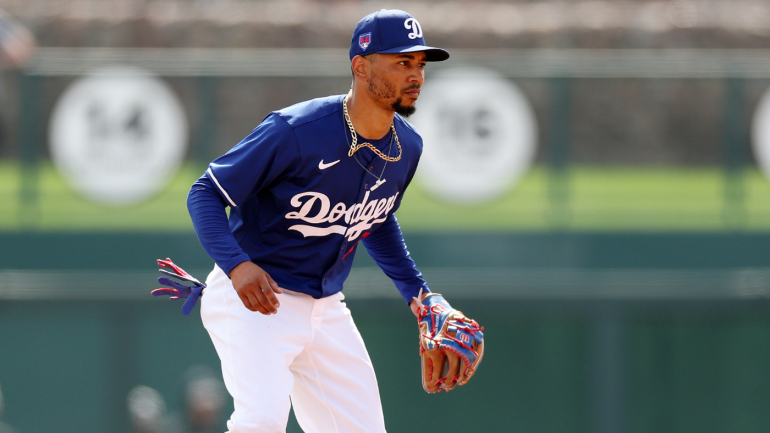
When pondering the 2024 Los Angeles Dodgers, our thoughts understandably turn at first to their historic offseason – one that's seen them commit more than $1 billion in future salary to the likes of Shohei Ohtani and Yoshinobu Yamamoto, among others. Now, though, let's make time for Mookie Betts.
As you're probably aware, Betts is poised to be the Dodgers' starting shortstop in 2024. That wasn't supposed to be the case. Instead, Betts was expected to be the regular at second base – a bold move all its own – with the still-promising Gavin Lux pinning down short. However, Lux this spring has struggled to make throws, which has led the Dodgers to move him to the keystone, where those heaves to first base are much less challenging. That puts Betts at the most critical position on the diamond, and that's already something to behold.
Let's frame this another way: Betts is a 31-year-old, a 10-year MLB veteran, and for his career a primary right fielder, and now he's going to be the starting shortstop for a team that has squarely upon it immense pressure to win the World Series. Suffice it to say, this is a rare set of circumstances:
Mookie Betts moving from RF to SS - since 1900, two players have played 70 games at SS after playing 100+ games in the OF the prior season: Tom Tresh (1968) and Tony Womack (2000). Chris Taylor calls Betts “the best athlete I’ve ever played with.”
— Tim Kurkjian (@Kurkjian_ESPN) March 11, 2024
Know, however, that this isn't an act of desperation by the Dodgers. Miguel Rojas was their primary shortstop in 2023, when they won 100 games, and he remains on the roster. It would've been entirely reasonable to put Rojas back in the role and keep Betts in right field. That, however, likely would've meant part-time duty for James Outman or Jason Heyward, and the Dodgers don't feel that would've been the best use of their lineup resources. So at an age when most players are struggling to retain value in the field at their most familiar position, Betts is raising his degree of difficulty by quite a bit.
Famed analyst Bill James tapped into these common-sense notions back in the 1980s when he developed the "defensive spectrum," which orders positions according to their defensive rigors and value. Going from easiest on the left to hardest on the right, the spectrum goes like this:
DH - 1B - LF - RF - 3B - CF - 2B - SS - C
Betts is jumping four spots to the right on the spectrum. That's a vanishingly rare change in assignment for any player, let alone one in his thirties. Let it be noted that Betts does have experience in the middle infield. He was drafted by the Red Sox as an infielder, and in 2011 and 2012 he spent limited time at short while in the lowest rungs of the system. Soon, though, he was shifted to the outfield because Boston's middle infield was occupied by Dustin Pedroia at second and, by the time Betts arrived, Xander Bogaerts at short. Betts over the years has, as noted, been a predominant right fielder, but he's also seen time in center and has logged more than 700 career defensive innings at second base. Last season, he made 16 appearances at short.
More generally, you should not doubt Betts' ability to achieve anything athletically, no matter how unlikely it seems. Action-sports footage forthcoming:
Yes, he can sell a double move, dunk a basketball at 5-foot-9, and bowl a perfect game. Heck, he also touched the mid-90s on the mound back in high school. So in some ways it's not a surprise that Betts, even with his very limited recent exposure to the shortstop position, has already had his moments:
This isn't to say Betts is going to be a defensive asset at the position. Being such a thing at the position of shortstop is hard enough for those in their prime ages and with a deep level of familiarity with the role. Betts, though, may pass muster, particularly as he gets more and more game-speed reps. And then there's how special his bat will be by shortstop standards.
Betts over the last three seasons has a combined slash line of .281/.373/.536, while the average big-league shortstop over that same span has batted .253/.314/.400. That's a huge margin, and it reflects an outgrowth of the defensive spectrum principle noted above – the more demanding the position, the more difficult it is to find offensive production at it. As well, Betts is coming off a 2023 season in which he put up some of the best plate numbers of his career. In addition to his MVP-caliber top-line results, Betts last year backed it up with the absolute best quality-of-contact indicators of his career. That bodes very well moving forward for the future Hall of Famer.
All of this is why Betts should very much be on your National League MVP shortlist for 2024. He finished second in the balloting last season, and this year he's primed for a vintage Betts season at the dish while also, yes, being a shortstop. That only enhances his already immense value.
In conclusion, let's note a handful of carefully tailored milestones that set the stage for Betts, his unique qualities and skills, and his new position. Consider:
- The record for most home runs in a season by a primary shortstop – i.e., those spending at least 75% of games played at the position – who stands 5-foot-9 or less: Miguel Tejada of the A's with 34 in 2002 and 2004.
- The record for most home runs by a primary shortstop who stands 5-foot-9 or less and is age 30 or older: Tejada of the A's with 34 in 2004.
- The record for most home runs by a Dodgers shortstop: Corey Seager with 26 in 2016.
- The record for most home runs by a Dodgers shortstop age 30 or older: Pee Wee Reese with 16 in 1949.
- The record for most home runs by a Dodgers shortstop who's age 30 or older and stands 5-foot-9 or less: Jimmy Rollins with 13 in 2015.
Don't be surprised if the Dodgers' new shortstop takes down all of these marks during the season to come. It's already a bold season for Betts and the Dodgers, and it figures to be a special one, too.