
Pirates sign Bryan Reynolds to two-year contract, but All-Star should continue to be trade target
Reynolds inked a reported $13.5 million deal with Pittsburgh covering the 2022 and 2023 seasons

By
Mike Axisa
•
5 min read
Last week the Pittsburgh Pirates locked up franchise third baseman Ke'Bryan Hayes to a seven-year, $80 million contract extension. The deal buys out his five remaining years of team control, plus two free agent years. The contract also includes a club option for an eighth year. Hayes is locked in as Pittsburgh's cornerstone. That's exciting. On Thursday, the Pirates locked up another cornerstone player, though not to a long-term extension like Hayes.
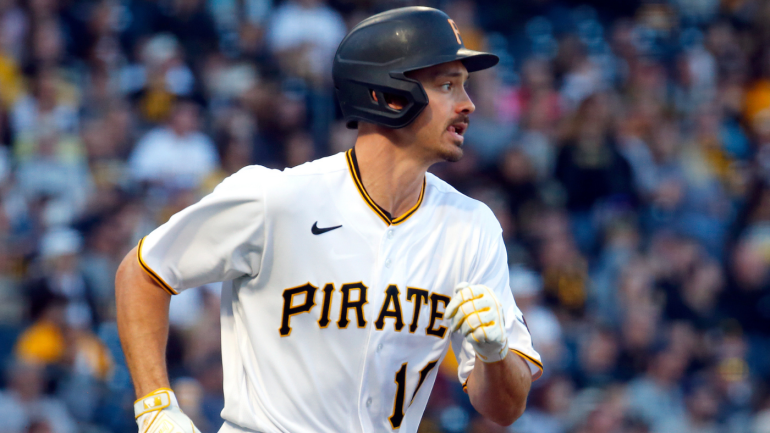
The Pirates inked center fielder Bryan Reynolds to a two-year contract, the team announced. The deal is worth $13.5 million total -- Reynolds will earn $6.75 million this year and next, according to The Athletic.
Reynolds, now 27, joined the Pirates in the Andrew McCutchen trade with the Giants four years ago. He was a Rookie of the Year candidate in 2019 and an All-Star in 2021. Reynolds posted 5.5 FanGraphs WAR last season, tied for ninth in baseball with Brandon Crawford, Aaron Judge, and Starling Marte. He is 5 for 22 (.227) with one homer to begin 2022.
Here are five things you need to know about the Reynolds extension and what it means going forward.
1. Reynolds will not be a free agent in two years
This two-year contract buys out Reynolds' first two years of arbitration-eligibility as a Super Two. Once this deal expires, Reynolds will remain under team control in 2024 and 2025 as an arbitration-eligible player. This contract gives Pittsburgh cost certainty over 2022 and 2023, and it gives Reynolds a nice little guaranteed payday early his career. He remains on track to become a free agent following the 2025 season. That is unchanged.
2. An arbitration hearing is no longer necessary
Last month Reynolds filed for a $4.9 million salary prior to the arbitration salary filing deadline. The team filed $4.25 million. Had the two sides been unable to agree to a contract, they would have gone to an arbitration hearing, and the panel would have picked the salary Reynolds filed or the salary the team filed. Nothing in-between. The extension eliminates the need for a hearing.
"They didn't say anything about an extension, so it wasn't really on our minds," Reynolds told the Associated Press after filing salary figures last month. "I would have obviously liked to reach an agreement so we didn't have to do this now. But, like I said, that's part of the game, too."
3. Reynolds has rejected long-term extensions
The Pirates have tried to lock up Reynolds long-term. He turned down two long-term extension offers prior to last season, according to the Miami Herald's Craig Mish. Furthermore, Reynolds told Jason Mackey of the Pittsburgh Post-Gazette the two sides did not discuss a long-term contract between the end of the 2021 season and the start of the owners' lockout this past winter. That doesn't mean Reynolds is unwilling to sign long-term with Pittsburgh. He just didn't want to do it at the numbers presented.
"It doesn't change anything the way I feel about Pittsburgh or anything like that," Reynolds told the Associated Press last month. "Any of my teammates or the team or anything like that. I understand it's part of the game."
4. Trade chatter is likely to continue
Because this is not a long-term contract, Reynolds is likely to remain a popular trade target. The Mariners, Marlins, Padres, and Yankees have all had interest in Reynolds, according to the New York Post's Jon Heyman. You can expect those teams -- and others -- to continue pursuing Reynolds. He's a good player on a rebuilding team and he is not signed long-term.
Pirates GM Ben Cherington would be doing his job if he didn't listen to offers for Reynolds. He doesn't have to trade him, but he has to listen. Reynolds will play this season at 27 and the Pirates may still be 3-4 years away from contention. They may not get back into the race until Reynolds is over 30 and nearing free agency. His prime could go to waste in Pittsburgh, and his value to the franchise may be greatest as a trade chip than as a player on the field. So, listen to offers. You never when a team will blow you away.
5. The structure is a bit unusual
Generally speaking, salaries escalate during a multi-year contract, particularly when the player is early in his career. Last spring Walker Buehler signed a two-year contract that bought out two arbitration years (but zero free agent years) like Reynolds. It paid him $2.75 million in Year 1 and $3.25 million in Year 2. That's a common structure. The Year 2 salary is higher than Year 1.
With Reynolds, his two-year contract calls for a flat $6.75 million salary each year. There are three possible reasons to structure the contract this way. One, Reynolds would not do it any other way. It was either this or go to an arbitration hearing. That's always possible. I do not think that's likely in this case, but it is possible. Sure.
Two, it frees up the Pirates to spend more next year. Instead of, say, a $5 million salary this year and an $8.5M salary next year (i.e. the same $13.5 million guaranteed), this structure leaves spending room in 2023. No, the Pirates probably won't contend in 2023, but maybe this allows them to sign an additional free agent who they can flip for prospects later.
And three, it pumps up the team's 2022 payroll. The new collective bargaining agreement includes a provision raising the threshold at which teams must prove how they used revenue-sharing dollars when challenged during a grievance. From The Athletic's Evan Drellich:
Per the union memo, sustained profitability for clubs remains admissible in any grievance challenging revenue-sharing usage. In the past, a team with a payroll up to or less than 125 percent of the amount it receives in revenue sharing had the burden of proving during the grievance process that it was using the revenue-sharing dollars appropriately, as described in the CBA. That figure is now 150 percent.
The MLBPA already has a grievance pending against the Pirates (and Athletics, Marlins, and Rays) alleging they improperly used revenue sharing funds. MLB reportedly tried to get the union to drop that grievance as part of the collective bargaining agreement talks, but they wouldn't budge. That grievance is still pending, and the Pirates don't want another filed.
Consider the structure of the Hayes extension. Prior to the extension, Hayes was due to make something close to the $700,000 league minimum as a pre-arbitration-eligible player. His salary jumped to $10 million:
- 2022-23: $10 million per season
- 2024-27: $7 million per season
- 2028-29: $8 million per season
- 2030: $12 million club option ($6 million buyout)
The extension increased Hayes' salary significantly, and also increased Pittsburgh's payroll, which currently sits at $56.925 million, per FanGraphs. That's still one of the lowest payrolls in baseball, though it was significantly lower before the Hayes extension. It will help keep the MLBPA at bay. The Reynolds extension accomplishes that as well, though to a smaller degree.