
Three reasons Joe Musgrove could become the next Pirates ace or their next big trade chip
Musgrove is poised to break out whenever baseball returns

By
Mike Axisa
•
9 min read
A new era of Pittsburgh Pirates baseball has arrived. Following a disappointing 2019 season that saw the club go 69-93 and lose 48 of their final 73 games, the Pirates cleaned house. They have a new team president (Travis Williams), a new general manager (Ben Cherington), and a new manager (Derek Shelton). Four straight postseason-less seasons meant it was time for a change.
The turnaround is unlikely to be quick, of course. SportsLine projected the Pirates as a 67-win team this year prior to the shutdown, and the big-league roster is short on long-term building blocks. There's Josh Bell, Bryan Reynolds, probably Mitch Keller and Kevin Newman, and that's about it. Top prospects Ke'Bryan Hayes and Oneil Cruz aren't too far away, so that's something.
Right-hander Joe Musgrove, who was part of the incredibly one-sided Gerrit Cole trade, could be a long-term building block as well. He has been a solid innings guy the last two years, and at age 27 and with two years of control remaining as an arbitration-eligible player beyond 2020, you can see Musgrove as part of the next contending Pirates team. Just squint your eyes a bit.


Musgrove has a 4.28 ERA in two years with the Pirates, which is essentially league average once you adjust for ballpark, and hey, there's value in being league average. He's also shown flashes of being much, much better that. Not counting a start in which was ejected after two outs, Musgrove had seven starts with zero earned runs last year. Only 10 pitchers had more.
For the Pirates, the key is helping Musgrove break out and take his game to the next level. Right now other clubs view him as a buy low opportunity. Get him for pennies on the dollar, make some tweaks, then reap the rewards. That's exactly what the Astros did with Cole. Fortunately for Pittsburgh, there are reasons to believe Musgrove's breakout is imminent. Here are three.
1. He's adding velocity
More accurately, he's getting velocity back. Musgrove's velocity was down noticeably early last season, dipping from 94 mph on average in 2018 to 91-92 mph in the early months of 2019. By the end of the season, he was not only back up to 94 mph, he was sitting 95 mph on the regular.
Not surprisingly, Musgrove's strikeout rate climbed as his velocity returned:
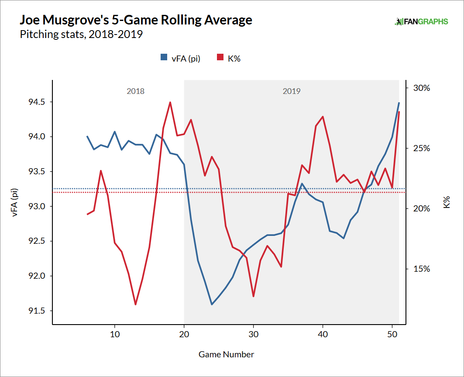
There's a strong league-wide correlation between strikeout rate and velocity rate, which makes sense, intuitively. The harder you throw, the less time the hitter has to react. Velocity helps everything play up, fastballs and secondary pitches. Musgrove threw harder and had better results late last year. Not much of a mystery here.
The velocity returned after Musgrove made a slight change to his mechanics. Specifically, he shortened his arm action. On the left is Musgrove in July. He breaks his hands, brings his arm all the way down, then goes forward with his delivery. On the right is Musgrove in September. He keeps his arm bent after breaking his hands rather than bring it all the way down.
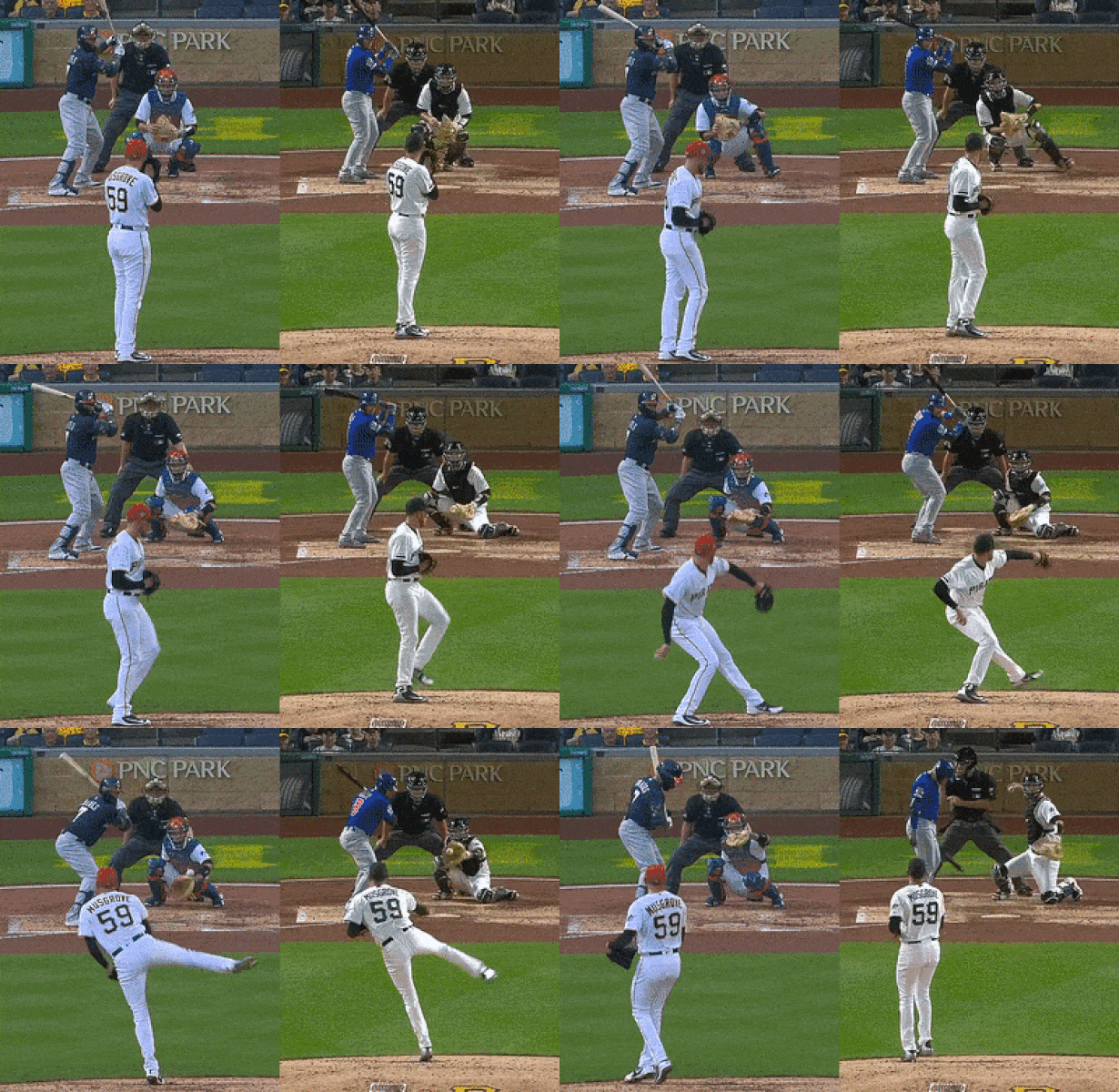
The short arm action is a relatively new trend sweeping across baseball. Lucas Giolito adopted it last season and had a breakout year. Joe Kelly and Joe Ross have adopted it as well, ditto Taijuan Walker when he returned from Tommy John surgery last year. Musgrove is the latest pitcher to go with the shorter arm action and see his velocity spike.
"I think I was able to tap into a little bit more power that I have with the shorter arm action, just staying more connected, but the biggest change was getting my lower half to start to move normal again," Musgrove told MLB.com's Adam Berry in February. "Stride length increased a little bit, getting better extension. I think the short arm action was a contributing factor, but I would say mostly it was the legs getting back under me."
Musgrove at 94-95 mph is a different animal than Musgrove at 91-92 mph. At the lower end velocity, he's an average-ish starter who is steady more than spectacular. At the higher end, Musgrove has a chance to dominate. Velocity is not everything, we know that, but it's not nothing either, and the arm action gives us a tangible reason to believe Musgrove's velocity spike is here to stay.
2. He has three swing and miss secondary pitches
Moreso than the velocity, Musgrove's secondary pitches give him a chance to be one of the league's better starters, I think. His curveball is a hammer. It's a low-80s pitch he can throw for a strike or bury in the dirt. His slider is a mid-80s offering that snaps down and away from righties. The changeup sits mid-80s and tumbles down and away from lefties.
The characteristics of each secondary pitch suggest Musgrove has three put-away secondary pitches. The curveball and slider are high spin pitches that miss bats while the changeup fades down to get whiffs.
| Musgrove | MLB average | |
|---|---|---|
| Changeup swing-and-miss rate | 32.3 percent | 30.7 percent |
| Curveball swing-and-miss rate | 39.6 percent | 31.6 percent |
| Slider swing-and-miss rate | 39.3 percent | 35.8 percent |
As noted by Pitcher List's Michael Ajeto, only four other pitchers had three better than average swing-and-miss pitches last season: Tyler Beede (changeup, curveball, slider), Gerrit Cole (fastball, slider, changeup), Zac Gallen (cutter, curveball, changeup), and Noah Syndergaard (changeup, curveball, slider). Musgrove's in good company.
Not only does Musgrove have an improved fastball and good secondary pitches, he also fills up the strike zone. He walked only 5.2 percent of batters faced the last two years, 11th lowest among the 128 pitches to throw at least 200 innings from 2018-19. That's on par with control artists like Kyle Hendricks (4.9 percent) and Masahiro Tanaka (5.4 percent). All the tools are there for success.
3. He has a new pitching coach
As part of their offseason overhaul the Pirates dismissed longtime pitching coach Ray Searage and replaced him with the more analytically inclined Oscar Marin. Searage helped the Pirates get to the postseason three straight years from 2013-15 by getting the best out of veteran hurlers like A.J. Burnett, J.A. Happ, Francisco Liriano, and Edinson Volquez. He was a career-saver.
The more recent results have not been favorable, however. Cole left Pittsburgh and became an instant ace. Charlie Morton broke out once he left the Pirates. Tyler Glasnow went to the Rays and immediately started living up to his potential. Even Jordan Lyles turned things around after being traded away last year. Fair or not, that all reflects poorly on Searage, and a change was made.
At risk of oversimplifying it, Searage preached pounding the fastball down and getting quick outs via ground balls. It worked great from 2013-15. As the game shifted toward launch angle though, the high fastball and high spin breaking balls became the weapons of choice, and the Pirates never really adjusted. At least not in a way that had a meaningful impact on the field.
The Pirates began incorporating more technology last season, but having the technology and knowing how to interpret and use the data are two very different things. The club hopes Marin, who had been with the Rangers as their bullpen coach, will help make their pitching operation more state of the art than it was under Searage.
"Last year, it seemed like we were trying to go in an analytical route with the Rapsodo and the numbers and the information that was made available to us, but some of it was getting lost in translation from the analytical guys to the players," Musgrove told Jason Mackey of the Pittsburgh Post-Gazette in February. "Having a pitching coach that we spend every day with and we talk with and see and communicate with regularly, him being educated in that department is huge for us. Now we have multiple lines of communication, and we have constant feedback."
Even with velocity at an all-time high, pitchers around the league are throwing fewer fastballs these days. Offspeed pitchers and breaking balls that move are harder to hit than relatively straight fastballs, so teams are throwing more non-fastballs than ever. Makes perfect sense. It's a bit surprising it took so long to catch on, but it did.
Musgrove threw 57.8 percent fastballs last year, which is more or less league average. Given the quality of his secondary pitches, I think he's a great candidate to cut back to 50 percent fastballs, or maybe even 45 percent fastballs, and bury hitters with his array of secondary pitches. Here are the pitchers who threw the fewest fastballs in 2019:
- Aaron Nola: 46.2 percent
- Justin Verlander: 46.9 percent
- Jacob deGrom: 47.6 percent
- Stephen Strasburg: 48.3 percent
- Luis Castillo: 49.1 percent
The two Cy Young winners, the World Series MVP, and two of the better young pitchers in the game. Not a bad group to emulate, I say. Not everyone can get away with throwing that few fastballs, you need quality secondary pitches to make it work, and Musgrove has them. Going forward, I reckon we'll see Musgrove threw fewer fastballs under Marin than he did under Searage.
So what happens next?
Realistically, the Pirates have two options with Musgrove: sign him to a long-term extension or trade him. They don't have to make a decision now but the decision will have to be made eventually. Keeping Musgrove through his arbitration years and letting him walk as a free agent after the 2022 season seems unwise. Either sign him or trade him. Get long-term value one way or the other.
Musgrove signed a one-year deal worth $2.8 million for 2020. That sets him up to make about $6 million in 2021 and $10 million in 2022. The going rate for a league average-ish starter in free agency is $12 million or so per year, so figure a four-year extension covering 2021-24 will run the Pirates about $40 million. Maybe a little less since extensions typically come with a discount.
The elephant in the room is the shutdown, which will hurt all 30 teams financially, and especially small market teams like Pittsburgh. They rely more on ticket sales and gate revenue than their larger market brethren, and fans probably won't be allowed into the stadium this year. Any financial losses will trickle down to the players via free agency and arbitration, Musgrove included.
Waiting is the best move for all involved. Musgrove can see whether his newfound velocity and the new pitching coach help take his game to the next level, putting him in position to cash in big. The Pirates, meanwhile, will be able to evaluate the financial impact of the shutdown, and see whether Musgrove really does take his game to the next level. If his does, his trade value skyrockets.
The Pirates have had rotten luck trading away pitchers the last few years. Cole, Glasnow, Lyles, and Morton left and improved with their new teams. They don't want that to happen with Musgrove. They have new leadership in place and he has the tools that suggest he can become a high caliber starter. The Pirates want to be the team to unlock his potential, then either keep him long-term or trade him in a deal that doesn't immediately look so one-sided against them.