Pushing ethics aside, UFC secured the Conor McGregor showcase fight it desperately needed
At the end of the day, the UFC needs 'Notorious' at the forefront

•
5 min read
The king is back, the king is back. Long live the UFC's pay-per-view king.
Did you hear the explosion that erupted on social media on Friday afternoon when UFC president Dana White closed the promotion's 25th anniversary fall news conference in Los Angeles by throwing to a video promo on the big screen behind him? It was the sound of hope being sprung, money being printed and the temporary health of a sport being diagnosed a clean bill.
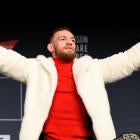
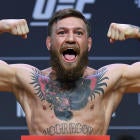
Former two-division champion Conor McGregor will return from a nearly two-year layoff to challenge newly-heated rival Khabib Nurmagomedov for the lightweight championship at UFC 229 in Las Vegas on Oct. 6.
Just how valuable is the brash Irish star's return after a 21-month sabbatical from the Octagon to his employers? Consider the fact that McGregor's absence, which began following a historical knockout of Eddie Alvarez at UFC 205 in 2016, sparked a period of sagging PPV numbers, declining television ratings and an empty cupboard of crossover stars.
Can't get enough UFC? Subscribe to my podcast In This Corner with Brian Campbell where I break down everything you need to know in the Octagon.
When McGregor walked away from UFC at the peak of his record PPV-drawing prime, his subsequent turn to pro boxing -- and the reported $100 million windfall he earned from losing to Floyd Mayweather -- provided him the most leverage any fighter in promotional history had ever known. And while his return stands to raise the profile and financial health of the UFC in the same "rising tides lifts all boats" effect that Tiger Woods has on the sport of golf, it revealed one darker truth.
While terms such as ethics and morality have never been closely linked with the promotion of combat sports, McGregor's ability to draw attention for a sport badly lusting for it on the mainstream level proved an easy cover for the one major sin that threatened to derail his comeback. Just months after McGregor's maniacal attack against Nurmagomedov ahead of UFC 223 at the Barclays Center in Brooklyn, New York, when he threw a dolly through a bus window, causing injuries to other fighters and four fights to be changed last minute, UFC decided against punishing "The Notorious" in any form. He later agreed to a plea bargain in court, and will serve community service as well as pay a fine.
The UFC's decision did just as much to showcase McGregor's true worth to the company as it did add just another questionable promotional move to the recent wrap sheet of Brock Lesnar getting a title shot following a failed drug test, Darren Till getting the same despite missing weight by four pounds and the constant roulette wheel of interim titles that has made a mockery of UFC's credibility.
But deciding against disciplining McGregor -- and in essence rewarding him for his felony actions -- sets a dangerous precedent that's hard to simply gloss over. In one sense, money wins again; no surprise. The problem is that this one feels even dirtier than normal, especially considering Friday's video presentation which dramatically announced the fight largely using footage of McGregor's attack as a means to sell it.
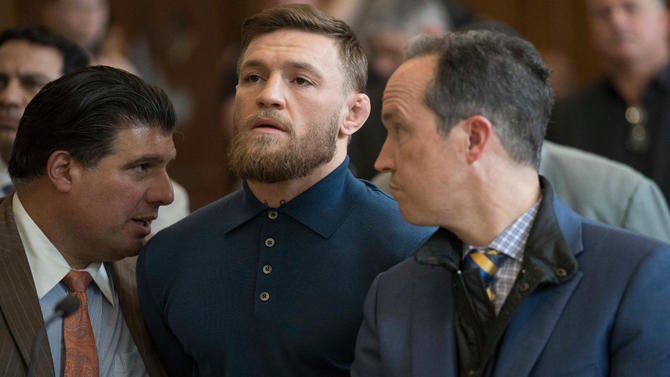
Even worse, White's 180 in the days after McGregor's incident seemed completely transparent once UFC realized the marketing potential of an immediate fight. White went from chastising the "disgusting" McGregor for creating "the worst moment in UFC history" to openly softening his tone.
"People say to me, 'Oh, this looks so bad for the sport,' and everything else," White said following UFC 223. "I agree, it doesn't look good. But at the end of the day, there's a lot worse that goes on in all the other sports. So I'll take a dolly through a window any day."
White's stance is indefensible, especially considering Paul Daley was banned for life from the UFC following a sucker punch of Josh Koscheck after a fight in 2010. Daley also wasn't the biggest star in the sport, which plays a big part in why McGregor's return was so widely celebrated following Friday's surprise announcement.
The part that makes this so hard, even aside from justifying this as merely a smart financial decision, is that McGregor simply makes the sport much more fun to watch and cover. And a bout against Nurmagomedov for the championship McGregor never lost is not only the best fight that can be made in the sport stylistically and the one with the juiciest real-life pro wrestling angle attached to it, there's also the fact that it has potential to be the biggest in MMA history.
Would waiting six more months for McGregor to finish out some sort of mandated UFC suspension make much of a difference in this case? How about having White simply come out and admit that this is all about money and McGregor is above the law because he brings in the most?
Nope, not really.
The truth is that it would be hard to find any promoter in combat sports who wouldn't have made the exact same decision as White for a fight this ripe and lucrative. How can something so wrong feel so right?
While providing impunity for McGregor represented a new low for the promotion, his return represents the biggest solution for the majority of UFC's biggest problems -- up to and including the need for closure atop its lightweight division.
For a sport already soaked in the moral dilemma that comes with cheering one man to concuss the brain of another for a lucrative purse, a question such as this surrounding McGregor whether something in the fight game can be both morally and the smartest decision UFC could make at the same time is an easy call.
The answer is yes.
Money wins out again, and both the sport and its fans will be better for it in the long run. The UFC has made its bed, and come Oct. 6, there will be many happy customers willing to sleep in it.
Don't let the bed bugs bite.