2020 NFL Draft: Focus on finding top receiving trios not a surprise as league tries to catch up with Chiefs
We are moving to a league in which an increasing number of teams will have three star receivers

•
5 min read
We'll look back on the 2020 NFL Draft class of wide receivers as a key component of a seismic offensive shift in the NFL. The days of teams being content with two quality receivers are going by the wayside. Quickly. There were a whopping 37 receivers selected in the 2020 draft, tied for the most in one class since the league reduced draft rounds to seven in 1993. Altogether, 11 teams (at least) doubled up on receiver in 2020, and three teams tripled up -- Eagles, Broncos, and Raiders (I'm counting Lynn Bowden as a receiver).
Of the 11 clubs that at least doubled up at receiver in the draft:
- Five used a first-round pick in 2020 on one of the receivers (49ers, Eagles, Broncos, Raiders, Vikings)
- The Bills have a returning 1,000-yard receiver (John Brown), a returning 750-plus yard receiver (Cole Beasley) and acquired a 1,000-yard receiver (Stefon Diggs).
- The Chargers have two returning 1,000-yard receivers (Keenan Allen, Mike Williams).
- The Jaguars have a returning 1,000-yard receiver (D.J. Chark), and a returning 750-plus yard receiver (Chris Conley).
- The Broncos have a returning 1,000-yard receiver (Courtland Sutton).
- The Ravens spent a first-round pick on a receiver in 2019 (Marquise Brown).
The Cowboys weren't one of the nine teams to double up at receiver but have a pair of returning 1,000-yard receivers (Amari Cooper, Michael Gallup) and spent a first-round pick on wide receiver (CeeDee Lamb). If we count the last time we saw A.J. Green on the football field (2018), the Bengals return a pair of 1,000-yard receivers (Green, Tyler Boyd) and picked Tee Higgins with the first selection in Round 2.
More than one-third of the league invested heavily at the receiver spot in this draft -- doubling up -- and it's sensible because of how frequently the league utilizes three-plus receiver sets. Over the past four years, NFL teams on average have passed out of a three-plus receiver set of some kind just under 70% of the time per Sharp Football Stats. As teams have shifted their strategy on the field -- using three wide receivers at the same time rather than two -- they have also shifted their strategy off the field when it comes to roster building.
The league has gone bananas at wide receiver. Which is awesome. But how did this all start? Let's dive into it.
History of loading up on weapons
With the focus on three receivers in the modern NFL, it wouldn't be a surprise if one team was able to break through with three 1,000-yard receivers, a feat that's only been accomplished five times. The 1980 San Diego Chargers became the first team to pull it off with their trio of John Jefferson, Kellen Winslow and Charlie Joiner, followed by the '89 Redskins, the '95 Falcons, the 2004 Colts and most recently, the 2008 Arizona Cardinals with Larry Fitzgerald, Anquan Boldin and Steve Breaston.
Six teams have gotten relatively close in the last dozen years, with the Chargers nearly posting a 1,000-yard trio last season but for Austin Ekeler falling seven yards shy of the mark. It wouldn't shock anyone if a team like the Cowboys with their three star receivers, or the Chiefs with their top-tier depth, was able to join the club in 2020.
Chiefs as catalysts for going deep at receiver
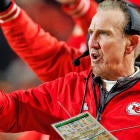
Forever a copycat league, my assertion is the Chiefs set this stud receiver abundance into motion for this current era of the NFL. And it started right before the Patrick Mahomes eruption.
In 2017, with Alex Smith as Andy Reid's starter, the Chiefs had a 1,000-yard receiver in then 23-year-old Tyreek Hill and 1,000-yard tight end in Travis Kelce. It was the first 4,000-yard passing season of Smith's long career. Kansas City went 10-6, won the AFC West, yet blew a 21-3 halftime lead to the Tennessee Titans in the divisional round of the playoffs. In the third and fourth quarters of that game, Smith went 5 of 10 for 35 yards as the lead crumbled and was never regained. Kansas City lost 22-21.
That offseason, GM Brett Veach traded Smith to the Washington Redskins for cornerback Kendall Fuller and 2018 third-round pick. Despite the presence of Hill and Kelce, the Chiefs signed Sammy Watkins to a very lucrative, three-year, $48 million contract in free agency, a deal that included a whopping $30M fully guaranteed at signing (that would still rank eighth among all receivers).
Mahomes took over, threw 50 touchdowns and won MVP, and the Chiefs were an overtime away from advancing to the Super Bowl. Given Hill's off-field issues that offseason, Kansas City picked burner receiver Mecole Hardman in the second round of the 2019 draft. When Hill skirted punishment from the league, suddenly Kansas City's receiver group featured Hill, Watkins and Hardman along with Kelce at tight end.
And last year, Kansas City still finished second in Football Outsiders' pass offensive DVOA despite Mahomes missing two games due to injury. The backup who filled in, Matt Moore, at 35 years old after spending 2018 out of football, completed 65.5% of his throws at a solid 7.32 yards per attempt with four touchdowns and no interceptions in two and a half outings. Everything he did as a passer equated to a 102 quarterback rating.
The future
We've long realized the slot cornerback is a starting position, with 70-75% of defensive snaps coming in some type personnel grouping that features two or fewer linebackers (and thereby more defensive backs) in the NFL.
And that's been due to the proliferation of more receiving options on the field, of course. The receiver saturation is here. In 2019, there were 25 receivers who eclipsed the 1,000-yard mark. In 2018 there were 18. In 2017, 13 receivers achieved the feat. In 2016 and 2015, 23 and 20 receivers went over 1,000 yards, respectively. Even in 2014, when a similarly talented draft class of receivers surged into the league, 22 receivers ultimately passed 1,000 yards receiving (two were rookies).
In 2019, there was more widespread receiver production than any season since 2001 and we had the most receivers picked in the draft in over 25 years.
The slot receiver has been a starter for many seasons in the NFL, and the 2020 campaign is primed to begin an era when clubs can seriously threaten with three star-caliber receivers.