2021 NFL Draft: Biggest weaknesses for Trevor Lawrence, Zach Wilson and the consensus top 10 prospects
These prospects are the best of the best, but they don't come without weaknesses

•
7 min read
No one should be faulted for believing top NFL draft prospects are essentially flawless on the field. With the most marquee talents in every draft, 90% of analysis is (rightfully) centered around how and why they are the most sought after collegiate players entering the NFL.
But they're not all perfect. And during the evaluation process, of course it's vital to pinpoint weaknesses in every single prospect, regardless of their reputation. It's vital to know these flaws. Why? Because they're the aspects prospects need to improve (or hide) once they're pros.
Below are the top 10 most highly regarded prospects in the 2021 class and their most glaring weakness. No sugarcoating.
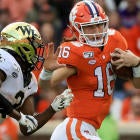
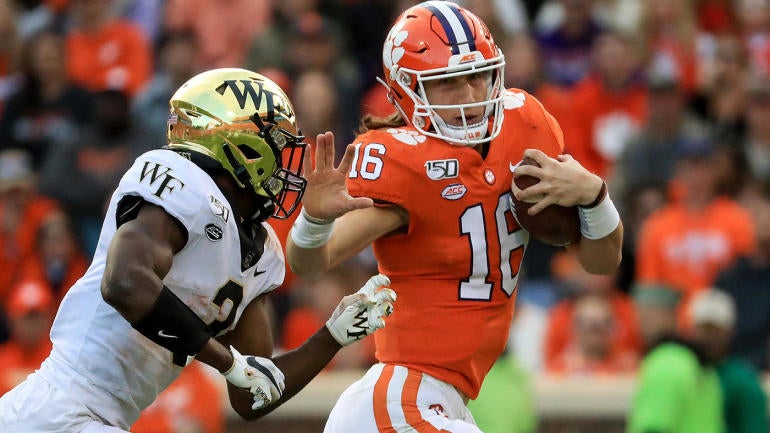
Clemson QB Trevor Lawrence
Biggest weakness: Pocket management
Lawrence is inconsistent inside the pocket. And, sure, every quarterback behaves differently when kept clean as opposed to when pressure is mounting, but that's not what I mean with Lawrence.
Sometimes, he'll effortlessly drift away from chaos, then rip a frozen rope to his second read through a closing window. In other instances, he'll hang onto the ball for far too long, then absorb an essentially unnecessary gigantic hit. On the next series, he'll stoically scan the field from an exquisitely constructed pocket, then on the next play see ghosts and leave way too early and run into pressure on the edges.
Most quarterbacks operate the same way in each situation presented to them on the field. With Lawrence, sometimes it's impossible to predict what type of pocket management he's going to have in a game or on a given possession.
BYU QB Zach Wilson
Biggest weakness: Over-extension of plays
Wilson can do what I call "overextend" plays, which is precisely what it sounds like. He'll run out of the pocket, spin away from pressure, run to the other side of the field before uncorking a pass down the sideline.
And while that is as trendy in the NFL as NFTs are in the cryptocurrency space, there are times when it's simply the better decision to just throw the football out of bounds to live to see another play. At BYU, Wilson got away with many overextensions. It's part of why he's such a blast to watch and likely to be the No. 2 overall pick in the class. In the NFL, overextensions aren't as much of a cinch to execute, even for the high-level athletes with freaky arm talent.
And Wilson is right on the cusp of being a high-level athlete with freaky arm talent. He's not quite the physical specimen to routinely pull off the magnificent improvisational magic of Patrick Mahomes, Josh Allen, Russell Wilson, or Deshaun Watson.
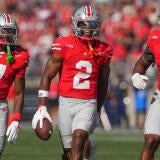
Ohio State QB Justin Fields
Biggest weakness: Reaction time
In one specific way, Ohio State did Fields a disservice. The team was too darn talented. And while it helped Fields win the vast majority of his games and appear in the College Football Playoff twice, it didn't necessarily boost his NFL readiness.
Receivers were open frequently, and, in most of his games, he played from a squeaky-clean pocket. Sure, tight-window darts are littered all over Fields' film, but in the Northwestern and Indiana games from 2020, two contests in which Ohio State's offensive line and offensive coordinator were legitimately challenged, we saw Fields' weakness quite clearly.
At times, he takes an extra split second moving from read No. 1 to read No. 2 or simply just pulling the trigger. Because the Buckeyes' scheme was so good, and he was so brilliant operating it, Fields didn't get loads of experience processing rapidly inside the pocket as a passer.
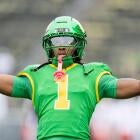
Oregon OT Penei Sewell
Biggest weakness: Overaggressive tendency
As a 19-year-old sophomore in 2019, Sewell was demolishing upperclassmen on the edge like he was an NFL veteran. But -- though there aren't many occasions when this occurs -- the Oregon phenom can rely a little too much on his athletic gifts and wrecking ball type power. He can get out over his feet, which throws off any blocker's balance.
And it doesn't matter if it's when he's looking for a linebacker at the second level on a run play or dealing with a patient but speedy edge rusher. Sewell can typically recover in those situations, because he's an otherworldly athlete and is built like a stocky guard with long arms, but the overaggressive nature needs to be curtailed once he's in the NFL.
LSU WR Ja'Marr Chase
Biggest weakness: Releases against press coverage
On Chase's film, his unique style against press coverage is immediately apparent. Instead of winning with lightning quick feet and karate-esque hand work, Chase leaned on his overt physical nature to legitimately power through press. I've never scouted a receiver who even tried this method, let alone one who was naturally strong enough to continue with a relatively good amount of speed while basically grappling with a cornerback five yards down the field.
In the NFL, that's not going to fly on a weekly basis. I do think Chase is an overwhelming power player who'll be able to get the best of some veteran NFL cornerbacks who try to press him. But there will be many who invite that attacking nature and disrupt the timing of Chase's route enough that he and his quarterback won't be on the exact same page.
Alabama WR Devonta Smith
Biggest weakness: Frame
Smith is pretty darn quick at the line and knows how to use his hands to swat away press attempts. But physical corners with high-level feet are going to attempt to shut down his releases off the line because of his light frame (6-1, 174 pounds) and minimal power in his upper half.
Beating press is typically challenge No. 1 for all rookie receivers once they get into the pros because they see that type of man coverage much more frequently in the NFL than they did in college. Also, NFL corners are significantly more proficient in deploying it and are much stronger.
Alabama WR Jaylen Waddle
Biggest weakness: Limited production, experience, positional versatility
Waddle was never "the guy" at Alabama, which might be the biggest nitpick in NFL draft scouting history because he found himself in the same receiver room as three other first-round picks.
But I know it's a gripe for some when it comes to other prospects at the receiver spot. Also, Waddle predominantly ran his routes from the slot in college. While the slot receiver spot is absolutely a starting role in today's NFL, there's some thought that the lack of experience outside -- where there's less room to operate and a second "defender" covering you every play (the sideline) -- makes "slot-only" wide receiver prospects a tick less valuable than a contemporary with more positional diversity on his draft resume.
Alabama CB Patrick Surtain II
Biggest weakness: Limited athleticism
Surtain might be the most calm, cool, and collected cornerback I've ever scouted. And I like that. Sometimes. Other times, I wish he was more of an in-your-face cornerback. Beyond that though, there are clear athletic limitations in his game. At his towering size (6-2, 203 pounds), he's not a twitched-up rocket to the football and doesn't appear to have blazing speed.
A decade ago, he would have been a top 3 overall pick and would be an instant superstar. I really believe that. Today's NFL is about hyper-dynamic separators and yards after the catch. Surtain doesn't match up well with those types, and he's not a punisher at the line of scrimmage.
Penn State LB Micah Parsons
Biggest weakness: Lack of coverage production
At linebacker today, you have to be a stud in coverage to thrive. Period. Parsons might be best suited to play a hybrid off-ball linebacker/edge rusher role because he's big, flexible, strong, and has pass-rushing moves around the corner.
Doing that would keep him out of coverage, which, at this point, wouldn't be the worst idea. His coverage ability should be considered "incomplete." He simply didn't sink in zone coverage or run with tight ends down the seam often. And when he did either of those two things -- minimal ball production.
Florida TE Kyle Pitts
Biggest weakness: Frame
Pitts is listed at 6-foot-6 and 240 pounds which, based on the height, means he's on the slender side of what his frame could carry. No, there aren't many 240-pound defenders who'll be able to run with him down the field and elevate as high as him even if they do cover him well, but the lighter weight could lead to more losses at the line of scrimmage.
Teams will try to be ultra-physical with him at the outset of his NFL career -- chipping him off the line will be somewhat common. More weight on his frame would allow him to absorb that type of early contact and continue his route without much impediment.