2021 NFL Draft: Justin Jefferson and the impact of bias, plus other lessons from scouting hits and misses
Here's what have some of my hits and misses taught me about evaluating NFL Draft prospects

•
8 min read
Evaluating the NFL Draft can be humbling. It's easy to pour over hours of a prospect's film and consider every available analytic, and, in a few years, your pre-draft evaluation proves to have been way off. But it's not all bad. Hits happen a fair amount of the time too. And you can learn a lot from both outcomes.
I started this series during the 2020 pre-draft process. And last year, the lessons I outlined were:
- Don't underestimate arm strength and mobility for QBs
- Trust the combo of major production *and* an awesome combine
- Keep evolving with the league
They all -- particularly the last one, which is general -- still apply.
It's crucial to acknowledge the lessons the NFL's yearly educated crapshoot session provides. These are the lessons I've learned in my comprehensive evaluation of the past seven draft classes, (the three most recent here at CBS Sports).
Lesson 1: Don't automatically assume college position = only NFL position
Most of the time, watching a college prospect comes with the assumption the evaluation is based on him playing that position in the NFL. And with receivers, pre-snap alignment matters. In college, the vast majority of slot wideouts are smaller, hyper-quick weapons. Some teams uses their tall wideouts as a "big slot" to get an advantage against shorter nickel corners. And with the latter type comes another assumption -- that a prospect's coaches place the taller wideout into the slot because they have trouble beating press coverage and need more space to efficiently operate.
And that assumption thereby limits said wideout's value in the NFL. They can only play one position because that's all they played in college, and they were given the slot "boost" by their coaches. Or so it's easy to think all those things.
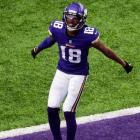
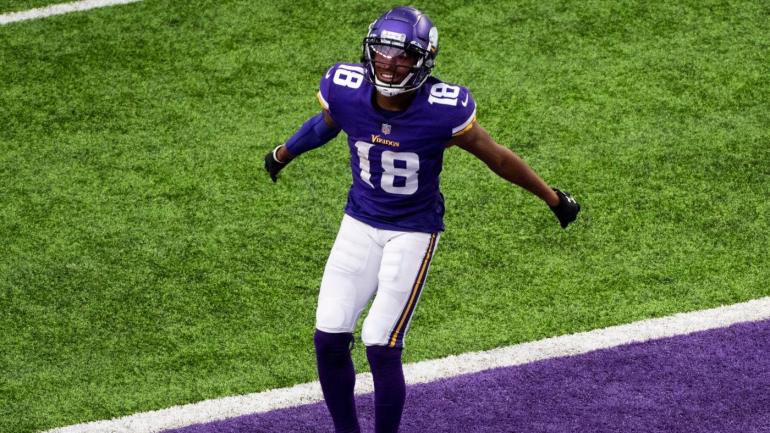
I flat-out whiffed on former LSU star and current Vikings star Justin Jefferson -- my No. 64 overall prospect last year -- for a few reasons. His time spent predominantly in the slot as a lanky, 6-foot-1, 202-pounder created the illusion in my head that he simply had to run routes out of the slot to get open.
[Dwight Schrute voice] FALSE.
Jefferson played in the slot on 92.3% of his snaps in 2019 during LSU's legendary national title season. As a rookie in Minnesota? Just 30.6%. And, of course, he rocked in every way imaginable for the Vikings as a rookie.
Without direct access to coaches, we can't treat pre-snap alignment or specific position as the be all, end all of where that prospect can play in the NFL. Jefferson's situation at LSU, with Ja'Marr Chase and potential first-round pick Terrace Marshall in the same receiver contingent made him a unique case, and heck, maybe Ed Orgeron and Joe Brady knew how dynamic of a route runner and how crafty Jefferson was beating press at the line and realized putting him in the slot would lead to even more production. And, really, they were right.
It didn't have anything to do with an inability to generate space on his own which necessitated the slot-only designation.
And this concept is true with all positions. An edge-rusher who never dropped into coverage might be able to in the NFL. A slot corner could play on the outside. A shorter, athletic college offensive tackle may have a future at guard or even center. That's why it's vital to scout traits.
Applying the lesson to the 2021 draft class
Minnesota's Rashod Bateman has a Jefferson-like profile. He's over 6-foot, doesn't look immensely shifty on film, and ran many routes from the slot in his illustrious career with the Golden Gophers.
Did Minnesota's coaching staff feel he needed to primarily be in the slot to win? Or were they just maximizing his skills?
Lesson 2: Insane production in a cushy environment in college is actually a red flag at QB
We are now to the point in which production from collegiate quarterbacks might not matter anymore. Or, at least, statistical output at the position has improved so much, so fast, that we collectively haven't been able to process the numbers to place them in the correct context.
Think about this -- of the last three quarterbacks to be picked No. 1 overall, Kyler Murray's final college season completion percentage of 69% is the lowest. Yards-per-attempt figures are routinely well above 10.0 for first-round picks. Baker Mayfield essentially broke a bunch of quarterback efficiency metrics, a fact that was part of why he was almost universally liked as a prospect. Then, the next year, Murray was more efficient from a yards-per-attempt perspective. Then, the season after that, noticeably raw passer Jalen Hurts transfers into the Oklahoma program and has a season almost identically as efficient as Mayfield two years earlier. Bananas.
Tua Tagovailoa was ultra-productive at Alabama. We all viewed his 69% completion, 11.2 yards-per-attempt season in 2018 with 42 touchdowns and six picks as unfathomable. Then, before his injury in 2019, his yards-per-attempt figure was a tick higher than he'd eclipsed the 70% completion threshold. Unreal, right? Turns out, it wasn't. Jones completed 77.4% of his throws this season at Alabama at the same yards-per-attempt number as Tagovailoa had in 2018 with a better touchdown-to-interception ratio.
Mayfield bounced back after a down sophomore season in the NFL, but has he lived up to the pre-draft hype in Cleveland? No. Neither has Murray, and Tagovailoa's reputation took a sizable hit after a mostly disappointing rookie campaign. Hurts flashed on a few occasions in Philadelphia in 2020 but looked ghastly in other instances.
One more example that applies here -- Dwayne Haskins completed 70% of his throws with 50 (!) touchdowns in his final season at Ohio State. He didn't even make it to the end of his second season on the team that drafted him in the first round.
And all this leads back to college scheme, and more critically, the talent around many of the quarterback prospects today. All the Oklahoma quarterbacks had an abundance of teammates who've gone into the league. Same with Haskins.
Maybe Joe Burrow bucks the trend, but it's difficult to find the last quarterback prospect -- picked early -- who played in an amazingly cushy environment -- scheme, offensive line, receivers -- who ultimately thrived in the NFL. There's Deshaun Watson, although Clemson's offensive line wasn't amazing, and then, yeah, good luck.
Applying the lesson to the 2021 draft class
Kyle Trask and especially Mac Jones. Those are the two easy-to-spot quarterback prospects who were unbelievably effective from stat and analytics angles who were surrounded by many future NFL players. Justin Fields could fall into this category to a lesser degree. The same applies to Trevor Lawrence at a lower level, especially because the 2020 Clemson Tigers are sending fewer picks to the upcoming draft than that program has had in many years.
Can Trask or Jones transcend their college environment when they get to the pros? Well, their NFL situations will again matter a great deal, more than other prospects at the position.
Lesson 3: Do everything in your power to eliminate bias and be authentic
I have a mini obsession when it comes to my job -- evaluating draft prospects -- to do everything possible to eliminate bias from the process, whatever that process may be. And it's always a major challenge. We all -- yes, every single one of us, including myself -- are inherently biased in many ways, and it bleeds into everything we analyze.
Specifically with scouting, bias appears in a variety of forms.
Recency bias -- if a prospect has an outstanding or dreadful bowl game. Confirmation bias -- when a prospect who looks really fast on film runs then gets a boost after running 4.37 at the combine. Availability bias -- our brain quickly remembers one huge play from a prospect (good or bad) and then our evaluation of that prospect leans in that direction regardless of everything else we witness. Anchoring bias -- the first game on film of a prospect swings our thoughts on him. The halo effect -- we recall an Ohio State cornerback we liked and who flourished in the NFL and therefore subconsciously assume all Buckeyes corners are awesome or we've never seen a good running back from [insert school] so we have a harder time placing a high grade on the latest back from that program.
Also too -- there's a major "echo chamber" effect in every industry, especially given the ubiquity of social media, and it's a major presence in the scouting community. Imposter syndrome is real too.
Early on, I realized those biases would lead to worse, inauthentic evaluations, and it's certainly not a part of my job description to project my biases whether I realize they're sneaking into my prospect write-ups or happening inadvertently.
And I'm not insinuating I'm above all these examples of cognitive bias. Of course not. But I am keenly aware of them -- in everything I do -- and definitely when it comes to scouting NFL draft prospects. That, in and of itself, matters. Watching prospects on film, applying the analytics that you, yourself deem important and landing on a final grade, regardless of whether or not it aligns with the rest of the group is, to me, the most essential part of scouting
Applying the lesson to the 2021 draft class
The shortened college season, the loss of the combine and heightened reliance on pro days will create more ambiguity than ever before. Big Boards should and likely (see: hopefully) will be all over the place. It's going be more difficult to not feel like an imposter or avoid the echo chamber.
But for the purest and best possible evaluations of an entire draft class, the acknowledgement of bias and ways to combat it -- a grading system works well -- are imperative.