Takk McKinley landed in ideal situation with Falcons, and he's flourishing in rookie year
The unrelenting pass-rusher has been an important complementary piece in Atlanta this season

•
4 min read

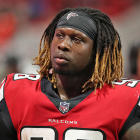
Takk McKinley is famous for his draft-night interview with Deion Sanders, but he's much more than that. Actually, he's currently second among rookies with six sacks, and has been a key piece of the Falcons improved defense in 2017.
McKinley's strong debut campaign in the NFL should come as no surprise, considering what he displayed at UCLA and his environment in Atlanta.
Let's look back on the 22-year-old's time as a prospect before he embarked on what has become one of the more underrated rookie seasons for an outside pass-rusher in recent memory.
Strengths
McKinley's motor stood out more than anything else on film. In fact, his relentless pursuit of the quarterback on every play was as impressive as any edge-rusher I've ever scouted. Every snap, McKinley was firing off the snap like he was shot out of a cannon. Didn't matter the formation, the score, the opponent. He was a hustle player to the nth degree.
In his final season with the Bruins, McKinley had 10 sacks, 18 tackles for loss and 61 total tackles in 11 games. That right there, straight box-score scouting, indicated he was a no-nonsense producer on the field.
And while constant hustle can be overlooked as an important but not vital coach-pleasing quality, McKinley's ability to rush the quarterback with the same speed and explosiveness in the fourth quarter as he did in the first quarter allowed him to wear down offensive tackles later in games.
McKinley is who "high-motor" prospects aspire to be.
Weaknesses
Despite his rigorous nature on the field, McKinley didn't use an array of pass-rushing moves with his hands to beat offensive linemen, which is typically the trait that separates the second- and- third-round selections from the first-rounders.
At 21 years old, McKinley shouldn't have been viewed as a totally finished product in that department, but he was likely not picked for his nuance as a pass-rusher.
Then, at the combine, McKinley had a poor showing in the crucial agility drills -- three-cone and short shuttle -- for edge-rushers. His times placed him in the 14th and 12th percentile respectively among all edge-rushers who participated in the combine starting in 1999, per MockDraftable.com.
McKinley likely saved his draft stock by running the 40-yard dash in 4.59 seconds (95th percentile) and broad jumping 122 inches (85th percentile).
And those figures precisely matched with what he put on film. For as rapidly as McKinley accelerated at the snap, he lacked bend around the corner and the ability to sharply flatten to the quarterback.
Perfect fit with Falcons
I'm not sure if McKinley would have enjoyed the same rookie season had he been picked by a team that asked him to be their No. 1 edge-rusher right away. He wasn't ready for the jump from uncultivated collegiate pass-rusher to alpha rusher before his 22nd birthday, and there's nothing wrong with that.
Atlanta kinda-sorta followed what the Chargers did with Joey Bosa when they had Melvin Ingram -- they double-dipped at a position of strength. After all, Vic Beasley led the NFL with 15.5 sacks in 2016. They also got 4.5 sacks from Adrian Clayborn and Dwight Freeney was still producing at high level relative to his age.
And just like the Bosa-Ingram first-round duo has been a boon to Los Angeles this season, the Falcons are currently reaping the rewards of that rare but shrewd draft decision.
Beasley is the primary edge-defender for which the opposition game plans. Clayborn's had a breakout season with 9.5 sacks -- with six against the Cowboys in one game -- so he's drawing attention as well.
The presence of those two veterans has benefited McKinley. Falcons head coach Dan Quinn was the Seahawks defensive coordinator when the team surprised many and picked Bruce Irvin in the first round to be a situational, pass-rushing specialist despite an unrefined skill set. Irvin became a key, rotational piece for Seattle in the club's Super Bowl runs.
That's basically the role McKinley is playing now for Quinn in Atlanta.
According to Pro Football Focus, he has 31 quarterback pressures (six sacks, four hits, 21 hurries) on 236 pass-rushing snaps. That equates to a Pass-Rushing Productivity score of 10.5, which sandwiches McKinley between Myles Garrett (10.4) and Everson Griffen (10.4). Nice company.
McKinley's appeared on a grand total of 349 snaps (37.7 percent) of the Falcons' defensive snaps this season, and 71.9 percent of those have been pass plays for the opponent. Ideal usage.
I had McKinley as my No. 11 edge-rusher in the 2017 draft class, which looks to be too low of a ranking, in his first year has clearly been impressive than a few players I had ahead of him like Jordan Willis and Charles Harris.
Conclusion
The Falcons have an enormous matchup with the Saints in Week 16, a contest that'll have major implications on playoff positioning for both clubs. In the team's first game just two weeks ago, McKinley was blanked in the quarterback pressure department. He only rushed the passer 10 times on 12 total snaps.
He'll need to make more of an impact to help Atlanta slow down New Orleans' potent, well-balanced attack.
In McKinley, the Falcons have a young, hungry pass-rusher who'll be a nice complement to Beasley for many years.