Agent’s Take: Key financial benchmarks for Kirk Cousins as QB market nears explosion
It would be a surprise if Cousins doesn't sign the richest contract in the NFL when he finds a new team
By
Joel Corry
•
7 min read
Quality quarterbacks are one of the rarest commodities in the NFL. That's why good starting quarterbacks almost never become unrestricted free agents. Most teams give them contract extensions before or during their contract year.
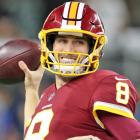
Kirk Cousins is the exception. He has spent the last two seasons with the Redskins playing under franchise tags. There was speculation that Cousins would be designated a franchise player for a third and final time at almost $34.5 million. Redskins senior vice president of player personnel Doug Williams shot down the notion last week in a media session at the NFL combine.
Cousins will be the litmus test for the value of a good, healthy quarterback in his prime hitting the open market. In three seasons as a full-time starter in Washington, Cousins averaged nearly 4,400 passing yards, 27 touchdowns and 12 interceptions while completing 67 percent of his passes for a 97.5 passer rating. His completion percentage and passer rating rank third and sixth, respectively, in the NFL over the last three years. The Redskins had a 24-23-1 record with Cousins under center.
Here's a look at the financial benchmarks of key contract metrics that should be relevant for Cousins during free agency.
Contract value
Average yearly salary
This is the most popular contract measure with the general public. It is also the least important because of the lack of security in NFL contracts.
Team | Year signed | Avg. salary | Contract package | Contract length | |
2018 | $27,500,000 | $137,500,000 | 5 years | ||
2017 | $27,000,000 | $135,000,000 | 5-year extension | ||
2017 | $25,025,000 | $125,025,000 | 5-year extension | ||
2016 | $24,594,000 | $122,970,000 | 5-year extension |
Professionals within the industry (agents and team negotiators) typically value deals by new money. New money is the amount of compensation in a contract, excluding what a player was scheduled to make before receiving a new deal. For example, Carr had one year left on his rookie contract with a $977,519 base salary when he got his new deal last June. Although he signed a six-year contract for $126,002,519, it is considered as a five-year, $125.025 million contract extension with a new money average of $25.005 million per year among industry professionals.
Carr's remaining 2017 base salary for $977,519 was subtracted from the 126,002,519 six-year total to arrive at this number.
First-year cash
Front-loading is one of the aspects of a contract indicating a player-friendly structure. It is a necessity because NFL contracts aren't fully guaranteed. Salary deferrals are a common occurrence in the most lucrative NFL contracts. Typically, when a player has a large signing bonus in his contract, he doesn't receive a portion of the money until the next calendar year. Large signing bonuses are broken into two to four installments rather than paid in a lump sum regardless of whether all of the money is received in the same calendar year the deal was made.
Players deferring money has been a standard practice in the NFL for quite some time. The seven-year, $98 million contract Peyton Manning signed with the Colts in March 2004, which made him the NFL's highest paid player (by average salary), included a $34.5 million signing bonus, while $18.5 million of the $34.5 million wasn't paid to Manning until the following March. Tom Brady didn't receive the final $5 million of the $30 million signing bonus in his 2013 contract renegotiation with the Patriots until February 2015.
Team | Year signed | 1st-year salary | Deferred amount | 1st-year actual cash | Payment date | |
2013 | $40,000,000 | None | $40,000,000 | N/A | ||
Matthew Stafford | Lions | 2017 | $51,000,000 | $16,500,000 | $34,500,000 | 2/15/2018 |
Jimmy Garoppolo | 49ers | 2018 | $42,600,000 | $10,000,000 | $32,600,000 | 2/15/2019 |
2015 | $37,500,000 | $5,500,000 | $32,000,000 | 3/15/2016 | ||
Andrew Luck | Colts | 2016 | $44,000,000 | $14,000,000 | $30,000,000 | 3/31/2017 |
Stafford set an NFL record with his $50 million signing bonus. The previous mark was held by Ravens quarterback Joe Flacco, who got a $40 million signing bonus as a part of his 2016 extension for three years worth $66.4 million ($22,133,333 per year).
Three-year cash flow
A cash flow analysis looks at a player's compensation under a deal in its totality. The concept of new money is irrelevant in this metric. The focus is on the amount of money received in the first three years of a contract regardless of whether it's considered as new money.
Team | Year signed | Three-year cash flow | |
Matthew Stafford | Lions | 2017 | $87,000,000 |
Jimmy Garoppolo | 49ers | 2018 | $87,400,000 |
Andrew Luck | Colts | 2016 | $75,000,000 |
First three new years compensation
This is a different metric than cash flow in the first three years of a deal. The new years approach focuses on the amount of money in a contract exclusive of what a player was scheduled to make before receiving a new deal, just like with new money when determining average yearly salary.
The difference in the two metrics can be illustrated with Carr's five-year extension. His cash flow in the first three years (2017-2019) is $67.5 million. The compensation in the first new three years (2018-2020) is $85,522,481 million. As previously mentioned in the average yearly salary section, Carr had an existing 2017 contract year with a $977,519 base salary remaining when he signed his new deal. This remaining money is subtracted from the $86.5 million four-year cash flow total to reach $85,522,581 million. Both metrics have the same dollar amount when a player signs a new contract as a free agent or when his contract is set to expire.
Team | Year signed | First three new years | |
Matthew Stafford | Lions | 2017 | $92,000,000 |
Jimmy Garoppolo | 49ers | 2018 | $86,400,000 |
Derek Carr | Raiders | 2017 | $85,522,481 |
Andrew Luck | Colts | 2016 | $79,970,000 |
Contract security
Overall contract guarantees
Teams no longer do extremely lucrative deals where a signing bonus is the only form of guaranteed money. The preferred structure by a majority of teams is a contract consisting of a signing bonus and salary guarantees. The base salary in the first contract year is usually fully guaranteed (injury, salary cap and skill guarantees) at signing. Roster bonuses in the first contract year due a few days after signing are fairly common. Even though these roster bonuses technically aren't guaranteed, they are considered as a part of the guaranteed money. Salary guarantees in subsequent contract years are mainly base salary. In the most lucrative contracts, the base salary in the second contract year is typically fully guaranteed upon execution, although the general trend is for base salaries after the first contract year to be conditionally guaranteed. They are guaranteed for injury only initially but fully guaranteed if a player is on the team's roster on a particular date in each specific contract year. The date will vary from team to team but is normally within the first few days of the current league year (i.e.: 2018 base salary becomes guaranteed on third day of the 2018 league year). This type of structure gives teams a window annually to get out of a deal before that year's financial commitment is firm.
Team | Year signed | Overall guarantees | |
Matthew Stafford | Lions | 2017 | $92,000,000 |
Andrew Luck | Colts | 2016 | $87,000,000 |
Jimmy Garoppolo | 49ers | 2018 | $74,100,000 |
Derek Carr | Raiders | 2017 | $70,200,000 |
2016 | $70,000,000 |
Fully guaranteed at signing
Overall contract guarantees are misleading and don't tell a complete picture of a contract's true security since NFL deals aren't fully guaranteed like in MLB and the NBA. The amount of money fully guaranteed at signing and how much will become fully guaranteed early in the contract are the best and most accurate measures of security.
This aspect of NFL contracts began to receive more notoriety thanks to Colin Kaepernick's six-year extension in 2014, worth a maximum of $126 million. On the surface, it appeared as if the 49ers made a huge financial commitment to Kaepernick because of the overall value of the deal and the $61 million in guarantees. Kaepernick's contract didn't provide him the same level of security as comparable quarterback deals, since only a little less than $13 million was fully guaranteed at signing. Those deals had approximately $40 million completely secure, which was essentially triple Kaepernick's amount.
Team | Year signed | Fully guaranteed at signing | |
Matthew Stafford | Lions | 2017 | $60,500,000 |
2015 | $59,955,000 | ||
Jimmy Garoppolo | 49ers | 2018 | $48,700,000 |
Andrew Luck | Colts | 2016 | $47,000,000 |
Luck's $3 million fifth-day-of-the-2017-league-year roster bonus is included in the $47 million because it was guaranteed of skill and injury at signing and became fully guaranteed three days later.
Fully guaranteed within 12 months of signing
Quarterbacks are typically the standard bearers for all NFL contract metrics. An aberration currently exists since defensive players Von Miller and Ndamukong Suh rank second and fourth in this metric.
Team | Year signed | Fully guaranteed within 12 months of signing | |
Matthew Stafford | Lions | 2017 | $86,000,000 |
Von Miller | Broncos | 2016 | $61,000,000 |
Andrew Luck | Colts | 2016 | $60,000,000 |
Ndamukong Suh | Dolphins | 2015 | $59,955,000 |
2013 | $59,000,000 |
Final thoughts
The quarterback market is on the verge of exploding. Garoppolo was the first domino to fall. It will be a surprise if Cousins doesn't sign the richest contract in NFL history or at least establish some new benchmarks in key contract metrics. A deal averaging $30 million per year with $100 million in overall guarantees where at least $65 million is fully guaranteed at signing isn't out of the question, especially if a bidding war erupts. The Jets are reportedly willing to do "whatever it takes" to sign Cousins. The Broncos, Cardinals and Vikings have also reportedly expressed interest in him.
In addition to Cousins, Aaron Rodgers and Matt Ryan are expected to sign extensions with the Packers and Falcons this offseason. Packers general manager Brian Gutekunst wants to finalize a new deal for Rodgers as soon as possible. The two-time league MVP doesn't have the same urgency because a Cousins deal should be beneficial. Rodgers' and Ryan's current contracts, which were negotiated in 2013, made them the NFL's highest-paid and second-highest-paid players respectively when signed. The same thing is likely to happen with their new deals.