NFL playoff team weaknesses: Fatal flaws range from Bills' leaky run defense to major quarterback questions
No team is perfect, but some teams have bigger flaws than others

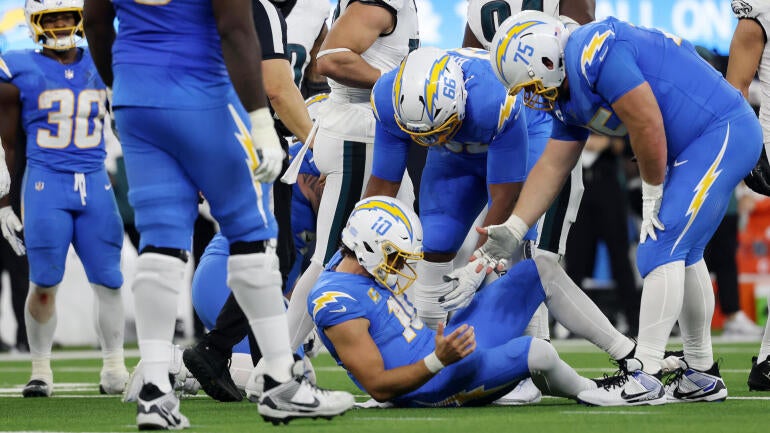
Football is a game of imperfections, and the best teams are the ones who do the best jobs covering them up. Often, it's a quarterback who can cover up a litany of issues, whether it's the offense surrounding him or the defense opposite him. Sometimes, it's what's around the quarterback -- superb play calling and designing, outstanding protection, game-changing play-makers, etc. -- that covers for the quarterback, and sometimes it's the defense that covers for the offense as a whole.
There's a reason it's been well over half a century since a team went undefeated, and this year didn't come close to ending that streak: The last undefeated teams were the Buffalo Bills and the Philadelphia Eagles, who only made it to 4-0. It was the earliest every team had a loss since 2014.
But the slates are wiped clean for the postseason. It doesn't matter how teams got there. It just matters what they do once they've made it. And even among this upper tier of teams, there are plenty of weaknesses. How they are hidden or overcome will determine a champion. But if they become exposed too much, they could prove a fatal flaw. Here's each playoff team's most significant weakness:
AFC
1. Denver Broncos: Is Bo Nix consistent enough?
There's little doubting Nix's clutch gene -- his seven game-winning drives led the NFL -- and there are times when he is terrific all game long. There are also times when he is a little too risky or inaccurate downfield, leading to missed opportunities and turnovers. Then there are other times where he's too risk averse. Finding that happy medium can be a challenge. Nix was 25th in off-target rate and 28th in yards per attempt. He threw 11 interceptions, and he had seven more dropped, tied for second-most in the NFL. Nix often does a great job keeping the Broncos on track, and his mobility is underrated, but he also plays with fire more than Sean Payton would like.
2. New England Patriots: Run defense
Halfway through this season, run defense would have been considered one of New England's strengths. Through the first nine weeks, the Patriots were seventh in defensive rushing success rate. Since Week 10, though, the Patriots are dead last by a wide margin. Injuries have undoubtedly played a part, with notable offseason acquisitions Milton Williams and Robert Spillane missing time. Same with run plugger Khyiris Tonga. This issue might be survivable against a poor Los Angeles Chargers offensive line, but tougher rushing attacks await.
3. Jacksonville Jaguars: What happens against some of the elite pass rushes?
The Jaguars have a solid statistical profile, especially after Trevor Lawrence's red-hot finish to the season. But sacks can still be an issue, especially against some of the NFL's best. The Broncos sacked Lawrence five times in Week 16. The Houston Texans had five in Week 10. The Seattle Seahawks and Los Angeles Rams both had seven in consecutive weeks. Lawrence finished 22nd in sack rate this season, and though he was better in the second half of the year, that issue can still pop up.
4. Pittsburgh Steelers: Downfield passing
The Steelers had the sixth-fewest plays of 10+ yards this season and the second-fewest among playoff teams. Aaron Rodgers can still make some magic happen, but in general he's been one of the shortest and fastest passers of the ball this season. His 6.0 air yards per attempt is lowest in the NFL. That's worked well enough to make the postseason, but can it work against an aggressive, downhill Texans defense that will hunt everything short and force Rodgers to try to win over the top? DK Metcalf's return could help, but it's asking a lot for an offense that was 25th in yards per game.
5. Houston Texans: Red-zone offense
The Texans enter the playoffs ranked 28th in offensive success rate and 30th in rushing success rate. They can somewhat make up for it by 1) having arguably the NFL's best defense that gives them lots of short fields and 2) an occasional big play, but overall, it's ugly. It somehow gets even uglier in the red zone, where they are 30th in touchdown rate. There are way too many penalties (16 red zone offensive penalties, most in the NFL), runs that go nowhere and hopeless passing plays.
6. Buffalo Bills: Run defense
It's a tough call between run defense and outside wide receivers as Buffalo's biggest weakness, but ultimately the run defense is too big an issue to ignore. Only one team ever -- the 2006 Indianapolis Colts -- allowed more than 5 yards per rush and won the Super Bowl. The Bills were at 5.1. Plus, when it breaks, it breaks completely: Buffalo allowed eight touchdown runs of 30+ yards, most in a season in NFL history.

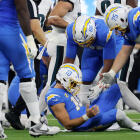
7. Los Angeles Chargers: Offensive line
The Chargers are tied for last in PFF's pass-blocking grades and dead last in its run-blocking grades. Enough said.
NFC
1. Seattle Seahawks: Turnovers
Only the Minnesota Vikings had more turnovers than the Seahawks did this season, and 20 of Seattle's 28 turnovers were from Sam Darnold (14 interceptions, six fumbles lost). Darnold has always been a bit loose with the ball -- sometimes trying to make high-difficulty throws, other times just making the wrong throw or being fooled -- but another emerging worry is sacks. Since Week 13, Darnold has an 8.2% sack rate, 22nd in the NFL. Prior to that this season, he had a 3.6% sack rate, second-best in the league.
2. Chicago Bears: Reliance on turnovers
The Bears committed the fewest turnovers (11) and forced the most turnovers (33) in the NFL this season. Only 28% of opponent drives ended in punts, 28th in the NFL. If the Bears didn't force a turnover, they probably allowed a score. That can work in the regular season, but counting on it to work in the playoffs agains less mistake-prone teams can be tough. From 2020-24, five teams finished a regular season with at least 33 turnovers forced. They combined to win one playoff game.
3. Philadelphia Eagles: Stop-and-start offense
The Eagles had four scoreless halves this season, tied for third-most in the NFL. The only teams with more? The Tennessee Titans and the Cleveland Browns. Philadelphia tends to get in these offensive funks and struggle to pull itself out. It can't fall back on Saquon Barkley -- whose explosive rushing numbers are way down -- like last year, and the passing game has been a rollercoaster with a lot of all-or-nothing plays (fifth-highest deep throw rate in the NFL). The Eagles are just 24th in offensive success rate, second-worst of all playoff teams.
4. Carolina Panthers: Bryce Young's inconsistency
Young has had some shining moments in the clutch this season, but the overall product is underwhelming. He finished 30th in yards per attempt and per completion, 26th in first-down rate, 25th in interception rate and 22nd in completion percentage. He threw for 200 yards or more just four times. Carolina's road to victory -- lean on the run game and get a few plays from Young -- is narrow. The Panthers were 1-5 when they didn't hit a 40% rushing success rate this season.

5. Los Angeles Rams: Pass defense, especially against star receivers
The Rams have the NFL's cheapest defense, and it especially shows up in the secondary. The pass rush is cheap because of a lot of promising youngsters still on rookie deals. The secondary hasn't seen that sort of investment. It's a group of castoffs and veterans on relatively small deals. The Rams' most-used cornerbacks are Cobie Durant and Emmanuel Forbes, who rank 32nd and 70th, respectively, in PFF's coverage grade (out of 85 cornerbacks). When it comes down to it, a standout wide receiver -- especially bigger ones -- can simply win his one-on-one matchup. Potential playoff opponents Tetairoa McMillan, A.J. Brown and Jaxon Smith-Njigba have all had big days against Los Angeles.
6. San Francisco 49ers: Pass rush
This could say "defense" as a whole -- San Francisco is last in defensive success rate and last in defensive rushing success rate -- but at least the 49ers usually do a decent job limiting the damage, touchdowns-wise. The bigger issue is the 49ers finished last in sacks and sack rate and 30th in pressure rate this season.
7. Green Bay Packers: Defensive front
After the Packers acquired Micah Parsons, the biggest question defensively was if cornerback was the only weak link. Now, after injuries to Parsons and Devonte Wyatt, the biggest question by a mile is the defensive front. Over the past three weeks, the Packers are dead last in defensive rushing success rate and 31st in overall defensive success rate. They have one sack -- yes, one -- and one takeaway. It is really hard to win in the playoffs if you can't stop the run or disrupt the pass.