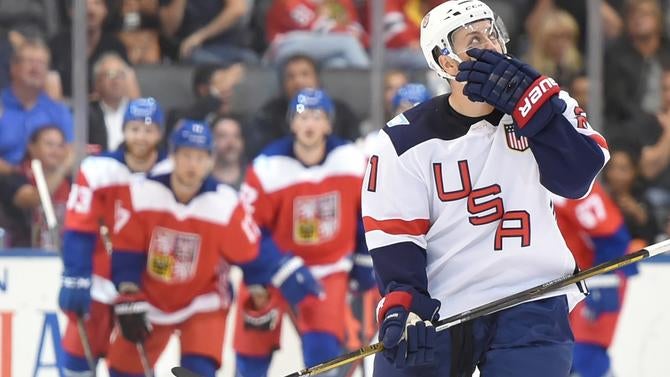
They didn't have anything to play for aside from pride, or however much pride not finishing in last place can give you. Even that didn't matter. Team USA's World Cup ended in a 4-3 loss to the Czech Republic, securing an 0-3 record and a little bit of unfortunate history.
This is the first time in a best-on-best format, including Canada Cups and Olympics, that the U.S. failed to win at least one game at any point in the tournament. It's stunning when you consider that the American talent pool -- even without the young players that were ineligible due to Team North America -- is about as deep as it's ever been in the NHL. The top players may have been better in the mid-1990s, but there are more guys to choose from now. Obviously, the U.S. didn't invite the best available players, but they did
It's impossible to dress up or to make excuses for. If not for Finland scoring only one goal in the tournament, Team USA would have finished dead last. Instead, they'll finish seventh thanks to goal differential.
Every decision made surrounding this team seemed to blow up in their faces. General manager Dean Lombardi had the wrong philosophy when it came to building the team, made only more obvious by the results. It was admitted by both the GM and coach John Tortorella that they didn't prepare well enough for the tournament opener against Europe. The way they structured lines did nothing to generate the offense necessary for success. The list can keep going on and on what went wrong.
The players didn't do anyone, including themselves, any favors either. It was more of the same against the Czech Republic, aside from the fact that for one game in this tournament they actually had some kind of response even if it wasn't a strong enough one. They at least had a little push back and played with a little more pride, but the end result was the same.
If this doesn't bring meaningful change to the process of how national teams are selected, how coaches are vetted, how players are valued and how adjustments are made over the course of a tournament, then USA Hockey is doomed to repeat its failures.
Here are a few takeaways from a meaningless game that made sure Team USA's tournament ended on the loudest possible thud:
1. Loss to Czechs was just more of the same
Despite having nothing to play for, the U.S. players actually seemed to play hard. There wasn't nearly as much emotion compared to the other games, but they didn't just lay down. But that still didn't matter, which is even more troubling about this team's roster construction.
There were a few bad bounces, but mostly, Team USA's execution was just poor. Teams are supposed to get better as the tournament goes on and you definitely can't say that about this team.
In this game, the U.S. outshot the Czechs 39-27, but they never held the lead in the game. In fact, they held the lead for a grand total of 1:29 in the entire tournament. That was against Canada before it all went down the tubes.
One of the truly disappointing things about this U.S. roster was that it could not dig itself out of a hole. Teams are going to have bad stretches and they're going to give up goals. How those bouts with adversity are handled matters. They didn't respond swiftly or firmly enough. That will stand out from this tournament.
2. Hey, at least Cory Schneider finally got to play and show off his cool pads
Cory Schneider, the goalie with the highest career save percentage on the team, finally got to dress and after Ben Bishop allowed four goals, he actually got to play. Schneider came on in relief for the third period.
We finally got a chance to see his awesome American flag pads in action, even if he only needed to make seven saves.
USA hockey highlight - pads pic.twitter.com/JsJnjokCJb
— CJ Fogler (@cjzero) September 23, 2016
If there's been one player that has been undervalued throughout his career and now by his own national team, it's Schneider. This is a guy who has done nothing but play consistently in net and put together some great numbers. Over the six seasons where he's played more than 25 games, his save percentage has never dipped below .921. He's at .925 for his career.
If the Devils were better over these last three years, we'd be talking about him a lot more for the Vezina, but they haven't given him much goal support. Jonathan Quick and Ben Bishop are really good goalies. Both were Vezina finalists this year, both have quite a bit of experience in big games, too, but there's a good argument that the best goalie on the team was sitting in the press box for most of the tournament.
3. Time for some organizational soul searching
I already spent a few thousand words on trying to examine what went wrong for this team and what needs to be fixed, but that was before things went from disastrous to full-on nuclear meltdown levels.
Everything said before still holds true, but maybe USA Hockey should go even further. Maybe they should get their best hockey minds together at the office in Colorado Springs, or wherever there's a room big enough to hold them all, and hash everything out.
Development is not necessarily the problem as there have been wheels in motion on that front for years. There's a reason the young guys on North America play a more exciting brand of hockey than this current group of USA players.
It all comes down to how these teams are built. And it's not just the men's Olympic or World Cup team. It's every team. World Championships, World Junior Championships have suffered many of the same problems - though it's tough to even get players to go to the World Championship anymore.
This tournament is not a statement on where hockey is in the United States. There are plenty of other things about USA Hockey we can point to and say that it is unquestionably better than it used to be. But their men's national team is the most visible team under their large umbrella. The best-on-best tournaments are the measuring sticks you are ultimately judged on. When they consistently fall short on the biggest stage, and appear to be backsliding, it's a huge problem.
There is a lot of work that needs to be done, with no easy solutions. It's going to take a lot of conversations, a lot of study and analytical work. More than anything, it's going to take someone with the courage to ask the tough questions and for the people in charge to have the humility to listen.
This is a failure that simply cannot go without some sort of reckoning.