WNBA CBA talks: How WNBPA's proposal to create developmental roster spots would benefit players and teams
The WNBPA wants teams to have to carry a minimum of 12 players at all times

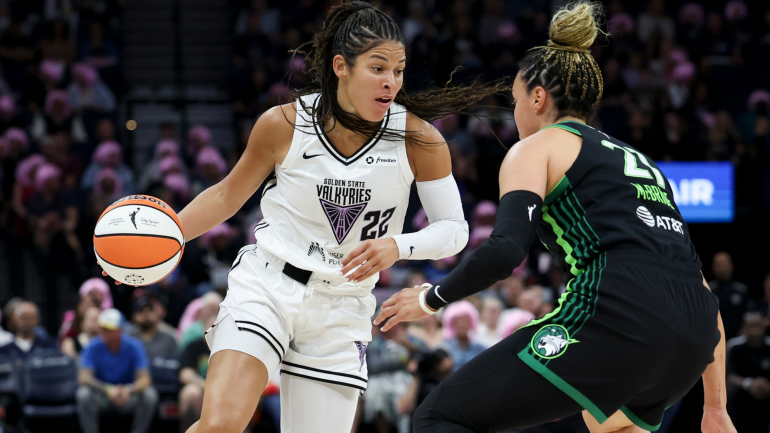
Golden State Valkyries guard Veronica Burton, the 2025 WNBA Most Improved Player and All-Defensive Second Team honoree, did not come out of nowhere. She was a three-time Big Ten Defensive Player of the Year, WBCA Defensive Player of the Year and an AP All-American at Northwestern, and was the No. 7 overall pick in the 2022 draft.
So why were the Valkyries her third team in four years? Blame, in part, the WNBA's small roster sizes and lack of developmental pathways.
During her first two seasons with the Dallas Wings, Burton was stuck behind veterans on a playoff team and received limited minutes -- during which she showed flashes, but was inconsistent. Ahead of the 2024 season, Burton was one of the Wings' final cuts as the front office cleared room for five incoming rookies, including three top-five picks. She later caught on with the Connecticut Sun, and spent one season there before the Valkyries stole her in the expansion draft and gave her an opportunity to start full time last season.
While it's easy to criticize the Wings' decision to let go of Burton in retrospect, they were doing what every WNBA team has always done with young players who aren't immediately productive: move them out for the new wave of rookies.
WNBA teams can have a maximum of 12 players on their roster, but many only carry 11 due to salary cap constraints. There is no G League nor two-way contract equivalent (like there is in the NBA), practice time is limited once games begin and the season, even now that it has been extended, is only 44 games. During the offseason, many players head overseas or to other domestic leagues where they often play a different role in a different system.
Beyond the logistical challenges of developing players, 75% of the league has made the playoffs for the majority of the WNBA's history, which puts nearly every franchise in win-now mode. If you can't help a team win right away, your odds of sticking around long enough to change that are low, and your odds of doing so for the team that drafted you are even worse.
From 2020-2024, there were 120 players selected in the first and second rounds of the draft. (The 2025 draft was not included because it is too recent.) Only 50 remain in the league (41.6%) and only 23 remain on the team that drafted them (19.2%).
If you break the numbers down even further, there's a wide gulf between lottery and non-lottery picks, as well as first- and second-round picks.
- Of the 20 lottery selections between 2020-2024, 15 remain in the league (75%) and 10 remain with the team that drafted them (50%)
- Of the 40 non-lottery first-round picks, 22 remain in the league (55%) and eight remain on the team that drafted them (20%)
- Of the 60 second-round picks, 13 remain in the league (21.6%) and six remain on the team that drafted them (10%)
Here's a look at the year-by-year breakdown:
*Note: "Remain in the league" is defined as having played a game in the 2025 season or opted to sit out
2020 WNBA Draft
| Draft round | Played in WNBA | Still in WNBA | With original team |
|---|---|---|---|
First | 12/12 | 4/12 | 1/12 |
Second | 12/12 | 3/12 | 1/12 |
- Players still in the WNBA: Sabrina Ionescu, Satou Sabally, Tyasha Harris, Kitija Laksa, Luisa Geiselsoder, Leonie Fiebich, Kaila Charles
- Player still with their original team: Ionescu (New York Liberty), Geiselsoder (Wings)
2021 WNBA Draft
| Draft round | Played in WNBA | Still in WNBA | With original team |
|---|---|---|---|
First | 12/12 | 4/12 | 1/12 |
Second | 7/12 | 3/12 | 0/12 |
- Players still in the WNBA: Awak Kuier, Aari McDonald, Michaela Onyenwere, Iliana Rupert, Dana Evans, Natasha Mack, DiJonai Carrington
- Player still with their original team: Kuier (Wings)
2022 WNBA Draft
| Draft round | Played in WNBA | Still in WNBA | With original team |
|---|---|---|---|
First | 11/12 | 9/12 | 6/12 |
Second | 10/12 | 3/12 | 2/12 |
- Players still in the WNBA: Rhyne Howard, NaLyssa Smith, Shakira Austin, Emily Engstler, Nyara Sabally, Lexie Hull, Veronica Burton, Rae Burrell, Kierstan Bell, Christyn Williams, Naz Hillmon, Olivia Nelson-Ododa
- Player still with their original team: Howard (Atlanta Dream), Austin (Washington Mystics), Sabally (Liberty), Hull (Indiana Fever), Burrell (Los Angeles Sparks), Bell (Las Vegas Aces), Hillmon (Dream), Nelson-Ododa (Sun)
2023 WNBA Draft
| Draft round | Played in WNBA | Still in WNBA | With original team |
|---|---|---|---|
First | 11/12 | 9/12 | 4/12 |
Second | 7/12 | 1/12 | 1/12 |
- Players still in the WNBA: Aliyah Boston, Diamond Miller, Maddy Siegrist, Lou Lopez Senechal, Haley Jones, Grace Berger, Laeticia Amihere, Jordan Horston, Zia Cooke, Dorka Juhasz
- Player still with their original team: Boston (Fever), Siegrist (Wings), Senechal (Wings), Horston (Seattle Storm), Juhasz (Minnesota Lynx)
2024 WNBA Draft
| Draft round | Played in WNBA | Still in WNBA | With original team |
|---|---|---|---|
First | 11/12 | 11/12 | 6/12 |
Second | 6/12 | 3/12 | 1/12 |
- Players still in the WNBA: Caitlin Clark, Cameron Brink, Kamilla Cardoso, Rickea Jackson, Jacy Sheldon, Aaliyah Edwards, Angel Reese, Alissa Pili, Carla Leite, Leila Lacan, Marquesha Davis, Nika Muhl, Kate Martin, Elizabeth Kitley
- Player still with their original team: Clark (Fever), Brink (Sparks), Cardoso (Sky), Jackson (Sparks), Reese (Sky), Lacan (Sun), Muhl (Storm)
Changes on the way?
In Burton's case, her breakout likely would not have been possible if she didn't hang around the league after being waived by the Wings. How many other Burtons may have slipped through the cracks over the years because they got waived once and never got another chance?
That brings us to an interesting note in Ben Pickman's report at The Athletic about the most recent collective bargaining agreement proposal from the Women's National Basketball Players Association:
The WNBPA has proposed mandating teams carry 12 players at all times. Each team currently can carry a maximum of 12 players and a minimum of 11.
The WNBPA is also proposing that teams be allowed to sign up to two additional developmental players, who would receive a stipend and could appear in up to 10 games per season at a prorated minimum league salary, before signing a rest-of-season contract. Developmental players would also receive full benefits.
Mandating that teams roster 12 players and creating two developmental roster spots per team would obviously benefit players. It would ensure that every roster spot is filled, and offer players on the cusp of making a roster the ability to remain around the team.
In-season development would still be a challenge, but creating a developmental pool would force teams to make it more of a priority. And even if said developmental players didn't end up earning a rest-of-season contract, or even seeing much game time, they would have a chance to work on their craft in a WNBA environment and form relationships with coaches that may pay off down the line.
"With the developmental part, you get the chance to grow with each other," Kelsey Mitchell said Monday during Unrivaled's media day. "I think if you want to develop who you want on your team and mold them to who you want them to be, I think it's a great recipe to have for basketball across the board."
This change would also benefit teams, even if it may complicate their salary cap sheets. The cost to keep two developmental players around on stipends would be minimal, and would allow teams to keep players who just missed out on a final roster spot in their system. Often, teams select more players in the draft than they have open roster spots for, which is a major reason why the third round, in particular, feels like a waste of everyone's time. With these developmental slots, second- and third-round picks would become more valuable and give teams a real path to finding, and keeping, young talent.
An answer to injury issues?
Injuries and the schedule were a major talking point during the 2025 season, which saw each team play 44 games for the first time in league history. Numerous high-profile players, including Caitlin Clark, Breanna Stewart and Napheesa Collier, spent extended spells on the sidelines, and players regularly criticized commissioner Cathy Engelbert over the amount of games and lack of time off.
Few teams felt the pain as badly as the Fever, who lost Clark, Sophie Cunningham, Sydney Colson, Aari McDonald and Chloe Bibby to season-ending injuries in the regular season, then saw Damiris Dantas and Kelsey Mitchell go down in the playoffs. The Fever regularly had to apply for hardship exemptions and had 18 different players appear in a game.
It's no surprise that Mitchell is in favor of adding developmental slots.
"I think it's effective. I think anything you do that can sustain us being who we need to be without overcompensating so much," Mitchell said. "If you have a developmental league, I think the players that are on the team already won't have as much to worry about as far as everything that comes with losing certain people on your team."
Monique Billings, who also spoke at Unrivaled media day on Monday, concurred.
"It's something you see in the W often -- not having enough bodies and players, coming down to seven, eight, maybe nine people and having to thug it out. It's not always easy," Billings said. "I think a development pool would be phenomenal and something that our league has never seen before. I think it would be a big help for sure."
Teams having access to two developmental players would not solve all of the league's injury issues -- which will not subside any time soon -- but it would help teams navigate periods of poor health. In the event of multiple injuries, teams could call up their developmental players instead of going through the hassle of signing players off the street to seven-day contracts.
Will a player development pool come to pass?
Creating a developmental pool would be beneficial to both players and teams on multiple fronts: player development and health and safety. It is fair to wonder how much the stipend would pay players, but the only apparent downside is the (relatively minor) cost associated with having more players on the books.
Historically, though, the WNBA and its teams have not always been willing (or able) to put up the money to make seemingly obvious improvements to further professionalize the league. Even now, players are still fighting for teams to improve their facilities and hire more security personnel.
The league is not going to willingly assume the cost of adding more than two dozen players to the books -- even on stipends, rather than a salary -- without extracting something from the WNBPA in these negotiations. Which means, how badly do the players want a developmental pool, and what are they willing to part with on their end to make it happen? For example, the league might agree to a developmental pool in exchange for smaller salary increases for current players.
If the players make a developmental pool a central tenet of their demands, it does seem realistic. If not, forget about it. After all, this proposal isn't coming from the league.