Fantasy Basketball Draft Prep: How will shortened season, COVID-19 protocols impact the 2020-2021 season?
Here's everything you need to know about the 2020-21 changes.
By
Nick Whalen
•
6 min read
Coming off of the shortest offseason in NBA -- and American professional sports -- history, the start of the 2020-21 season is now just a week away. Fantasy draft season is already in full swing, and this season will present a number of unique challenges for managers in all varieties of leagues.
First and foremost, the season will begin in the midst of a global pandemic, as COVID-19 remains a daily part of life around the country. And while a vaccine became available in the United States last week, it's still in the very early stages of distribution, so it will likely be several months until the results become tangible on a nationwide scale. The thought is that NBA players and personnel may be able to gain early access to the vaccine -- just as the league was able to purchase thousands of COVID-19 rapid tests for the Orlando bubble -- but it's unclear how realistic that may be.
In the short term, the NBA will kick off a slightly reduced season (72 games, compared to the usual 82) under strict COVID-19 protocols. Unlike the conclusion to the 2019-20 season, games will be played at teams' home arenas, though most arenas will not allow fans to begin the season. Fantasy-wise, the lack of fans is not really a concern, but the added variable of cross-country travel is.
More Fantasy Basketball Draft Prep: Positional tiers -- Point Guard | Shooting Guard | Small Forward | Power Forward | Center -- Preseason Injury Updates -- Depth Chart Changes -- Rookie Targets -- Offseason Recap
The COVID-19 Protocol
Thinking back to July and August, there was some initial concern about the viability of the Orlando bubble. Some players arrived late, and others tested positive before arriving, but once the bubble was "sealed", concerns over positive tests quickly subsided. The NBA deserves credit for pulling off the bubble with minimal setbacks, but it's a near-guarantee that things won't go as smoothly this time around.
In Orlando, the league was able to monitor players' movements on a 24/7 basis. That will no longer be the case. With players living and working in-market, positive tests will be inevitable -- prior to training camp, 48 players tested positive -- so Fantasy managers should be more vigilant than ever when it comes to tracking player news.
Per the NBA's health and safety protocols, players who test positive for the virus will be subject to a process that sidelines them for a minimum of 12 days, including:
- Players who test positive but are asymptomatic must:
- Sit out for 10 days from when first positive test occurs
- Pass a cardiac screening
- Work out alone at team facility for two days
- Players who test positive and are symptomatic must:
- Sit out for 10 days from when symptoms subside
- Pass a cardiac screening
- Work out alone at team facility for two days
A 12-day absence may not sound too severe, but given the condensed schedule, it could mean a player missing seven or eight games. Another key point outlined in the league's protocols is that players are not allowed to work out -- either at home or at team facilities -- while recovering from the virus. So while a player can return after 12 days, he'll likely need at least a day or two of practice to ramp up his conditioning.
Before the Fantasy season begins, it will be important to communicate with your league mates and commissioner regarding how your league will handle players who test positive. Will you add an extra IR spot or two? Or perhaps an IR spot that can only be filled by a player who's currently in the league's COVID-19 protocol?
For managers, it will also be imperative to work the waiver wire harder than ever. Even if your league designates IR spots for players who test positive, you'll still need to find temporary replacements. Managers with a deep knowledge of the player pool, as well as team depth charts, will have a leg up if outbreaks occur.
The Schedule
In a normal league year, each NBA team plays 82 games between late-October and mid-April. This season, operating under a condensed schedule, all 30 teams will play 72 games between late-December and mid-May, when the play-in tournament for the eighth playoff spot in each conference begins.
The schedule itself -- part one was released earlier this month -- is not dramatically different from those of years past. Back-to-backs have increased, but not by a massive margin. Where the NBA is really saving time is by cutting back on longer stretches with no games. Five-game weeks are still rare, but two-game weeks have also been all but eliminated, meaning the vast majority of the league will play three or four games each week of the season.
For Fantasy, this could be both a blessing and a curse. On one hand, dealing with two-game weeks for star players is always frustrating. But on the other, when virtually every player has three or four games, lineup decisions can't be easily solved by simply rolling with the player who has two or three additional games that week. This will be especially true in points leagues with weekly matchups.
In terms of the nuts and bolts of the schedule, each team will play all 29 opponents at least once at home and once on the road. But teams will only face most conference opponents three times, instead of the usual four.
The goal of the condensed schedule is to enable the league to return to a "normal" calendar for the 2021-22 season, but it will carry some consequences. For one, there's some concern that the reduction in built-in rest could result in an uptick in injuries -- particularly soft tissue injuries. It remains to be seen whether that will ultimately be the case, but it will be interesting to note whether teams that played in the Orlando bubble -- as opposed to having the last nine months off -- are affected any differently.
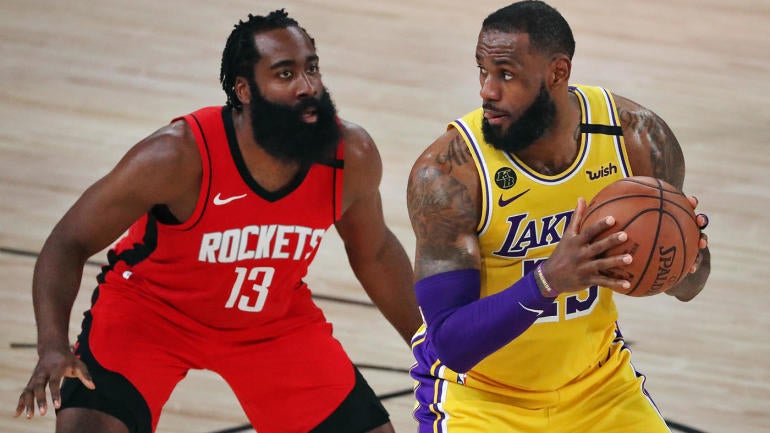
In response to concerns over rest, it's widely assumed that large swaths of the league's veterans will take more nights off for "load management" purposes. The face of the league, LeBron James, was vocal regarding his concerns about starting the season before the turn of the calendar. The Lakers, who played into October in the bubble, will likely monitor his workload throughout the regular season -- and especially early on.
Somewhat surprisingly, the league pushed back on this notion earlier in December, when it issued a new resting policy that prohibits teams from resting star players for any national TV games. The policy also advises against resting two star players for the same game, as well as resting star players on the road. The message to teams: If you're going to rest players, do it during a home game when no one is watching.
For Fantasy players, this updated policy is probably a win. As has been the case in recent years, teams will undoubtedly find ways around the rules, but the league doubling down on its rest policy should -- in theory, at least -- dissuade players from going overboard when it comes to load management.
Still, players like LeBron James, Chris Paul, Kevin Durant, Russell Westbrook and Jimmy Butler should all be slightly downgraded in fantasy drafts due to the likelihood that they'll sit out more games than they normally would.
What's the exact Fantasy value of every NBA player? And which surprising player cracks the top 10? Visit SportsLine now to get optimized Fantasy basketball rankings, all from a daily Fantasy pro who has won almost $2 million in his career and has simulated the entire season 10,000 times.