2018 MLB Draft: Six things to know about Rounds 1 and 2 plus the best players remaining for Round 3 and beyond
Teams went heavy on college players early in the first round

By
Mike Axisa
•
9 min read
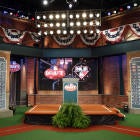
Monday night at the MLB Network studios in New Jersey, the 2018 MLB draft opened with the first 78 picks. The Detroit Tigers held the No. 1 pick and selected Auburn right-hander Casey Mize. He is the first player taken No. 1 overall out of college after going undrafted out of high school since the Washington Nationals selected Stephen Strasburg with the No. 1 pick in 2009.
Here is our pick-by-pick analysis of the first round of the 2018 draft. The MLB draft is a three-day event covering 40 rounds and over 1,200 picks. The draft continues with rounds 3-10 on Tuesday and concludes with rounds 11-40 on Wednesday. Here are six takeaways from the first day of the 2018 MLB draft.
College players dominated top of the draft
Thanks to the talent available in this year's draft class and the draft tendencies and preferences of the clubs picking early, five straight college players came off the board to begin the 2018 draft. Here are the top five picks:
- Detroit Tigers: Auburn RHP Casey Mize
- San Francisco Giants: Georgia Tech C Joey Bart
- Philadelphia Phillies: Wichita State 3B Alex Bohm
- Chicago White Sox: Oregon State 2B Nick Madrigal
- Cincinnati Reds: Florida 3B Jonathan India
The New York Mets ended the run of college players when they selected Wisconsin high school outfielder Jarred Kelenic with the No. 6 pick. The 2018 draft is the first time five college players were selected with the top five picks since 2006, when the top six picks were college players. The top six picks that year:
- Kansas City Royals: Tennessee RHP Luke Hochevar
- Colorado Rockies: Stanford RHP Greg Reynolds
- Tampa Bay Rays: Long Beach State 3B Evan Longoria
- Pittsburgh Pirates: Houston RHP Brad Lincoln
- Seattle Mariners: UC Berkeley RHP Brandon Morrow
- Detroit Tigers: North Carolina LHP Andrew Miller
There is a caveat here, however. Hochevar did not actually attend Tennessee in the spring of 2006. He was drafted by the Los Angeles Dodgers with the 40th overall pick in 2005 and the two sides were unable to reach a contract agreement. So, to maintain his signing eligibility, Hochevar pitched in an independent league in 2006 rather than pitch for the Volunteers. That allowed him to continue negotiating with the Dodgers right up until the 2006 draft.
For the last time five true college players were selected with the top five picks, you have to go all the way back to 1992. The top five picks that year:
- Houston Astros: Cal State Fullerton 3B Phil Nevin
- Cleveland Indians: North Carolina RHP Paul Shuey
- Montreal Expos: Mississippi State LHP B.J. Wallace
- Baltimore Orioles: Stanford OF Jeffrey Hammonds
- Cincinnati Reds: Central Florida C Chad Mottola
The two high schoolers who ended the run of college players in 1992 and 2006? Just a couple of nobodies named Derek Jeter (sixth overall in 1992) and Clayton Kershaw (seventh overall in 2006). I guess that means good things -- very good things -- are on the horizon for Kelenic.
A once projected No. 1 pick fell to No. 18
At one point earlier this year, Florida RHP Brady Singer was projected to be the No. 1 pick in the 2018 draft. He has the stuff and the pedigree, and this spring he threw 88 innings with a 2.25 ERA and a 92/18 K/BB. I projected him to go fourth overall in my final mock draft.
Despite all that, Singer did not go No. 1 overall. He didn't even go in the top five. Nor the top 10 for that matter. Singer slipped all the way to the Royals with the No. 18 pick. Why? Two reasons. One is money. The general belief is Singer wants a bonus commensurate with a top of the draft talent and, once he got outside the top 5-10 picks, not many teams could afford to pay him that. Teams these days are given a bonus pool -- it is effectively a hard spending cap for draft picks -- and Singer didn't fit in the bonus pool for many teams.
The Royals, however, have multiple extra picks this season thanks to the free agent defections of Eric Hosmer and Lorenzo Cain. Extra picks means extra bonus pool space, and, sure enough, Kansas City has the largest bonus pool this year at $12,781,900. They're one of the few teams that can afford to pay Singer top of the draft dollars without blowing up their bonus pool. So, once he fell into their laps, they pounced.
The second reason Singer slipped to the Royals is likely his unorthodox delivery and low arm slot, which can make it tough for him to turn over a changeup properly. Here's some video:
Unorthodox doesn't mean bad. It just means different and sometimes teams get scared away by different. There were enough concerns about Singer's unorthodox delivery and his "signability" that he went from projected No. 1 pick to projected top five pick to the 18th overall selection. Singer's fall is the Royals' gain, and they're likely to hand him a bonus on par with a top five pick anyway, so it's hard to say Singer lost out Monday.
The A's are letting their top pick play football
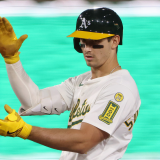
Kyler Murray, who backed up quarterback Baker Mayfield, the No. 1 pick in this year's NFL draft, was selected with the No. 9 pick by the Oakland Athletics on Monday. Murray plays baseball for Oklahoma as well -- he hit .296/.398/.556 with 10 home runs in 226 plate appearances this year -- and he's a premium athlete with explosive tools. He is raw, however, which is not surprising for a kid who's split his time between two sports.
Murray is slated to replace Mayfield as Oklahoma's starting quarterback later this year and that really complicated his baseball draft stock. Would he sign or would he turn stick with football? Selecting Murray and not signing him would mean forfeiting the bonus pool money associated with his draft pick, and teams these days don't risk those precious bonus pool dollars. They take players they know they can sign.
The A's, who have emphasized acquiring young players with star-caliber upside in recent drafts and trades -- they simply can't afford players like that in free agency, so they have to develop their own -- are willing to compromise to bring Murray into the organization. They'll let him play quarterback in the fall and begin his baseball career next year. From Susan Slusser of the San Francisco Chronicle:
"The risk of the football, in our opinion, was outweighed by the upside on the baseball field," (A's scouting director Eric) Kubota said. "We're totally on board with his desire to play quarterback at Oklahoma and frankly, we're kind of excited to be Oklahoma fans for 12 games. That's not easy for a Cal guy to say."
It is not unprecedented for a baseball team to let a prospect play football. Kyle Parker, a first round pick by the Rockies in 2010, was allowed to continue playing college football at Clemson after turning pro as a baseball player. Back in the day the New York Yankees let Drew Henson split his time between baseball and football. This has been done before.
Murray is not a significant NFL prospect -- he's a 5-foot-11 quarterback who hasn't played a whole lot the past few years -- so the A's don't have to worry about him pulling a Henson and wanting to play football full-time. Murray will play out his senior year with the Sooners this fall, then join the Athletics as a full-time baseball player in 2019. For Oakland, it's a chance to add a top end talent to their organization. All they had to do was compromise a little with the football thing.
The Rays drafted another two-way player
Los Angeles Angels wunderkind Shohei Ohtani is currently having tremendous success as a two-way player at the big league level, hitting .289/.372/.535 with six homers in 129 plate appearances while throwing 45 1/3 innings with a 3.18 ERA. He's been incredible.
In the minors, the Rays have baseball's next two-way player in Brendan McKay, the No. 4 pick in last year's draft. McKay, a first baseman/left-handed pitcher, is hitting .238/.446/.307 in 139 plate appearances and has thrown 41 2/3 innings with a 1.51 ERA and a 59/3 K/BB in Class A ball. On Monday, Tampa drafted another two-way player.
The Rays intend to send their comp round B pick, Tanner Dodson, out as both a pitcher and outfielder.
— keithlaw (@keithlaw) June 5, 2018
Dodson, the No. 71 pick in the 2018 draft, played both ways at Berkeley as an amateur. This spring he hit .320/.384/.386 with one homer in 255 plate appearances while throwing 40 innings with a 2.48 ERA and a 35/7 K/BB. Dodson saved 11 games as the team's closer. Ohtani and McKay are starting pitchers.
The Rays are a team that has to squeeze every last drop of value from their 25 MLB roster spots to compete in the AL East, and they are trying like crazy to develop a two-way player to create maximum roster flexibility. A starter who can hit the days between starts like McKay (and Ohtani) would be ideal. An outfielder who can pitch in relief like Dodson would be pretty cool as well.
Welcome to the 21st century
Ready to feel old? For the first time in baseball history, a player born in the year 2000 was drafted Monday night. Five of them, to be exact. The St. Louis Cardinals made history by selecting Arizona high school third baseman Nolan Gorman with the No. 19 pick. His date of birth: May 10, 2000. Here are the five 2000s kids:
- St. Louis Cardinals: Arizona HS 3B Nolan Gorman (DOB: 5/10/2000) drafted 19th overall
- Boston Red Sox: Florida HS 3B Triston Casas (DOB: 1/15/2000) drafted 26th overall
- Cleveland Indians: Ontario HS C Noah Naylor (DOB: 2/21/2000) drafted 29th overall
- Tampa Bay Rays: Indiana HS OF Nick Schnell (DOB: 3/27/2000) drafted 32nd overall
- Cleveland Indians: Georgia HS RHP Ethan Hankins (DOB: 5/23/2000) drafted 35th overall
Later this summer, when the 2018-19 signing period for international amateurs opens July 2, teams will begin signing kids born in 2002. Good gravy.
The top remaining players
In the bonus pool era, talent comes off the board much more linearly. The best players go high in the draft, as it should be. That wasn't always the case. Back in the wild west days when teams could spend whatever they wanted on draft picks, players would float huge bonus demands and try to finesse their way down to their preferred team. That doesn't really happen anymore.
Because of that, there are no elite draft prospects still on the board. Here are the five best available prospects heading into rounds 3-10 on Tuesday, according to MLB.com:
- Georgia HS RHP Cole Wilcox (MLB.com rank: 19th)
- Georgia HS RHP Kumar Rocker (MLB.com rank: 23rd)
- Stanford RHP Tristan Beck (MLB.com rank: 35th)
- Pennsylvania HS OF Mike Siani (MLB.com rank: 40th)
- Texas HS RHP Adam Kloffenstein (MLB.com rank: 43rd)
Mostly high school players. At this point, either those players will be drafted by teams with extra picks and thus extra bonus pool money (Rays, Royals, San Diego Padres, Chicago Cubs, among others) or they're going to college. When a projected first round high schooler is still on the board going into round three, it usually means he wants a lot of money and teams are either unable or unwilling to meet his demands.