Blue Jays 2021 season preview: Projected lineup, rotation and three questions as George Springer joins Toronto
Toronto is looking build upon a bounce-back season in 2020

By
Dayn Perry
•
6 min read
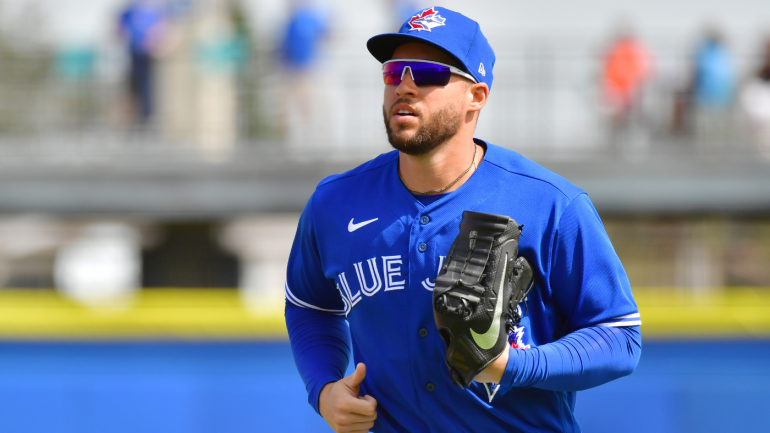
The Toronto Blue Jays' rebuild yielded fruit a bit ahead of schedule last season. Across the abbreviated, pandemic-compromised 60-game slate, they triumphed at a .533 clip, which scales to an 86-win pace across the usual 162. As well, the Jays qualified for the expanded postseason, which meant they were a part of the playoff fray for the first time since 2016.
Coming off that resurgent season and buoyed by an active winter that saw the Jays add to the fold the notable likes of George Springer, Marcus Semien, Steven Matz, Kirby Yates, and Tyler Chatwood. As such, expectations are high for Toronto going into 2021, even against the hotly contested backdrop of the AL East. Now let's take a deeper dive into the state of the Jays heading into this crucial season.
Win total projections, odds
- 2021 Sportsline projection: 85-77
- World Series odds (via William Hill Sportsbook): +2200
- 2020 record: 32-28
Projected lineup
- George Springer, CF
- Marcus Semien, 2B
- Bo Bichette, SS
- Teoscar Hernandez, RF
- Vladimir Guerrero Jr., 1B
- Cavan Biggio, 3B
- Lourdes Gurriel Jr., LF
- Rowdy Tellez/Randal Grichuk, DH
- Danny Jansen, C
Bench: Alejandro Kirk, C; Tellez/Grichuk, OF/DH; Joe Panik, INF; Jonathan Davis, OF
The Blue Jays' offense last season ranked third in the AL in runs scored, fourth in OPS, and tied for fourth in OPS+ (which is OPS adjusted to reflect league and home ballpark conditions). So it was a strength, and that's before adding the likes of Springer to the mix. As well, the addition of Semien means that Biggio can be the primary at third base, which was a weak spot in 2020.
Of possible note is that TD Ballpark in Dunedin, Florida, where the Blue Jays thanks to the ongoing pandemic will play their home games for at least the early weeks of the regular season, has a short power alley in right-center. The Jays' lineup is pretty heavily right-handed, so going the other way could be of particular benefit. Manager Charlie Montoyo now has the depth to run a Tellez-Grichuk platoon at DH, which could be a nifty arrangement.
Projected rotation, bullpen
- Hyun-Jin Ryu, LHP
- Nate Pearson, RHP
- Robbie Ray, LHP
- Steven Matz, LHP
- Tanner Roark, RHP
Bullpen: RHP Kirby Yates, RHP Jordan Romano, RHP Rafael Dolis, RHP Tyler Chatwood, LHP Ryan Borucki, RHP David Phelps, RHP Ross Stripling, RHP A.J. Cole
Pitching and defense were not the Jays' strength in 2020. The staff ranked 11th in the AL in runs allowed per game, 10th in ERA, 10th in ERA+ (ERA adjusted for league and home ballpark conditions), and 11th in FIP (what an ERA might look like if you try to remove luck and defense from the mix). Broadly speaking, the Toronto rotation fared a bit better than the bullpen.
While the Jays' most conspicuous additions this winter fortified the lineup, they also added Matz to the rotation and Yates, Chatwood, and Phelps to the bullpen. A.J. Cole and Francisco Liriano are also potentially interesting non-roster invitees who could help the pen. As well, replacing Grichuk with Springer in center should substantially improve the outfield defense, and Semien should adapt well to second given that he's a quality defensive shortstop (and make the infield defensive arrangement flow better).
Now for three Jays-related questions -- burning in some cases, merely warm to the touch in others -- to ponder as the 2021 season approaches.
1. Can they navigate the 'plexiglass principle'?
As Bill James discovered long ago with regard to matters baseball, teams swing significantly in one direction or the other in one season tend to drift back toward the middle in the subsequent season. He called it the plexiglass principle, and the Blue Jays should possibly be concerned about it in 2021.
Last season, Toronto as noted won at a .533 clip. In 2019, however, they lost 95 games, which was good for a win percentage of just .414. So that's a major leap forward they enjoyed last season. The concern is that the momentum won't be maintained and they could slip back to the .500 mark and miss the compressed 10-team playoff field. To be sure, the Jays worked against James' law by investing in the roster this winter, but is it enough to erase all that regression risk? Compounding those concerns is that the Blue Jays last season had a negative run differential, which suggests they were a bit fortunate to finish four games above .500.
2. Is Vladito ready to take the next step?
Guerrero arrived in the majors as a ballyhooed prospect with Hall of Fame bloodlines and an unassailable record of performance in the minors. He's been darn good thus far -- a 109 OPS+ across two seasons, and he's still just 22 years of age. However, we're all waiting for Guerrero to take that next step toward stardom.
We've all seen the photos of a trimmed-down Guerrero, which further tantalizes. And there's no question that he hits the ball hard. In 2020, for instance, he was in the top seven percent of MLB in average exit velocity and hard-hit rate. Yes, the sample size is small, but those are indicators that stabilize and become meaningful very early. So he's got youth, pedigree, the ability to hit the ball hard, and some success against the best pitchers in the world. So what's the hand-wringing for? Really, it's over Guerrero's launch angle and how it affects his ability to hit for power.
For power purposes, the ideal launch angle, which is the vertical angle at which the ball leaves the bat on contact, is between 10 and 30 degrees (provided you're hitting the ball hard). Guerrero in his rookie season of 2019 had an average launch angle of 6.7 degrees. Last season, that figure fell to 4.6 degrees, which is firmly in ground ball territory. In matters related, Guerrero in his young career has a ground ball percentage of 51.8, which is well above the league average mark of 45.3. If you have blazing speed and aren't capable of hitting the ball all that hard, then a high ground ball rate might actually be a good thing. That, however, does not describe Guerrero Jr.
If you look at Guerrero's swing, you'll find that he has his arms stacked properly at contact, which indeed should help elevate the ball. For whatever reason, though, it's not translating into consistent hard-hit balls in the air. Maybe it's consistency, or maybe it's difficulty getting on plane with the pitch. Specifics aside, Guerrero will need to fix this if he's going to tap into the home run power that he ought to have. He can still be a quite useful hitter with his current profile, but those MVP expectations may never be realized if he doesn't start hitting more balls over the fence. Whether the 2021 season, which it should be noted will be Guerrero's first full campaign in the majors, brings about adjustments on this front will be interesting to watch. Or, heck, maybe he's so good he'll just start hitting home runs despite all that.
3. What can they expect from the back of the rotation?
You saw the less-than-optimal 2020 rotation numbers above. Is there really hope for improvement in 2021? Without question, Ryu is capable of ace-level results, but he's managed a qualifying number of innings just twice in eight years. Last season was the first since 2013 that Ryu managed to avoid the injured list, but last season also spanned just 12 starts for him. He remains an injury risk.
Nate Pearson certainly has upside, but he missed more than a month last season with a flexor strain, which suffice it to say is a concerning injury for a young hurler who sniffs 100 mph with his fastball. Pearson then suffered a groin strain in his first start of spring training. With just 18 MLB innings under his belt, Pearson also offers no guarantee that he's ready to thrive at the highest level, even assuming health.
There's some depth in numbers, but do the likes of Ray, Roark, Stripling, and Matz inspire confidence? Confidence enough to assume contention while playing an unbalanced schedule in the AL East? This is a rotation light on known quantities, and not much was done to address that critical situation this offseason. This is pretty plainly the Blue Jays' soft underbelly in 2021, and how the rotation fares may play a determinative role.