
2025 World Series: What to know about Dodgers' payroll, including Shohei Ohtani's deferrals
The Dodgers may be the Goliath of MLB, but the Blue Jays aren't far behind in payroll

•
6 min read
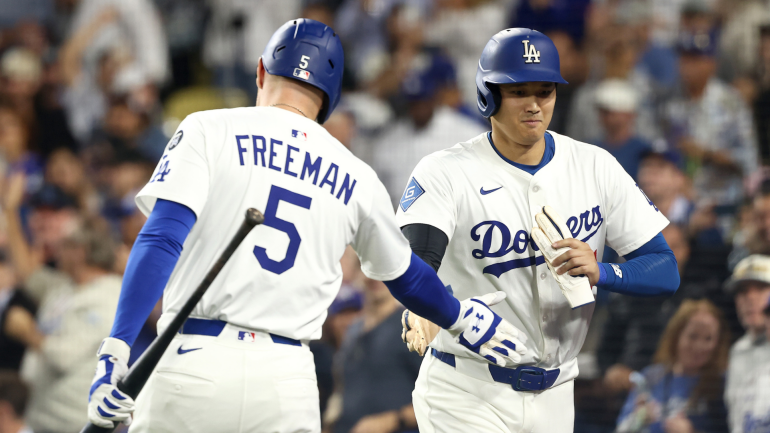
The 2025 World Series is just hours away from getting underway. Later tonight, the Los Angeles Dodgers and Toronto Blue Jays will begin their best-of-seven series to determine this year's champion. The Dodgers are looking to become MLB's first repeat title winner since the New York Yankees won three World Series in a row from 1998-2000. The Blue Jays, conversely, are hoping to bring home their first World Series victory since winning both the 1992 and 1993 World Series.
One narrative about this series that has already taken grip theorizes that a Dodgers win would increase the likelihood of a prolonged lockout once the 2027 season ends. The theory is that the other owners will be enraged by the Dodgers' success in light of their runaway spending, and that they'll do what it takes -- even if it means losing a whole season -- to install a salary cap once and for all.
While that storyline adds stakes, it ignores some crucial information -- like how owners have been pushing for a salary cap for decades, to the extent that it would be more notable if the owners went through a collective bargaining cycle without wanting a cap. The Blue Jays themselves are financially mighty too.
Predictably, the Dodgers were already being asked about their payroll before taking the field for the World Series.
"I can't speak to what revenue we're bringing in, but our ownership puts it back into players, a big chunk of it," manager Dave Roberts said during the NLCS. "That's the way it should be with all ownership groups."
It's an appealing storyline, because there's few things baseball fans love to argue about more than the salary cap. You're never going to change anyone's mind on the matter, regardless of how much data you have in your favor demonstrating that salary caps do not promote parity in other leagues. Patrick Mahomes, LeBron James, and Nikita Kucherov all have multiple rings despite the supposedly ultimate financial equalizer being in place.
So, is the quest for a salary cap about competitive balance? Is it about suppressing wages? Smoothing future costs? Or is it about something else entirely? That's for each individual to answer on their own, but it's not too tough to guess what most owners would say if they were first given a taste of truth serum.
Clearly, though, the Dodgers' payroll is going to remain a talking point for the next four to seven games (and beyond. With that in mind, let's attempt to answer four of the biggest questions you might have about the matter.
1. How much are the Dodgers spending on payroll?
This may read like a cop-out answer, but it's the truth: It depends.
There are several public estimates of team spending available online, but they tend to differ in both their methodology and their output. To wit, Cot's Contracts had the Dodgers' year-end 40-player roster payroll around $331 million. FanGraphs and Spotrac's estimates were higher, putting the Dodgers closer to $400 million.
If you're just curious about the Dodgers' luxury tax payroll, which uses average annual value, then Cot's pegs them at a little over $400 million. The resulting tax bill, with overage and multiplier fees included, comes out to about $154 million.
In other words, the Dodgers' commitment to winning another title has led them to forking over more money on their luxury tax than about a third of the league is on their 40-player payroll. Among that group: three playoff teams, in the Milwaukee Brewers, Cincinnati Reds, and Cleveland Guardians.
2. Where does the Dodgers' spending rank in MLB?
Again, acknowledging that different publications use different methodologies and therefore have different numbers, it's fair to write that the Dodgers have one of the highest payrolls in the majors.
Cot's had them in first by about $8 million more than the New York Mets, while Spotrac had them trailing the Mets by about $3 million. Either way, the Dodgers are up there.
Highest-paid Dodgers players in 2025, per Cot's Contracts
- RHP Tyler Glasnow, $32.5 million
- TWP Shohei Ohtani, $28.2 million
- LHP Blake Snell, $26.8 million
- SS Mookie Betts, $26.2 million
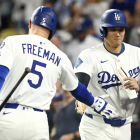
- 1B Freddie Freeman, $22.7 million
The Blue Jays are too, mind you. Both Cot's and Spotrac had Toronto with the sport's fifth-highest payroll. It's always nice when the sources agree on something.
3. What's the deal with the Dodgers and deferrals?
The Dodgers are not the only team to defer money. They weren't the originators or the popularizers of the strategy. The Washington Nationals of yesteryear made it a habit, and there's a reason why Bobby Bonilla receiving a check from the New York Mets became a running joke.
Any team can do this, and many of them do, albeit without the same level of scrutiny. (Be honest: did you know that Kyle Finnegan had deferred money? What about Alex Bregman? Anthony Santander?) If you need more evidence that deferrals are not just a Dodgers thing, consider that Andrew Friedman would use them when he was running the Tampa Bay Rays. In one such case, Friedman agreed to a contract with retired lefty David Price that helped Price avoid a federal tax hike. How's that for a player-friendly executive?
Without getting too far into the weeds on discount and marginal tax rates and all that jazz, there are some advantages for both sides of the equation.
One of the main benefits for the team is that they can shave some money off of their luxury tax payroll. "Some" is the operative term here. Yes, Shohei Ohtani's tax figure is only $46 million (as opposed to what his $70 million AAV suggests), but he's the exception rather than the rule. Most cases are like Tanner Scott, where the Dodgers are cutting a million here or there.
As for the players … foremost, yes, they can potentially improve their take-home amount through clever structuring. (To be fair, the Dodgers do face a natural disadvantage when it comes to marginal tax rate, so it can be argued that this is a way of countering that dynamic.) There's also the ego side, and who can blame them? Saying you signed for $700 million is more impressive than saying you signed for literally any number below $700 million.
4. What led Sasaki to sign with the Dodgers?
Clearly the Dodgers have no qualms about paying talent their market value. You may wonder, though, just how they were able to convince right-hander Roki Sasaki to join them last winter without having sheer financial might at their disposal. (Sasaki has since salvaged a disappointing, injury-ravaged rookie season by closing out games in the playoffs.)
Sasaki, a brilliant young pitcher with an impressive track record in NPB, did not meet the age or service time requirements for MLB to recognize him as a standard free agent when he was posted in December 2024. Instead, he was classified as an amateur, meaning he would be subjected to making the league minimum until he became arbitration eligible. Furthermore, teams could pay him a signing bonus only worth as much as they had in their international bonus pools.
MLB rules allow teams to trade for additional international bonus pool money, but the Dodgers found themselves at a clear disadvantage ahead of Sasaki's decision.


Indeed, these Blue Jays happened to be one of the other key teams the Dodgers outmaneuvered to land Sasaki. Toronto's front office absorbed outfielder Myles Straw's then-undesirable contract from the Cleveland Guardins to add a couple million more to their international bonus pool fund, running their available total to more than $8 million. Yet Sasaki still decided to sign with the Dodgers, who struck a few trades afterward so that they could afford a $6.5 million signing bonus.
While no one can say for certain what motivated Sasaki to join the Dodgers, some of the obvious explanations include Los Angeles' winning ways; reputation as a player-development juggernaut; and continued employment of Ohtani and Yoshinobu Yamamoto, two of Sasaki's Team Japan teammates. Whyever Sasaki put the Dodgers over the Blue Jays, he'll now have a chance to do it again -- this time with a World Series title hanging in the balance.