NL West X-factors: Yu Darvish's new digs, Madison Bumgarner's declining velocity and more
For the first time in a long time, the Dodgers have legitimate competition at the NL West

By
Mike Axisa
•
8 min read
The 2021 MLB season is fast approaching, and because there will be no expanded postseason this year, playoff spots will be at a premium. Three division winners and two wild card teams in each league, and that's it. Chances are this is the last time we'll see this postseason format, so enjoy it while you can. Personally, I love the chaos of the Wild Card Game.
The current postseason format creates a significant incentive to win the division. With that in mind, we're going to preview each division race and break down the potential X-factors between now and Opening Day, concluding today with the NL West. Here is one 2021 X-factor for each NL West club, listed alphabetically.
Arizona Diamondbacks: Bumgarner's velocity

Last year was close to the worst-case scenario for Madison Bumgarner, Arizona's $85 million ace. Bumgarner admitted he did not throw as much as he should have during the shutdown -- he was hardly alone and it had to do with the uncertainty about when the season would start back up -- and the result was reduced velocity and a 6.48 ERA with only 30 strikeouts in 41 2/3 innings.
Bumgarner's monthly velocity graph is, in a word, alarming:
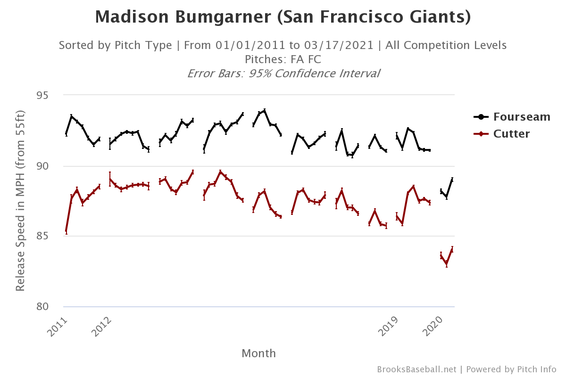
These days Bumgarner uses a cutter as his primary fastball and last year it averaged 83.7 mph. In 2019, he did not throw a cutter below 83.4 mph. When your average velocity one year is barely above your minimum velocity the previous year, it's cause for concern, especially when there are four years and $79 million remaining on your contract.
Bumgarner has made two Cactus League starts this spring (he also faced hitters in a simulated game to avoid facing the division rival Dodgers) and Statcast says his velocity is still down relative to 2019:
| Four-seam average velocity | Four-seam max velocity | Cutter average velocity | Cutter max velocity | |
|---|---|---|---|---|
March 4 | 90.2 mph | 91.1 mph | 84.0 mph | 84.5 mph |
March 16 | 88.0 mph | 89.5 mph | 83.8 mph | 86.3 mph |
Velocity is not everything but it's not nothing either. The harder you throw, the less time the hitter has to react, and the more your offspeed pitches play up. Bumgarner is 31 now and he has a ton of innings on his arm, so velocity loss is expected at this point in his career, but not this much. Sitting mid-to-upper-80s with a few low-90s is worrisome.
Of course, it is only spring training, and Bumgarner could continue to build arm strength as the season progresses. Velocity typically peaks in July and August, when it's nice and hot outside. Bumgarner's days of throwing 93-95 mph are almost certainly over. Can he get his four-seamer in the 90-92 mph range and his cutter in the 87-89 mph range though? That'd be a big help.
The D-Backs are facing an uphill battle in the NL West. Their best-case scenario is the second wild card spot in all likelihood, and it's hard to see them getting there with Bumgarner being something less than league average. Even if he's great, they might not get to the postseason. If he struggles through another poor year, it'll all but sink their already slim chances.
Los Angeles Dodgers: Lux's breakout?


The defending World Series champions have the deepest roster in baseball, and while they're not immune to underperformance or injuries, they are better equipped to deal with them than most teams. Their rotation depth is insane (Dustin May and Tony Gonsolin are at best sixth and seventh on the depth chart) and bench players Matt Beaty and Edwin Rios are sneaky good.
For Los Angeles, the biggest X-factor this year is Gavin Lux, who ranked among the top prospects in the game at this time last year. Swing and throwing issues landed him at the alternate site most of the season, and when he was called up, he wasn't all that productive. Lux went 11 for 63 (.175) last year is a .210/.278/.377 hitter in 151 career big-league plate appearances.
On one hand, Lux turned only 23 in November, and there's no shame in having not yet established yourself at the big-league level at that age. On the other hand, give the Dodgers a truth serum and I think they'd tell they would've expected Lux to have emerged as the starting second baseman by now given the prospect hype two years ago. Instead, he's still an unknown.
The Dodgers have a great offense and they can let Lux work through the learning curve as the No. 8 hitter, and not worry if he starts slow. And, if he proves he's not up to the task, they can plug Chris Taylor in at second, or even Max Muncy. He's played the position in recent years. Lux won't make or break the season, but he has the potential to make the Dodgers even more of a juggernaut.
San Francisco Giants: An aging offense


When Farhan Zaidi took over as president of baseball operations two years ago, I don't think many would've guessed the Giants would have the oldest projected roster in baseball in 2021. On days Mauricio Dubon sits, San Francisco could start an entire lineup of players in their 30s. At a time when every team is zigging toward youth, the Giants are zagging toward, uh, experience.
Zaidi added more 30-somethings (Curt Casali, Tommy La Stella) to an aging lineup that was pretty good last year. They scored 4.98 runs per game, eighth most in baseball, and their team 115 OPS+ was sixth best in baseball. San Francisco also scored 29 runs in a two-game series at Coors Field. They averaged 4.65 runs per game in the other 58 games, exactly the MLB average.
Old doesn't automatically equal bad even though teams treat players in their 30s like lepers these days. Mike Yastrzemski is a bona fide star-caliber producer, Donovan Solano and Alex Dickerson are productive, and stalwarts like Buster Posey and the Brandons (Crawford and Belt) still contribute. Gone are the days when an early 3-0 deficit was insurmountable at Oracle Park.
The Giants tied the Brewers for the No. 8 postseason spot last year but Milwaukee held the tiebreaker, so they went to the dance and San Francisco went home. In all likelihood, the best-case scenario for Zaidi & Co. this year is the second wild card spot, and to secure that, they'll need this aging offense to produce like it did last year, two-game series at Coors Field included.
San Diego Padres: Adjustment periods


Give the Padres credit, they loaded up this offseason at a time when it would have been easy to stay the course and focus on the long-term. The Dodgers are a powerhouse and San Diego isn't shying away from the challenge. Will they win the NL West? Maybe! The Padres are much more likely to do so now than six months ago.
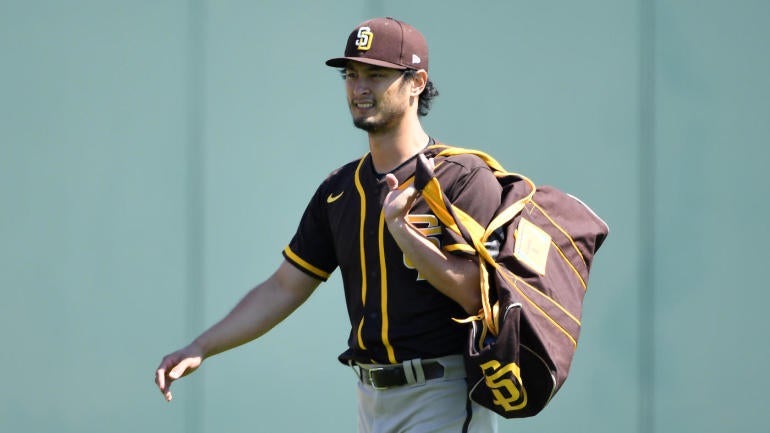
It's not uncommon for players, even established veterans, to struggle a bit or have a down season after joining a new team. In San Diego's case, two new additions going through adjustment periods could very well determine whether they push the Dodgers for the division title, or settle for a wild card spot. Those two players: Yu Darvish and Ha-Seong Kim.
Darvish has a bit of a history of struggling when he joins a new team. His worst season with the Rangers was his first (it wasn't bad, it just wasn't as good as his other years in Texas) and his worst season with the Cubs was his first. He also underwhelmed during his short stint with the Dodgers, particularly in the postseason. There's a history of an adjustment period here.
Kim is joining a new team in a new country (in the middle of a pandemic), and he's moving into a new super utility role too. That's a lot to take in. The history of Korean position players in MLB is very short (Shin-Soo Choo is by far the best, though he came over as a teenager and developed in the minors), with Jung Ho Kang the most obvious comparison. Kang hit the ground running in his first year as a big leaguer. The Padres hope Kim can do the same.
The Padres have enough depth that they don't need Darvish to be a Cy Young runner-up or Kim to be an All-Star level infielder right away. The rotation is plenty deep and Jake Cronenworth is more than capable of stepping in at second base alongside Fernando Tatis Jr. and Manny Machado. That said, San Diego's best chance at taking down the Dodgers involves Darvish and Kim having short (or no) adjustment periods and contributing immediately and substantially.
Colorado Rockies: The seemingly inevitable Story trade


It's a matter of when, not if, right? The Rockies traded franchise icon Nolan Arenado not long before spring training, and it stands to reason star shortstop Trevor Story will be next to go. Colorado is unlikely to contend this season (SportsLine gives them less than a one percent chance to make the postseason), so the Rockies have three options:
- Sign Story to a long-term extension.
- Keep Story and get a draft pick when he leaves as a free agent after the season.
- Trade Story for a package of young players.
The Rockies do have a history of paying big to keep their own (Arenado, Carlos Gonzalez, Todd Helton, Troy Tulowitzki, etc.), so we can't completely rule out a Story extension, but nah. Story had a front row seat for the Arenado drama, and why would he commit to a team that pretty clearly isn't committed to contending? Hard to see an extension as a real possibility.
Keeping Story and letting him leave as a free agent would be a mistake. Whatever he can net them in a trade will be much more valuable than a single draft pick. Eventually the Rockies will come to their senses and trade him. The Athletics, Brewers, Giants, and maybe even the Rays stand out as potential suitors for Story. Injuries could always push other teams into the mix.
Whenever the Story trade goes down, it will affect the NL West race, because he's a legitimate impact player. If Colorado trades him during the All-Star break, they'll play more games without him against the Dodgers than the Padres. If they trade the week before the deadline, they'll play more games without him against the Padres than the Dodgers. And, if they trade him right at the deadline, they'll play an equal number of games against the Dodgers and Padres without him. The timing of the trade is an X-factor.