World Series: Breaking down the Nationals' six-run inning that swung Game 2 and the series in their favor
The Nationals scored six runs in the seventh inning to win Game 2 -- five came with two outs

By
Mike Axisa
•
8 min read
HOUSTON -- Game 2 of the World Series had the look of a tight, thrilling postseason game. And that's exactly what it was for the first six innings. By the end of the game, the stands were half empty and the Nationals were celebrating a blowout win to take a 2-0 series lead over the Astros (WAS 12, HOU 3).
The score was tied 2-2 going into the top of the seventh inning and the Astros had just blown a golden run-scoring opportunity in the bottom of the sixth. Stephen Strasburg struck out Kyle Tucker with his 114th and final pitch to end the inning and strand two runners. After that, the Nationals went on the offensive. Let's break down the six-run rally that gave the Nationals a Game 2 win.
Suzuki's leadoff homer
It's been a long time since anyone called Kurt Suzuki "Kurt Klutch," the nickname he earned after starring with Team USA and at Cal State Fullerton as an amateur. In Game 2, he brought the nickname back with a go-ahead solo home run against Justin Verlander in the seventh inning. Tucker struck out to end the sixth, and two pitches later Washington had a 3-2 lead.
"It's was fun to watch. Offense kind of came out, scored a lot of runs," Strasburg said about the seventh inning rally. "I think the big one was Suzuki there in the seventh to kind of give us that lead, and everything started to get a lot better after that."
Interestingly enough, Verlander was pitching to Martin Maldonado for the first this season in that seventh inning. Robinson Chirinos was Verlander's personal catcher this year -- Chirinos caught every single Verlander pitch in 2019 up until the seventh -- but manager A.J. Hinch pinch-hit Tucker for Chirinos in the sixth inning, so Maldonado had to take over behind the plate.
Back-to-back walks
Did Verlander and Maldonado have trouble getting on the same page? The Suzuki home run came on a poorly located fastball, then Verlander fell behind in the count 3-0 on the next batter, Victor Robles. He eventually walked him on seven pitches. Either way, issues with Maldonado or not, the Robles walk ended Verlander's night. He threw 107 pitches.


Justin Verlander
View Profile
SF • SP • #35
2019 World Series Game 2 vs. Nationals
IP6
H7
R4
ER4
BB3
K6
HR1
"First off, Maldonado has caught him before (last season) and I doubt that had anything to do with the fastball to Suzuki," Hinch said after Game 2. "You have to ask Justin if it bothered him. With Tucker coming up in that spot, Strasburg is at the end of his rope. Try to win the game."
The first arm out of the bullpen was ace setup man Ryan Pressly, who has been anything but ace-like in the postseason. He had knee surgery late in the season -- Pressly was questionable for the World Series roster after stumbling and aggravating the knee in Game 6 of the ALCS -- and has struggled in the postseason, allowing four runs and 10 baserunners in 2 2/3 innings in the ALDS and ALCS.
Pressly walked Trea Turner, the first batter he faced, on six pitches to put two on with no outs. The at-bat was not particularly competitive. Three of the four balls were well out of the strike zone and easy takes.
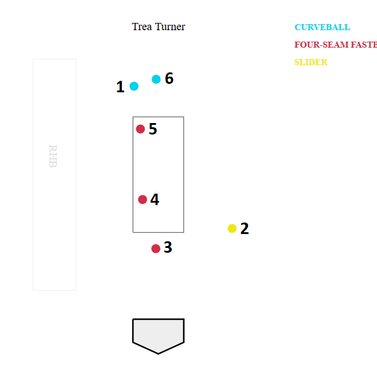
"I brought Press in to throw some sliders to Turner, give him a different look the fourth time through the order," Hinch said. "That led to a walk."
The Turner walk was only the start of Pressly's problems in the seventh. The inning got away from him and the Astros in a hurry.
To bunt or not to bunt?
Adam Eaton really likes to bunt, huh? His nine sacrifice bunts during the regular season were second most by a non-pitcher, trailing only White Sox utility man Leury Garcia (11). Eaton tried to lay down a sacrifice bunt in the first inning of Game 1 and it didn't work. Now, with two on and no outs in the seventh inning of Game 2, another bunting opportunity presented itself.
On one hand, Pressly had just walked Turner and has struggled all postseason, so I can understand swinging away and seeing if you can turn it into a big inning. On the other hand, one run in a game of this magnitude is potentially huge, and getting that runner to third with less than two outs is a big deal. That insurance run can make a world of difference.
Sure enough, Eaton bunted the runners up, but Anthony Rendon could not get the runner home from third. He flew out to medium center field and Robles did not even attempt to score. George Springer made a strong throw to plate. The Nationals went from runners on first and second with no outs to runners on second and third with two outs in a hurry.
The Astros issued an intentional walk!
This is notable because the Astros did not issue a single intentional walk during the regular season. Intentional walks became an official statistic in 1955 and the 2019 Astros are the first team in history to go an entire season without issuing a single intentional walk. Pretty crazy, huh?
The intentional walk went to Juan Soto after Rendon's fly out. I mean, duh, right? Soto hammered the ball in Game 1 and first base was open. Howie Kendrick was the NLCS MVP, sure, but he didn't have great at-bats in Game 1, and you'd rather take your chances with him than Soto. I understand it.
"No, he's seeing the ball really well right now, he's swinging the bat really well," Nationals manager Dave Martinez said when asked whether he was surprised to see an intentional walk. "I had a feeling once first base was open that they'd walk him. But again, that's okay. We have Howie behind him who's been unbelievable."
The intentional walk backfired. Kendrick hit a chopper to the shortstop hole and Alex Bregman could not corral it as he went to his left. He booted the grounder -- it was scored an infield hit -- allowing a run to score and the inning to continue. The Nationals had their insurance run. They were up 4-2.
"I've watched Soto just like you have. We see the downside of (the intentional walk)," Hinch said. "Clearly I think there's a lot of downside given that I haven't done it all year. But ironically, I thought it was our best chance to limit their scoring, and instead it poured gasoline on a fire that was already burning."
"You want to get the job done. Not that Juan doesn't or anybody else, but each guy wants to try to get it done," Kendrick said when asked what it's like to have the hitter in front of you intentionally walked to load the bases. "When you have that happen in front of you, they're doing it for a reason. I haven't been swinging the bat as well as Juan was. I get it. At the same time, we can all be dangerous at any time."
Cabrera breaks it open
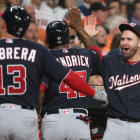
Asdrubal Cabrera, who played second base in Games 1 and 2 with Kendrick shifting to DH, had some pretty poor at-bats against Verlander. I mean, lots of guys have poor at-bats against Verlander, but Cabrera's were especially bad. He struck out swinging on fastballs in the first, fourth, and sixth innings against Verlander.
With the bases loaded and two outs in the seventh, Pressly used his breaking ball to get ahead in the count 1-2 on Cabrera, and it was easy to think another strikeout was coming. Instead, Pressly left a slider up just enough for Cabrera to poke it back up the middle for a two-run single. The Nationals took a 6-2 lead and the game was slipping away from the Astros.
"I've always said this: Strikeouts are not okay, regardless of what people say," Martinez said. "I don't believe in it. There's nothing that comes from it when you strike out. You're just going to walk back to the dugout. I believe in just putting the ball in play. Things happen when you put the ball in play, regardless. Regardless of whether you get a hit or not. But good things happen when you constantly put the ball in play. And we've got better at that. And tonight was a perfect example."
Bregman takes his slump to the field
Following Game 1, Bregman called himself out for his poor play this postseason. "I've been terrible this postseason ... Gotta figure this (expletive) out," he said. When he swatted the game-tying two-run home run against Strasburg in the first inning, it felt like Bregman was back. He got the big hit to get the monkey off his back, and it was time to do damage.
The damage came in the field, unfortunately for the Astros. Ryan Zimmerman hit a little tapper to third base, Bregman came in to field the ball, and his throw sailed wide of first base. Two runs scored on the play to give Washington an 8-2 lead, and the rout was on. Bregman finished the game 1 for 4 with the homer and a crucial error to help blow the game open.
"We'll take the luck when it happens," Kendrick said. "... Anytime you can make contact, it's a good thing, because when you put the ball in play anything can happen. Especially when you're on offense. It's about putting pressure on the defense. You get guys on base and things happen."
It was not a traditional pitchers' duel -- Verlander and Strasburg were both tagged for two runs in the first inning -- but the two aces settled down and put up zeroes in innings 2-6. The score was tied 2-2 going into the top of the seventh, then, in the span of 10 batters, the Nationals put six runs on the board, including five with two outs. That swung the game -- and the series -- in their favor.
"Every guy goes up, tries to put together really good at-bats," Kendrick said. "If one guy doesn't get it done, then it just seems like another guy steps up ... We don't rely on just one or two people. It's a team. That's what we've been doing all year."