Five early NBA surprises: Lakers, Rockets are good, Kemba Walker is a star
Meanwhile, Harrison Barnes has opened some eyes in Dallas

By
Brad Botkin
•
14 min read

We're almost a month into the NBA season, and a lot of things are going as expected. The Cavs are the best team in the East. The Warriors are cruising, winners of eight straight heading into Wednesday's rematch with the Lakers. Russell Westbrook and James Harden are lighting up the stat sheet. Even the Clippers' hot start I wouldn't classify as a surprise. If they get to the Western Conference finals, that would be a surprise.
But there are things happening that I don't think a lot of people saw coming.
Here are five of them from the early going.
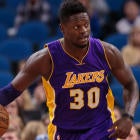
Who are these Lakers?
People forget, but it wasn't that long ago when the Golden State Warriors were a No. 6 seed that squeaked into the playoffs by a mere three wins only to be bounced in the first round by a Los Angeles Clippers team that was, in almost every way, better than them. This was in 2013-14, under then-head coach Mark Jackson.
Then, the very next year, with essentially the exact same roster, the Warriors won 67 games and the NBA championship. The only thing that changed was the coach.
Relatively speaking, that's what you're seeing with the Lakers this year. Sure, they added Luol Deng and the great ... Timofey Mozgov, but in large part they have the same roster as last year, and yet, under Luke Walton, they're an entirely different team than they were under Byron Scott. Does this mean they'll make the playoffs? No. Most likely, they won't even contend for the playoffs when the dust settles. But they're a different team. A markedly better team.
As of Wednesday, the Lakers are top 10 in 3-point attempts, 3-point percentage, true-shooting percentage, effective-FG percentage, offensive rating and defensive rating. They're also playing at the fifth-fastest pace in the league. (Matt Moore tells you everything you need to know about the Lakers here).
But in short, here's how things are going in L.A.:
The @Lakers pick up the W on @NickSwagyPYoung's clutch bucket! #LakeShowpic.twitter.com/kenV7jtvpj
— NBA (@NBA) November 23, 2016
Yeah, you know things are going swimmingly when Nick Young is hitting game-winners off passes that weren't even intended for him.
After his time on the Warriors' bench -- which of course included a 24-0 start to last year as the interim coach in Kerr's absence -- Walton has brought to the Lakers many of the base actions and ball-sharing principles he picked up in Golden State, even if L.A. hasn't mastered any of it, not by a long shot. But you can see the flow changing, and to that point, five Lakers are currently averaging better than 14 points per game -- D'Angelo Russell, Lou Williams, Julius Randle, Jordan Clarkson and Nick Young, the latter of which has actually turned into a veteran presence with a real-life interest in playing at least basic defense.
Meanwhile, Randle, who Walton says can be the Lakers' Draymond Green, has shown the ability to be the best player on the floor at times, at least offensively. (His defense is another story, but we'll save that for a more depressing day). Randle's scoring, shooting and assist numbers are all up considerably from last year, and I'm even taking his increased turnovers as a good thing, as Walton has empowered not just Randle, but all his young players to trust their talent and make plays, even putting the ball in Randle's hands as a perimeter initiator on occasion, much like Green does with Golden State.
I don't think Randle has star potential. I honestly don't think Russell does, either. But they can be good pieces on a good team, which the Lakers are looking more and more like with every game.
Walton has also made the right lineup moves. Clarkson struggled some to start as he adjusted to coming off the bench, but his 3-point shooting has spiked as of late and along with Lou Williams, he's giving L.A. some real second-unit punch.
You'd like to see the assists continue to climb. Right now the Lakers are a little over 21 per game, and you know that's an emphasis for Walton as this up-tempo, ball- and player-movement based offense continues to develop. You'd like to see Russell's low-40s shooting percentage improve. But these are details at this juncture of the Lakers' suddenly expedited rebuilding project. This now looks like a real foundation for a solid future -- one that, you know, might actually be able to at least get in the room with a marquee free agent to bring it all together.
Yes, the Lakers are headed in a legitimately exciting direction.
That's a surprise, at least this soon.
The Rockets are good
I thought the Rockets would be a tire fire under Mike D'Antoni. I'm still not convinced they won't end up that way. But so far, they've looked like a legit contender for a top-four seed in the Western Conference, and James Harden has been silly good (which, for the record, is not a surprise at all given his talent and D'Antoni's system).
Look, the Rockets are still a bottom-third defensive team. But they're not a joke, and they've shown an ability, and perhaps more importantly, a willingness, to defend with both principle and effort for at least stretches -- which, in theory, could prove to be just enough against a lot of teams given their offensive firepower.
It has been so far, at least.
And it's not just the defense that has looked different than I would say a lot of people expected under the notoriously run-and-gun happy D'Antoni. In fact, they're not even really running and gunning. Well, I take that back. They're absolutely gunning. Leading the league with over 35 3-point attempts per game.
But they're not necessarily running, at least not without cause, as they're smack dab in the middle of the pack in terms of pace. What they are doing is shooting the lights out -- 1st in 3-pointers made, 2nd in effective FG percentage, third in true shooting -- while running their offense through one of the best ball-in-hand creators we've ever seen in Harden.
Ultimately, we shouldn't get ahead of ourselves with this team. They did beat the Spurs in San Antonio, but they're 1-5 vs. plus-.500 teams, so for the most part they're taking care of business against average to below-average teams. Which talked about the improved-but-still-not-good defense, and though they're fourth in the league with over 24 assists a game, that stat can be deceiving as a lot of those are just one-pass assists from Harden rather than a product of real, sustainable ball-movement. This is especially true late in games, when Houston almost always devolves into a Harden isolation team.
Though who can blame them when he's cooking up things like this:
James Harden seals the deal for the @HoustonRockets! #Rockets50pic.twitter.com/6993SgxXsw
— NBA (@NBA) November 20, 2016
Straight filth. That's all that is.
If Houston can close out November with a couple road wins in either Sacramento, Portland or Utah, even if it loses to Toronto Wednesday night, Rockets fans would have to be ecstatic with 11 or 12 wins through the first month.
Kemba Walker is a star
I've always thought Kemba Walker was really good in the sense that when the ball is in his hands, I feel like he can get to wherever he wants, and when he misses, I'm generally surprised. The numbers have not always validated this visceral confidence, but this year they are.
At this point in the season, it would not be a stretch at all to include Walker in the MVP conversation. He wouldn't be at the top of that conversation, but he'd be pretty safely in the top 10 if they were to vote right now, and surely that's a surprise. He's dipped just below 25 ppg as of late, but it wasn't but a week ago that he and Stephen Curry were the only players in the league averaging better than 25 points and five assists while shooting 45 percent from both the field and three.
Pretty good company, that Curry guy.
Take a look at the highlights from Walkers 30-point, six-assist, five-rebound, five-steal night against Minnesota:
30 points, 6 assists, 5 rebounds & 5 steals for @KembaWalker as @Hornets win in Minnesota. #BuzzCitypic.twitter.com/bUN0wNKMA0
— NBA (@NBA) November 16, 2016
The most obvious difference in Walker's game this year is the shooting. You're talking about a career 33-percent 3-point shooter who is over 41 percent this year, and a career 40-percent shooter from the field who's currently at 47 percent. His effective FG percentage has never been over 50 percent before; this year it's 55 percent. Walker has always been able to score, but this year he's doing it more efficiently, and effectively, averaging nearly 27 points and six assists per 36 minutes while taking roughly three more shots per night than his career average.
In short, Walker is playing like he's the best player on the floor, and a lot of nights he's been exactly that. Even when he's not the best player, he's playing like he's the best, and that's important. He's aggressive. His teammates are trusting him to carry them offensively, and yet he's not trying to do it all on his own. He's become a real leader, cognizant of traditional point guard responsibilities while maintaining his natural scorer's instinct, intent on keeping the ball moving and making plays not just for himself but for everyone.
That kind of equitable approach from your best player is contagious. It is not a coincidence, after all, that over 65 percent of Charlotte's field goals this year have come courtesy of an assist, which is the second-highest mark in the league, trailing only Golden State's 71.6 percent.
It is also not a coincidence that the Hornets, small sample size notwithstanding, are looking like a top-3 team in the East. They've been a trendy team on the rise for a while now, and the East, I don't care what anyone says, is still weak outside the Cavs, but it still sounds weird to talk about Charlotte in that kind of light.
Without Kemba, they're the Hornets/Bobcats we're used to talking about.
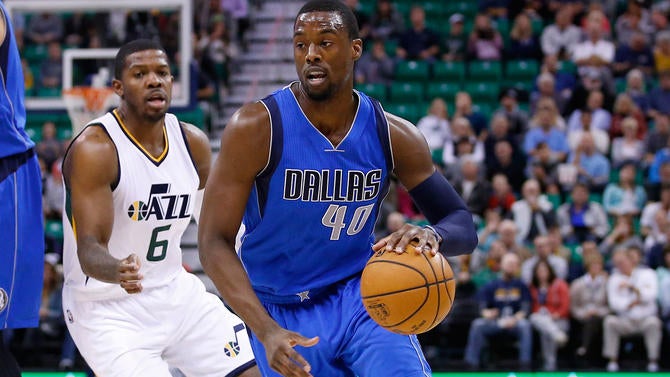
Harrison Barnes is a viable No. 1 option
Let's be clear here: Harrison Barnes is never going to be a legit No. 1 option on a really good team. He just doesn't possess that kind of playmaking ability, not for himself and certainly not for others. But in Dallas, he's proving that he can score, both consistently and relatively efficiently, as the defense's No. 1 priority.
That was the big question with Barnes when he came over from Golden State, where he basked as a defensive afterthought in the wide-open spaces created by the Splash Brothers. Could he be the man? The Mavericks bet $94 million that he could be, and thus far they've been pretty close to right.
As of Wednesday, Barnes is averaging over 21 points on just under 50 percent shooting on his 2-point attempts. That's the good news. The bad news is that he's connecting on just 28 percent of his 3-pointers, and he's averaging a barely recognizable one assist per game.
The 3-point struggles have been the clearest indication that Barnes was, to at least some degree, a product of the Warriors' system and surrounding talent. Camping out in the short corner with Stephen Curry and Klay Thompson drawing all the attention in the arena, he was one of the better 3-point shooters in the league at over 40 percent two years ago.
But perhaps Barnes doesn't need to be a 3-point shooter. He needs to be better than 28 percent, but he's proving that he can score from the block, off the dribble and in the mid-range even with the extra attention. He's sort of a poor man's DeMar DeRozan in that way, without near the ability to draw fouls. His first step looks explosive this year, too.
I'll admit I'm a huge Barnes fan. I fell in love with him in Golden State for his knack for scoring big buckets in big situations (he was the Warriors' go-to player for legitimate stretches in the 2013 playoffs), his toughness, his athleticism, his under-appreciated defense, and just his overall reliability. He went in the tank last year on some pretty big stages, notably in the NBA Finals, and that's what a lot of people will automatically point to, but Barnes was a really good player for the Warriors.
Still, I had my doubts that he could do what he's doing so far in Dallas. He was downright awful as the No. 1 option on Golden State's second unit when Mark Jackson pushed him to the bench upon Andre Iguodala's arrival in 2013-14. I would've called his ball-handling supremely sketchy, his one-on-one moves pretty deliberate, his aggression inconsistent.
I don't know how much better he's gotten at that stuff, to be honest, but he's doing work with what he has. He's not sneaking up on anyone anymore. He's the best player on a bad team, a defensive focal point both on the court and in the film room, and he's scoring the ball at close to a star level. As much as I hate to say I doubted Barnes, because I really do love him as a player and always have, that surprises me.
Wizards hitting a Wall
The Wizards stink. This does not surprise me.
What does surprise me is that there still seem to be people who are surprised by this. Why would you ever think the Wizards, as currently constructed, were going to be anything other than a completely average team at their very best?
Why? Give me your reasons. I'm dying to hear them. Let me guess, John Wall is a superstar. He and Bradley Beal are, in their own opinions, the best backcourt in the NBA. Scott Brooks is a good coach who had a lot of success in Oklahoma City that is going to re-energize a team with the talent to compete.
Wrong on all counts.
Look, Wall is a borderline great individual player. Beal, when he's healthy, is an All-Star. Together they're averaging more than 43 points and 11 assists this season. But for me, the numbers have always been deceiving when it comes to the Wizards. Two years ago, there was statistical reason to believe they could be an elite team if only Randy Wittman would commit to playing small. As such, they became a trendy pick as the top threat to the Cavs in the East.
Nobody was dumb enough to think that this year, but they didn't think they would be this bad, either. I would contend everyone should have known.
For me, this begins and ends with Wall. Again, he's a terrific individual player, great vision, nearly unstoppable in the open floor and a really good on-ball defender, but his impact doesn't spread far enough outside his own numbers to lift the play of those around him, and it all comes back to shooting. He's vastly improved, and indeed, the numbers aren't bad on the surface -- over 40 percent from three, and 44 percent from the field.
But look at little deeper and you'll see that he's only made 15 threes, so that 40 percent means basically nothing, and the 44 percent from the field doesn't mean much more as that number is largely a product of the 55 percent he's shooting on shots from less than five feet. Getting into the lane isn't a problem for Wall, but the less than four shots per night he's making from beyond 15 feet is a problem, even if he's actually hitting those limited shots at an acceptable 41-percent clip.
Why? Because the threat of your shot means almost as much, if not more, than your actual shot. Defenses want Wall to shoot. They play him to shoot. They go under pick and rolls. On the ball, they don't stretch out to him past the 3-point line, and they give ground even in the mid-range. Off the ball, they don't over-rotate to him. As a consequence, he doesn't really affect spacing on the weak side. His mere presence doesn't set up hockey assists. His understandable intent on probing the space he's given stops a lot of offensive flow.
So what you're left with are his own numbers -- the 23 points, and the 20 or so more that he creates with his nine assists. Throw in the 10 or 12 points Beal gets without an assist from Wall, and you've got a little more than 50 points. You need 100-plus every night to compete in this league, and the rest of this Wizards roster isn't good enough to score like that, particularly in the half-court, without someone creating some real space for them, and probably not even then.
Guys like Otto Porter, Markieff Morris and Marcus Thornton aren't going to consistently create their own offense. They need the ball to move, the defense to rotate. But the Wizards are 25th in assist percentage. They largely go at it on their own.
That's why they're 17th in offensive rating.
This shouldn't be a huge surprise. This is the way Brooks played it in Oklahoma City, where his teams were prone to stagnation as they let the stars do their work, but this time he doesn't have Kevin Durant and Russell Westbrook, which is a bit of a problem.
I don't want this to sound like an attack on Brooks. He's a pretty good coach. And I certainly don't want it to sound like an attack on Wall, who is more than a pretty good player. But he needs to have better surrounding talent than this. He's not going to lift a subpar team.
In the modern NBA, I'll just never believe you can win at a truly meaningful level with a non-shooting point guard as your best player. He can be your second-best player, perhaps, but not your best. Shooting is too important.
It's like quarterbacks who can't consistently throw from the pocket in the NFL. Sure, there are guys who get away with it from time to time -- Derrick Rose's MVP season in 2010-11 immediately comes to mind, when the Bulls won 62 games -- but as a rule, it's just not going to work over the long haul.