P.J. Tucker trade rumors: Ranking the likeliest destinations for the versatile Rockets forward
Tucker fits on basically any contender

By
Sam Quinn
•
9 min read
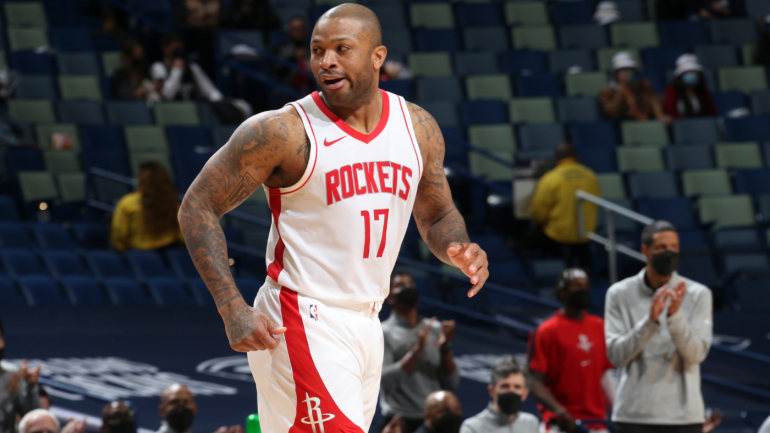
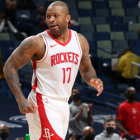
P.J. Tucker is the trade deadline's perfect storm. He's not the sort of niche role player that contenders tend to add at the deadline. His positional versatility makes him as valuable to teams that need forwards as he is to teams looking for a small-ball center. He doesn't need the ball, and this season notwithstanding has typically shot at roughly a league-average level. His $8 million salary is easy enough for most teams to match in a trade, and at 35 years old, isn't going to cost an arm and a leg to acquire. Add all of that up and Tucker might be the single most tradable player in all of basketball.
That makes finding suitable homes for him surprisingly difficult. Where do you send the player who fits everywhere? What does it cost to acquire the player that almost anyone could theoretically afford? There is no single, standout destination for Tucker because he would thrive anywhere.
So with Tucker on his way out of Houston, let's take a look at the likelihood of each contender taking a swing on Tucker. Basketball fit will matter, but given the adaptability of Tucker's game, available matching salary, tradable assets and front-court need will be the deciding factors here. Rather than ranking teams individually, we'll divide the contending class into three tiers, from least to most likely to acquire him by March 25.
Tier 3: Pretty unlikely
Los Angeles Clippers: The Clippers could match Tucker's salary with Lou Williams, but the question is why they would bother. Would Tucker help them? Sure. But lineups featuring Marcus Morris have scored an unfathomable 136 points 100 possessions this season, according to Cleaning the Glass. They've given up nearly as much, but if the primary purpose of five-out lineups is to increase scoring, the Clippers are covered on that front already. With Morris, Nic Batum, Paul George and Kawhi Leonard, they already have more than enough at forward. Their deficiencies are at guard (where they could use a playmaker, which Tucker is not) and up front, where their centers may not be burly enough to contend with Anthony Davis in a playoff matchup with the Lakers. Tucker proved last season he doesn't help on that front. He'd be helpful but redundant with the Clippers.
Phoenix Suns: Jae Crowder does most of the same things that Tucker does, and Dario Saric-at-center lineups are outscoring opponents by over 25 points per 100 possessions. Tucker just isn't needed here, and while the Suns could cobble together the salary to acquire him with youngsters like Jalen Smith and Jevon Carter, they just aren't going to be motivated enough to do so to bring Tucker back to Phoenix.
Milwaukee Bucks: The Bucks would absolutely love Tucker. Their dedication to switching screens in the regular season suggests that they want to go smaller in the playoffs, and subbing Tucker in for Brook Lopez would be an enormous help on that front. The question is what the Bucks would give up. They do not have a single tradable first-round pick, and the four second-rounders they can deal aren't particularly valuable. Donte DiVincenzo is too important to trade for Tucker, but the Bucks lack any other meaningful young talent unless the Rockets like Pat Connaughton more than the rest of the NBA does. Milwaukee will try, but they probably aren't going to have the ammunition to outbid the other teams on this list.
Utah Jazz: The Jazz have the draft capital to acquire Tucker. They might even have the need, as their net rating falls to roughly neutral when Rudy Gobert leaves the game. But their salary structure isn't conducive to acquiring Tucker. The Jazz have only eight players on their roster that make more than $2 million, and each of them are essential to the rotation. The likeliest of those seven to serve as matching salary in a Tucker trade would probably be Derrick Favors, as Tucker would presumably take over his backup center minutes, but such a swap would not only remove two-big lineups as a postseason possibility, but it would also force the Jazz to drastically alter their defensive scheme whenever Gobert leaves the game. As the Bucks have seen, going back and forth between switching and dropping tends to put an unhealthy strain on defenses, especially those that aren't used to it. You could argue that the Jazz should be switching and not dropping in the playoffs either way, and history might support that idea on a broader level, but Utah's defense is special because of Rudy Gobert's rim-protection. Giving up any of that for the sake of increased switchability undermines Utah's entire scheme. If there's a way to get Tucker without compromising the rotation, the Jazz should pursue it, but doing so would be extremely difficult.
Tier 2: Moderately likely
Los Angeles Lakers: The Lakers have a tradable first-round pick in 2027, and they Talen Horton-Tucker if the Rockets would prefer to add a young player than a draft pick. Matching salary is their big issue. At present, they have less than $2 million of flexibility below the hard cap. That means that one of three players would likely have to be in any Tucker deal: Dennis Schroder, Kentavious Caldwell-Pope or Montrezl Harrell. Given the difficulty the Lakers will have in retaining him and inessential place in the rotation, Harrell is the likeliest of the three to be dealt. But is Tucker worth Harrell, a pick and/or Horton-Tucker? Especially for a team that has a somewhat similar player in Markieff Morris? That's for Rob Pelinka to decide.
Brooklyn Nets: The Nets would be a perfect fit for Tucker on the court. They already switch as the basis of their defensive scheme, he played with James Harden in Houston and they are still attempting to sort out their center rotation. The question is, if Brooklyn was going to get Tucker, wouldn't they have done so in the Harden trade? If there was anything else the Rockets wanted from Brooklyn, wouldn't they have extracted it when they had Harden to dangle as leverage? Spencer Dinwiddie's expiring salary makes a deal logistically possible, but it just doesn't seem particularly likely given Tucker's absence in the first blockbuster between these teams.
Philadelphia 76ers: Daryl Morey is the general manager that pioneered playing Tucker at center. He knows his value as well as anybody and could absorb Tucker's salary through the $8.2 million trade exception generated in the Al Horford deal (though doing so would be prohibitively expensive against the luxury tax). Sending a suitable asset return back to Houston wouldn't be an issue either. Philadelphia has multiple first-round picks to work with, and even if Tyrese Maxey and Matisse Thybulle are too valuable to give up for Tucker, Shake Milton could be a viable middle-ground. But is upgrading the frontcourt really a priority for Philly? Probably not, especially if Thybulle remains with the team through the deadline. The 76ers will probably focus on adding guard help, or if a star of any kind becomes available, constructing a blockbuster on that front. Morey would love to reunite with Tucker, but his attention will likely be focused elsewhere.
Portland Trail Blazers: Portland only owes one first-round pick to another team: the one it sent Houston (which got rerouted to Detroit) as part of the Robert Covington trade. Here's the issue: that pick is so heavily protected that it technically might not convey until 2027, and even then, it might convert into second-rounders. That prevents the Blazers from trading any first-round picks. They have a few workarounds on the roster, though. For example, Anfernee Simons is extension-eligible this offseason, but Gary Trent Jr. has passed him in the Portland backcourt hierarchy. Might he be expendable in a Tucker deal? How about the injured Zach Collins, who will be a restricted free agent this offseason? The Blazers could match salary by sending out Rodney Hood, whose 2021-22 salary is non-guaranteed, but their emphasis on internal development will probably prevent a trade.
Golden State Warriors: The Warriors plan to be aggressive at the deadline, but it's worth noting that Tucker will be a free agent this offseason and Golden State is trying to build a championship roster next season, not this one. They could match Tucker's salary with Kevon Looney and another player, and assuming James Wiseman plays the bulk of the center minutes next season, it might make sense to turn Looney into an upgrade elsewhere now. The Warriors don't have a tradeable first-round pick to offer until 2026, but the protection on the 2021 pick they currently owe Oklahoma City is worth watching here. If it falls between No. 1 and No. 20, the Warriors keep it, but send the Thunder Minnesota's 2021 second-round pick, which, at present, would be No. 31 overall. Perhaps an arrangement could be made wherein the Warriors send the Rockets whichever pick doesn't go to Oklahoma City. Unless the Warriors are confident they can re-sign Tucker, though, they probably won't give up anything of value to get him.
Tier 3: Likely favorites
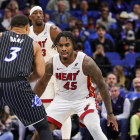
Miami Heat: The Heat have expiring contracts all across their roster, so matching money wouldn't be an issue. They don't currently have a tradable first-round pick, but make up for that with their depth of young players. Duncan Robinson and Tyler Herro are off-limits, but is Kendrick Nunn? Precious Achiuwa? The Heat surprisingly traded a young starter at the deadline last season when they flipped Justise Winslow for Andre Iguodala and Jae Crowder. Never doubt their short-term ambitions, especially coming off of a Finals berth, and the defensive potential of Tucker, Iguodala, Avery Bradley, Jimmy Butler and Bam Adebayo in a single lineup is mind-boggling.
Denver Nuggets: Need in the frontcourt? Check. Denver lost Jerami Grant this offseason, and while Michael Porter Jr. has played well recently in his place at power forward, there's no reason to believe he and Tucker couldn't coexist. Viable salary filler? Check. Paul Millsap's expiring deal works, but it's likelier that the Nuggets would simply absorb Tucker into the $9.3 million trade exception generated by Grant's departure. The Nuggets would need to shed a bit of money to avoid the tax, but it's entirely doable, and the Rockets could save quite a bit of cash by not taking back money in a Tucker deal. Tradable assets? Sure, take your pick. The Nuggets have their own first-rounder to offer as well as youngsters like Zeke Nnaji, Bol Bol and RJ Hampton. The only drawback here would be Denver's hesitance to give up younger assets for a win-now piece. The bulk of their core is still in its early-to-mid 20's. Tucker would be a short-term addition. If winning in the short term matters? Tucker could very well be a Nugget.
Boston Celtics: Like Denver, Boston can absorb Tucker without sending a cent back to Houston. Their trade exception is considerably larger, $28.5 million thanks to Gordon Hayward, but that's a double-edged sword here. Is Boston going to settle for an older role player with that exception? Probably not. They can carry it into the offseason if necessary, so their ambitions are likely greater than Tucker. Still, they can match salary with Tristan Thompson or even some of their younger players, and have all of their own draft picks to dangle. If the Celtics want Tucker, they have a number of different paths to getting him, and they've tinkered with small-ball units in the past. The Celtics are as young as the Nuggets and may take a similarly long view on their roster construction, but with such a surplus of mediocre youth, they can afford to spend a bit on a veteran like Tucker.