The case for Arvell Reese as the No. 1 pick in 2026: In a year without a slam-dunk QB, he's the safest bet
The tape and history are on our side of the argument that Reese, out of nowhere, is a great candidate to go No. 1 overall in the 2026 NFL Draft.

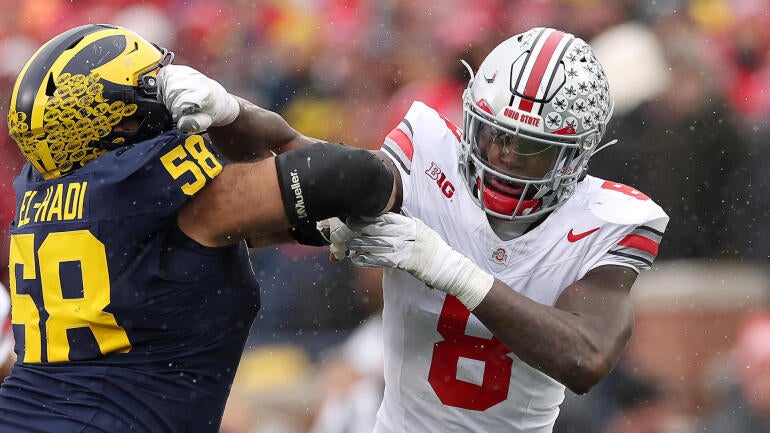
The 2026 NFL Draft is shaping up to be a referendum on positional value, and it's all thanks to an unexpected star from Columbus. It's hard to come out of nowhere when you play for Ohio State, but Arvell Reese has made a convincing case for just that with his dominant 2025 performance.
A true junior who won't turn 21 until next August, Reese played in six games in 2023 without recording a tackle. In 2024, there were only flashes -- a half-sack and 3.5 tackles for loss -- as he served as a cog in a national championship defense that sent eight players to the NFL last spring.
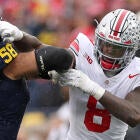
This season, those flashes -- as an off-ball linebacker and an edge rusher -- became a full-blown breakout reaching a level of impact that has separated him not only as one of the best players in Columbus, but arguably the best player in the entire draft class.
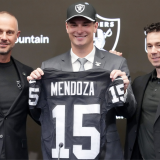
When I updated my 2026 NFL Draft 'Big Board' in mid-November, Reese -- who wasn't even in my top 50 in August -- had vaulted to No. 2, trailing only Indiana quarterback Fernando Mendoza.
But this story isn't just about Arvell Reese. It's about whether teams should stop overthinking the No. 1 pick.
Given the current 2026 NFL Draft order heading into Week 16, the Giants currently hold the No. 1 pick, and the Titans are sitting at No. 3. Neither team needs a quarterback. Ideally, if either team lands the top pick, they'd try to trade down and let -- take your pick -- the Raiders, Browns, Jets, Cardinals or Saints move up for Mendoza (and this assumes that Cleveland and New Orleans won't run it back with Shedeur Sanders/Dillon Gabriel or Tyler Shough).
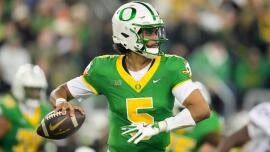
But there are far worse fates than getting "stuck" with Reese. In fact, it doesn't take much imagination to argue he's the safest player in the entire class and absolutely worth the No. 1 pick. He has drawn comparisons to Micah Parsons and Abdul Carter for his freakish athleticism, position flexibility and offense-altering playmaking ability, all while being relatively new to his role.
Parsons was the 12th overall pick in 2021, the same draft that saw Trevor Lawrence go No. 1. Parsons lasted that long because he opted out of his final college season because of COVID, he was an off-ball linebacker at Penn State, and some teams had maturity concerns about him ahead of the draft. Turns out, Parsons is a first-overall talent.
Carter, also a Penn State alum, was the No. 3 pick in 2025. And like Parsons, he began his college career as an off-ball linebacker, moved to edge rusher during his final season, and immediately looked like a natural, dominating with speed, power and physicality. If all three players were in the 2026 class, I'd have them rated Parsons, Reese and Carter.
Former Titans GM Ran Carthon, my co-host on the "With the First Pick" NFL Draft podcast, spoke about Reese on a recent episode:
"He's going to go very, very early -- probably a little earlier than people realize at this point ... [B]ut I'll be interested to see where someone plays him because to maximize his ability, he's a lot like Abdul Carter and Micah Parsons in terms of his role.
"Because both of those guys were off-ball linebackers at Penn State ... I remember watching [Parsons'] tape and I was actually reading my report on him this past summer in terms of me not loving him as an off-ball linebacker because I didn't think he saw the triangle well enough. But he was so fast, so explosive that he could overcome it. And then I remember just seeing snaps of him playing with his hand in the dirt and making a note to myself.
"Probably the best thing he does is rush [the passer]. ... But then you go and you look at Abdul Carter, two years of playing off-ball. Kind of the same thing. I didn't love him as an off-ball linebacker. I didn't think he made special plays, so to speak, as the way we were talking about him being a top five pick as an off-ball linebacker. And then you move him down on the edge and boom! He becomes a real guy. Now, again, of the three, I think Arvell Reese is a much better off-ball linebacker ... but if I'm ranking all three of them as pass rushers, he would be [No. 3]."
So what does history tell us about teams that used the top pick on a non-QB? In the 26 drafts since 2000, it's happened seven times.
The 2000 draft class
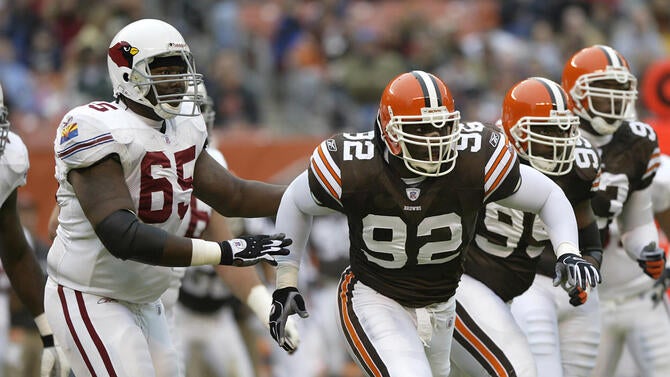
No. 1 overall pick: Penn State DE Courtney Brown to the Browns
Brown played six seasons, had a career-high six sacks in 2003 and finished his career with 19 sacks and 36 tackles for loss.
When was the first QB selected? Only one quarterback went in Round 1: Chad Pennington, to the Jets, 18th overall. There was another QB in this class who worked out (more on that below), but the Browns had taken Tim Couch the year before and weren't in the market for another face of the franchise.
Was it the right choice? Nope. Not even close. On a scale of 1-10, where 10 is Myles Garrett ... well, 1 is Courtney Brown. Yes, it's easy to blame the Browns for being the Browns, it's also a reminder that the draft is a crap shoot and this was an example of Cleveland getting it exactly wrong. More confirmation of that reality?
With the hindsight of a quarter-century, let's look at the best players from the 2000 class, based on Pro-Football-Reference's approximate value metric which allows you to "very approximately" (in their words) to compare players across years and positions.
Tom Brady (R6)
Brian Urlacher (HOF, R1)
John Abraham (R1)
Keith Bulluck (R1)
Brad Meester (R2)
Chad Clifton (R2)
Plaxico Burress (R1)
Shaun Ellis (R1)
Jamal Lewis (R1)
Julian Peterson (R1)
Shaun Alexander (R1)
Laveranues Coles (R3)
Adalius Thomas (R6)
Chris Samuels (R1)
The 2006 draft class
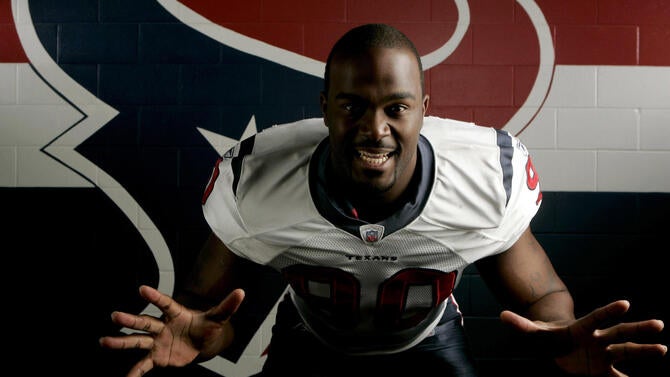
No. 1 overall pick: NC State DE Mario Williams to the Texans
Williams, who measured 6-foot-7, 295 lbs. at the combine, played 11 seasons with the Texans, Bills and Dolphins, had double-digit sacks five different times, including 14 sacks in his second season and 12 sacks in his third season. He finished his career with 97.5 sacks.
When was the first QB selected? Vince Young went No. 3 overall, Matt Leinart went 10th and Jay Cutler went 11th.
Was it the right choice? On the Courtney Brown-to-Myles Garrett scale described above, I'd put Williams at a 7.5. The Texans drafted David Carr with the top pick in 2002 and he started 16 games in '06, but the team moved on from him after the season and turned to Matt Schaub. I mention this because the Texans could have targeted Cutler, who ended up being the best QB in this class, with the first pick, but Williams turned out to be a solid -- and often spectacular -- player. The real drama leading up to this draft wasn't if the Texans would take a QB, but whether they would target USC's Reggie Bush. Bush ended up going No. 2 to the Saints, and his NFL career didn't approach that of Williams'.
Here are the best players from the 2006 class, according to PFR's AV metric:
Jahri Evans (R4)
Haloti Ngata (R1)
Andrew Whitworth (R2)
Jay Cutler (R1)
Brandon Marshall (R4)
Mario Williams (R1)
Kyle Williams (R5)
Tamba Hali (R1)
Maurice Jones-Drew (R2)
Nick Mangold (R1)
Marques Colston (R7)
The 2007 draft class
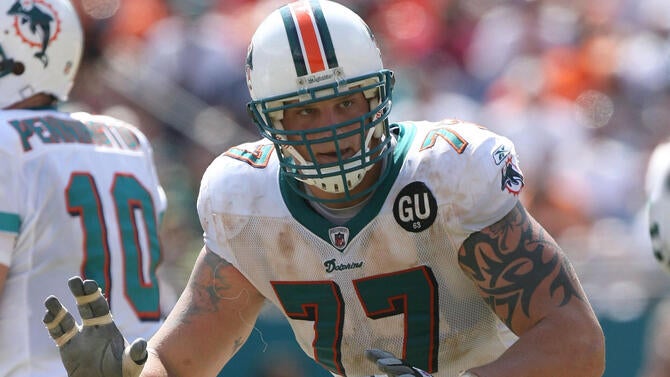
No. 1 overall pick: Michigan OT Jake Long to the Dolphins
Executive Vice President of Football Operations Bill Parcells was in his first year on the job and the team reportedly was also interested in Matt Ryan to stem a long run of pedestrian QB play in Miami. Ultimately the Dolphins settled on Long, who played nine seasons, was a four-time Pro Bowler his first four seasons, and was a first-team All Pro in 2010. In fact, he started 61 consecutive games before he was placed on injured reserve during the 2011 season. He later suffered ACL injuries in 2013 and 2014.
When was the first QB selected? Matt Ryan went No. 3 overall to the Falcons. The Ravens took Joe Flacco 10 picks later. Both QBs ended up as two of the top players from the '08 class.
Was it the right choice? On the Courtney Brown-to-Myles Garrett scale described above, I'd put Long at a 7.0. Parcells wanted to build the team through the trenches and Long fit that description. And while he proved to be a solid choice before the injuries cut short his career, passing on Ryan is a tough pill to swallow for a franchise that is still on the search for its next franchise quarterback.
Here are the best players from the 2008 class, according to PFR's AV metric:
Matt Ryan (R1)
Calais Campbell (R2)
Joe Flacco (R1)
Duane Brown (R1)
Matt Forte (R2)
Josh Sitton (R4)
DeSean Jackson (R2)
Jordy Nelson (R2)
Chris Johnson (R1)
Aqib Talib (R1)
Jamaal Charles (R3)
Ryan Clady (R1)
Ray Rice (R2)
Jake Long (R1)
The 2013 draft class
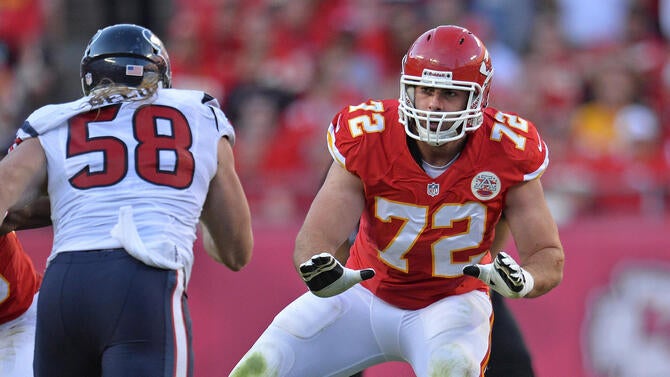
No. 1 overall pick: Central Michigan OT Eric Fisher to the Chiefs. At the time, this was considered one of the weakest draft classes in recent memory. The Chiefs reportedly tried to trade down, but because the class lacked a Mario Williams or even a Jake Long -- and certainly no QB worth moving up for -- the team stayed put and had to decide between Fisher and Texas A&M OT Luke Joeckel, who ended up going No. 2 to the Jaguars. Fisher played nine seasons (eight in Kansas City, one in Indy), made two Pro Bowls, including his final year with the Chiefs, served as Patrick Mahomes' blindside protector from 2018-20 and won Super Bowl LIV with the team. The organization thought enough of Fisher to pick up his fifth-year option and give him a second contract. And he was for sure the right call over Joeckel, who busted in Jacksonville.
When was the first QB selected? The Bills took EJ Manuel No. 16 overall, and he was the only first-round quarterback in the class. The next three QBs off the board? Geno Smith in Round 2, Mike Glennon in Round 3 and Matt Barkley in Round 4.
Was it the right choice? On the Courtney Brown-to-Myles Garrett scale described above, I'd put Fisher at a 6.0. Andy Reid had just been hired, the team had traded for Alex Smith and they were looking to rebuild the offensive line. Given that, and the lack of interest from other teams wanting to trade up, taking Fisher isn't controversial. Not unless you get your hands on a time machine and peek at the best players from the 2013 class, according to PFR's AV metric:
Travis Kelce (R3)
Lane Johnson (R1)
David Bakhtiari (R4)
DeAndre Hopkins (R1)
Keenan Allen (R3)
Tyrann Mathieu (R3)
Terron Armstead (R3)
Darius Slay (R2)
Eric Fisher (R1)
Sheldon Richardson (R1)
Le'Veon Bell (R2)
For as bad as the 2013 class was in the moment, it looks a lot better 12 years later. Kelce and Johnson are Hall of Famers, and there are five names taken in Round 3 or later that would've been revisionist home-run first-overall choices. The lesson: we've heard similar rumblings about the 2026 class, and I'd recommend just giving it time to play out.
The 2014 draft class
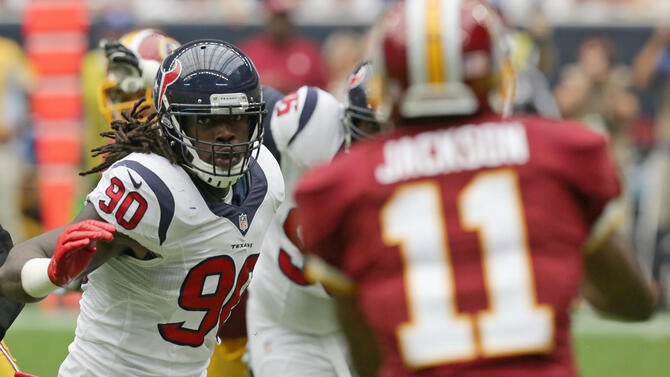
No. 1 overall pick: South Carolina DE Jadeveon Clowney to the Texans. Bill O'Brien was the coach at the time, and while Houston desperately needed a QB, this was another weak class. Clowney was considered the best player in the class, and the idea of putting him on the same defensive line as JJ Watt made the decision even easier.
Clowney, still just 32 years old, is in his 12th NFL season. He's played for the Texans, Seahawks, Titans, Browns, Ravens, Panthers and now the Cowboys. He had 29 sacks in five seasons with the Texans, and has 62 career sacks through 15 weeks of the 2025 season.
When was the first QB selected? Blake Bortles went No. 3 overall to the Jaguars. Two other QBs went in the first round: Johnny Manziel to the Browns (No. 22) and Teddy Bridgewater to the Vikings (No. 32). The best QB in this class didn't hear his name called until Round 2 (more on that momentarily).
Was it the right choice? On the Courtney Brown-to-Myles Garrett scale described above, I'd put Clowney at a 5.5. He was an easy choice at the time, but never quite lived up to the lofty first-overall expectations. Still, a solid player who's had a long career.
Here are the best players from the 2014 class, according to PFR's AV metric:
Aaron Donald (R1)
Zack Martin (R1)
Khalil Mack (R1)
Derek Carr (R2)
Davante Adams (R1)
C.J. Mosley (R1)
Mike Evans (R1)
Joel Bitonio (R2)
Jake Matthews (R1)
Brandin Cooks (R1)
DeMarcus Lawrence (R2)
Corey Linsley (R5)
Jadeveon Clowney (R1)
Odell Beckham Jr. (R1)
Kyle Van Noy (R2)
Donald lasted until the middle of the first round because he was deemed undersized, and Mack went fifth overall, in part, because he was a small(-ish) school player. The lesson: it's easy to overthink it -- try not to fall into that trap.
The 2017 draft class
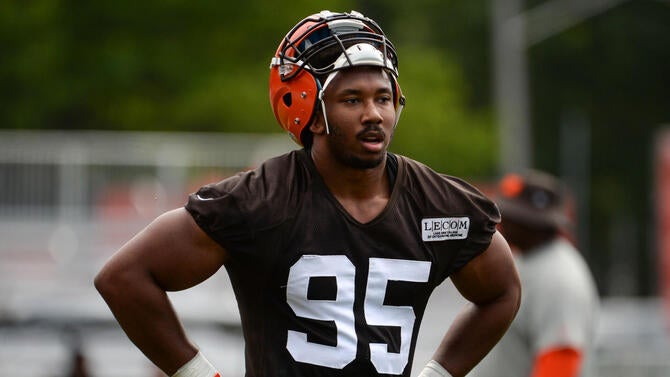
No. 1 overall pick: Texas A&M EDGE Myles Garrett to the Browns. He was the best player in this class. Nine seasons later, he not only remains the best player in this class, he's the best non-QB in the NFL.
The Browns needed a quarterback heading into the 2017 season (Cody Kessler, Robert Griffin III and Josh McCown all started games for Cleveland in '16), but they had three first-round picks and a second-rounder to find one. The team chose not to trade up for Patrick Mahomes (10th overall) or Deshaun Watson (12th overall), and instead took safety Jabrill Peppers at No. 25 and TE David Njoku at No. 29. They ended up getting QB DeShone Kizer with the 52nd pick in Round 2. Kizer started 15 games in 2017 (the team went 0-15 in those games on their way to an 0-16 record for the season). Kizer never started another game in the NFL.
When was the first QB selected? Mitch Trubisky, who made just 13 career starts in college, went No. 2 overall to the Bears, ahead of Mahomes and Watson in Round 1.
Was it the right choice? On the Courtney Brown-to-Myles Garrett scale described above, I'd put Garrett at 10, written in permanent marker with an adjoining plaque that recognizes this pick as one of the greatest decisions in Browns history. Now just imagine if they had drafted T.J. Watt or Dion Dawkins or Cooper Kupp or George Kittle with their two other first-round picks ...
Here are the best players from the 2017 class, according to PFR's AV metric: Patrick Mahomes (R1)
Myles Garrett (R1)
T.J. Watt (R1)
Alvin Kamara (R3)
Christian McCaffrey (R1)
Dion Dawkins (R2)
Ryan Ramczyk (R1)
Aaron Jones (R5)
Cooper Kupp (R3)
Deshaun Watson (R1)
Marlon Humphrey (R1)
Budda Baker (R2)
George Kittle (R5)
Joe Mixon (R2)
Trey Hendrickson (R3)
Matt Milano (R5)
The 2022 draft class
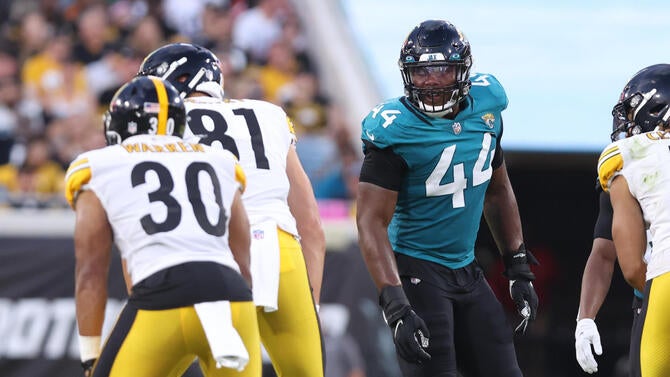
No. 1 overall pick: Georgia EDGE Trevon Walker to the Jaguars
In 2021, the Jaguars took Trevor Lawrence with the No. 1 pick. A year later, they again were picking first overall. I remember talking with someone in the organization at the 2022 Senior Bowl and they were hoping that Kenny Pickett or Malik Willis or Desmond Ridder or Sam Howell would have an impressive enough week to convince somebody to move up for them. It didn't happen, and Jacksonville stayed put and took a high-upside edge rusher in Walker, one pick ahead of Aidan Hutchinson.
When was the first QB selected? Pickett was the only quarterback to go in the first round, and the next QB -- Desmond Ridder -- didn't come off the board until Round 3.
Was it the right choice? On the Courtney Brown-to-Myles Garrett scale described above, I'd put Walker at a 5.0. At the time, the pick was questioned. In part because former GM Trent Baalke was behind the selection, and he was at the point in his journey where he could do no right in the eyes of Jags fans. But also because Walker, while physically imposing, was more projection than sure thing, even by NFL Draft standards. Those concerns were amplified after a rookie season in which he managed just 3.5 sacks compared to Hutchinson's 9.5-sack rookie campaign for the Lions.
But Walker logged 10 sacks in 2023 and 10.5 sacks in 2024 (he has just 2.5 sacks in '25 after being sidelined by injuries). Meanwhile, Hutchinson had 11.5 in '23 and 7.5 in '24 (before being lost for the year to a leg injury after 6 games); he has 8.5 sacks through 15 weeks of the '25 season. Walker is just in Year 4, and once healthy I'd expect him to continue to get better and his numbers will reflect as much. But given he's missed time this season with an injury, and he's still early into his career, I have him rated as a 5.0 ... for now.
Here are the best players from the 2022 class, according to PFR's AV metric:
Brock Purdy (R7)
Sauce Gardner (R1)
Trent McDuffie (R1)
James Cook (R2)
Drake London (R1)
Tyler Smith (R1)
Tyler Linderbaum (R1)
Garrett Wilson (R1)
George Pickens (R2)
Kerby Joseph (R3)
Charles Cross (R1)
Kyle Hamilton (R1)
Cordell Volson (R4)
Travon Walker (R1)
Derek Stingley Jr. (R1)
Kayvon Thibodeaux (R1)
Nik Bonitto (R2)
Rachaad White (R3)
Aidan Hutchinson (R1)
Chris Olave (R1)
So what's the overarching takeaway? It might be instructive to also look at the 19 quarterbacks taken No. 1 overall this century and ask if those decisions were worth it or reaches -- both in the moment and now.
QBs who went No. 1 overall this century
| YEAR | NAME | YEAR | NAME |
|---|---|---|---|
2025 | Cam Ward | 2011 | Cam Newton |
2024 | Caleb Williams | 2010 | Sam Bradford |
2023 | Bryce Young | 2009 | Matthew Stafford |
2021 | Trevor Lawrence | 2007 | JaMarcus Russell |
2020 | Joe Burrow | 2005 | Alex Smith |
2019 | Kyler Murray | 2004 | Eli Manning |
2018 | Baker Mayfield | 2003 | Carson Palmer |
2016 | Jared Goff | 2002 | David Carr |
2015 | Jameis Winston | 2001 | Michael Vick |
2012 | Andrew Luck | | |
- The jury is still out on Cam Ward, though I've been encouraged by what he's shown under some pretty dire circumstances in Tennessee as a rookie. Caleb Williams is proof that you can have all the talent in the world, but that talent has to be harnessed, both in his play-to-play decision making, but also by pairing him with a play-caller like Ben Johnson.
- Bryce Young appears to be "the guy" in Year 3, but it was touch and go during his rookie season. Again, the coaching staff did him no favors, and he'll forever -- fair or not -- be living up to the expectations of what it cost the Panthers to move up and select him in 2023.
- Trevor Lawrence has been inconsistent for much of his career, but he's also played for three coaches. Liam Coen could be the one who unlocks it all. The Jags also signed Lawrence to a huge deal after the 2024 season, so they're clearly all in. The pick was, and is, a no-brainer. Joe Burrow felt like he was on pace to be one of the best QBs in league history, but injuries have plagued him in recent years. That said, for all the reasons to question the Bengals, taking Burrow isn't one of them.
- I get why the Cardinals were intrigued by Kyler Murray, even 12 months after using a first-round pick on Josh Rosen, but he's likely taken his last snap in Arizona. In retrospect, Nick Bosa and Quinnen Williams, selected No. 2 and No. 3 in that 2019 draft, would have been better choices.
- Baker Mayfield flashed No. 1 overall ability in Cleveland, but he didn't hit his stride until he landed in Tampa Bay a few seasons ago. Yes, Josh Allen was also in this class, but no one (presumably even Josh Allen) knew what he would become. Mayfield wasn't a reach at the time, or when looking back at the '18 class.
- Jared Goff, like Mayfield, flashed early in his career but didn't become one of the league's best passers until he was traded. He's a No. 1 overall talent, even in a draft class with Tyreek Hill and Dak Prescott (two Day 3 picks, because of off-field concerns at the time).
- Jameis Winston and Marcus Mariota went Nos. 1 and 2 in the 2015 draft. Neither worked out as long-term franchise QBs, but both have made a living as good backups. If you're re-drafting that class, Winston (or Mariota) would still have a good chance to still go first overall; the leaders in PFR's AV from 2015 are Stefon Diggs, Danielle Hunter, Tyler Lockett and Amari Cooper.
- Andrew Luck is the original Joe Burrow; a special talent sidetracked by injuries.
- Cam Newton turned around the Panthers franchise, earning league MVP honors in 2015, while also getting Carolina to the Super Bowl.
- Sam Bradford was also a victim of injuries, and for as good as he was, I suppose you could make the case that Ndamukong Suh or Trent Williams would be worthy of the No. 1 pick from the 2010 class.
- Matthew Stafford is a no-brainer.
- Jamarcus Russell is a no-brainer for the exact opposite reasons; Calvin Johnson and Joe Thomas -- both Hall of Famers -- were picked Nos. 2 and No. 3. In fact, Patrick Willis and Darrelle Revis, also first-rounders in 2007, have been enshrined into the Hall of Fame.
- Alex Smith was a solid player, but Aaron Rodgers is the best player in the 2005 class, followed by Hall of Famer DeMarcus Ware. I'm not going to fault the Chargers (er, Giants) for taking Eli Manning in '04 -- the man won two Super Bowls -- or the Bengals taking Carson Palmer the year before. He, like Burrow, turned around the franchise before he suffered a serious knee injury.
- Finally, the Texans were a brand-new franchise and needed a quarterback. David Carr, Joey Harrington and Patrick Ramsey were the three QBs to go in the first round in 2002. Julius Peppers, Dwight Freeney and Ed Reed would have been better picks (all Hall of Famers), but none played quarterback, so I get it. Michael Vick was Cam Newton or Josh Allen but in a 6-foot-1 package. There were three Hall of Famers in the 2001 class -- LaDanian Tomlinson, Richard Seymour and Steve Hutchinson -- and Drew Brees will join the club soon enough, but Vick was one of one.
History shows that quarterbacks at No. 1 can work -- and fail -- for reasons that have little to do with draft slot. Which is why, if Arvell Reese is truly the best player in the 2026 class, the safest pick might also be the simplest one.