Why the Giants should use Saquon Barkley like the Rams utilized Todd Gurley in 2017
To maximize Barkley's value, he needs to be a key part of New York's passing game this season

•
3 min read
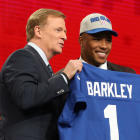
The Giants got poor draft value when they selected a running back with the No. 2 overall pick in the 2018 NFL Draft, but in Saquon Barkley, they have an undeniably hyper-talented ball-carrier on their roster.
Going that high in the draft will bring enormous expectations for Barkley, particularly on a team that's struggled mightily to run the football during the later stages of the Eli Manning era.
How should the G-Men utilize their new prized possession in an offense that also features Odell Beckham Jr., Sterling Shepard and Evan Engram?
By treating him like half-running back, half-receiver.
Looking for a hot new NFL podcast that's your home for NFL coverage? Look no further. The Pick 6 Podcast with Will Brinson has you covered each day with new episodes around 30 minutes each. Subscribe: via iTunes | via Stitcher | via TuneIn | via Google Play.
Leading up to the draft, I viewed Barkley as the running-back prospect most worthy of being a top-10 selection of at least the past five years.
Ezekiel Elliott was more efficient between the tackles, but Barkley's 4.40 speed and elite elusiveness on outside runs and as a pass-catcher make him ideal for today's NFL.
Just how prolific of a receiving running back is he? Here's how his collegiate receiving stats stack up with the four other ball-carriers who were most recently top-10 picks:
| Catches (Per Year Average) | Yards (Per Year Average) | Yards Per Catch | |
|---|---|---|---|
Saquon Barkley | 102 (34) | 1195 (398.3) | 11.7 |
41 (13.6) | 526 (175.3) | 12.8 | |
99 (33) | 1206 (402) | 12.2 | |
Ezekiel Elliott | 58 (19.3) | 449 (149.6) | 7.7 |
65 (21.6) | 615 (205) | 9.6 |
The Giants shouldn't follow the heavy ground-game workload plan of Elliott's rookie campaign -- when he led the league in rushing yards and overall carries with 322. They need to lean toward the way the Panthers used Christian McCaffrey last season, when he accumulated a whopping 50 targets in his first six professional outings.
Though Carolina's rookie got off to an extremely slow start running the ball, he averaged a solid 7.92 yards per reception in those first half dozen games and ended the season with with 80 grabs, five receiving scores, and an 8.14 yards-per-catch average on 113 targets.
However, there are too many quality receiving options in New York for Barkley to get to 113 targets. Todd Gurley's 87 targets and 64 snags last year would be more plausible benchmarks. Gurley averaged 12.3 yards per reception, the highest figure among running backs who made at least 40 receptions, and his average was higher than marquee wideouts like Dez Bryant, Michael Thomas and Davante Adams, among others.
Per Sports Info Solutions, among the 23 quarterbacks who attempted at least 10 screen passes to running backs in 2017, Eli Manning finished with the 12th-most yards on those plays (183). Also, screens from Manning averaged a mere 5.4 yards, the fifth-lowest figure among those qualifying signal-callers.
That will change with Barkley in the mix.
Manning has averaged 588 targets per season over his last five years. That means if Barkley gets in the 2017 Gurley range of targets, the veteran quarterback will be left with around 500 targets to distribute between Beckham, Shepard, Engram, and role players. That's reasonable.
On the ground, even with the addition of road-grader Will Hernandez, New York's first second-round pick in 2018 who's likely to start at left guard as a rookie, the Giants' offensive front as a whole is likely to be average at best.
However, Nate Solder, who was added in free agency, was one of the NFL's best run-blocking left tackles a season ago. He and Hernandez very well could formulate a dominate duo on the left side of the Giants' line. You don't need to be a Hall of Fame coach to recognize running Barkley to the left will probably be a good idea in 2018.
As a team in 2017, the Giants averaged just 4.9 yards per play, tied for the fourth-lowest figure in the NFL. Eli Manning averaged 6.1 yards per attempt, the seventh-lowest rate among 44 quarterbacks who threw at least 100 passes during the regular season. It was also his lowest yards-per-attempt average since his rookie year.
Handing the ball to Barkley around 18 or 19 times per game -- Gurley's carries-per-game average was 18.6 in 2017 -- along with frequent involvement in the pass game will not only maximize the former Penn State superstar's ability and value but help the Giants' offensive efficiency improve from where it was a season ago.