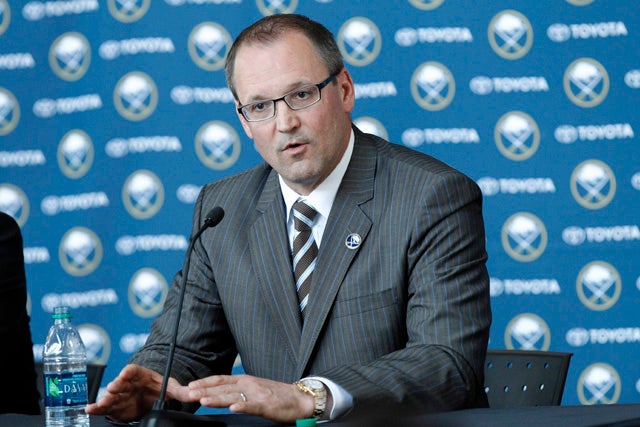
The Buffalo Sabres officially introduced new head coach Dan Bylsma Thursday afternoon. Though it did not quite have the pomp and circumstance as when the Toronto Maple Leafs rolled out the blue carpet for Mike Babcock’s introductory presser, the message was clear from general manager Tim Murray.
“We improved today by hiring him,” Murray said of Bylsma.
That has to be the general feeling throughout the Sabres organization. Following two seasons with the worst record in the NHL, the Sabres really have nowhere to go but up. Bringing in a coach of Bylsma’s pedigree at this stage of Buffalo’s rebuild is a coup, even if they were aiming slightly higher when initially targeting Babcock.
Bylsma spoke a lot about what he plans to bring to the team, even though there wasn’t a lot of specificity in his comments in terms of system or blueprint to success. Here are five important takeaways from Bylsma’s introductory press conference.
1. Bylsma wants to establish a winning culture immediately regardless of rebuilding status
One of the most commonly-uttered phrases of the Bylsma presser was “winning culture.” It’s something Bylsma feels he can bring to the team right away. It’s also a big factor in why Murray hired the former Penguins head coach.
Where Buffalo is now is a lot different than where the Penguins were when Bylsma was let go. Despite that, the head coach has no plans on changing his approach to winning.
“I don’t think I’m going to change my mindset on winning a hockey game,” Bylsma said.
“There’s certainly development, but it’s about developing a culture, a winning culture. That’s something we have to do every day.”
Bylsma noted that the pressure is different when you’re expected to win every game like the Penguins were, but that doesn’t mean the Sabres have to approach games any differently.
The worst thing that can happen with the current core of young players in the Sabres organization is that they become accustomed to losing, as they’ve been a losing organization for the last three years in particular.
Murray feels the players and everyone else in the organization needs someone to teach them differently, even thinking he could learn a lot from Bylsma.
“He’s been through it -- Stanley Cup Final as a player, winning a Stanley Cup as a coach,” Murray said. “To me, he’s a winner. He can teach the people in our organization so that we can walk around here so we can think like winners, eventually act like winners and become winners.”
There’s a lot to be said for that kind of mentality and what it may do to an organization.
2. Bylsma appears to be really, really excited to coach Jack Eichel
Though Jack Eichel is not officially a member of the Buffalo Sabres organization, he is expected to be selected with the No. 2 pick by Buffalo at the upcoming 2015 NHL Entry Draft. Bylsma just spent three weeks with Eichel as an assistant coach for the U.S. Men’s National Team at the IIHF World Championship. Eichel was the team’s top center as they won the bronze medal.
Bylsma initially was careful to talk in the hypothetical of “if” the Sabres were really going to draft Eichel.
Perhaps it was due to the absurdity of speaking in the hypothetical regarding a player the team is sure to take, or maybe it’s because he can’t hide his excitement, but Bylsma smiled each time he addressed questions about Eichel.
“You’ve got a chance to see a guy that’s going to be an elite player,” Bylsma said of the 18-year-old Boston University standout. “[At the World Championship] he matched up against Evgeni Malkin [of Team Russia]. He played against [Czech Republic forward] Tomas Plekanec in the bronze-medal game. He stacked up. He’s right up there with his skill and his size and his ability to play the game.”
Then Bylsma smiled again as he delivered this gem: “Jack’s going to be a good pick for anybody that takes him.”
Having the opportunity to work with Eichel already is going to give Bylsma a little bit of a head start with the player that could prove to be the franchise’s most important in some time. Perhaps that pushed Bylsma’s interest in the Sabres over the top.
3. Bylsma tried to take full advantage of his year off
After not coaching anywhere last season aside from one of his son’s youth hockey teams, Bylsma said he took a lot of time to study the game. Through that process, Bylsma feels like he’s going to be able to make some changes in his strategies behind the bench.
“I probably watched more hockey games than I wanted to last season,” Bylsma quipped. “It has afforded me the opportunity to look at the game from a distance and grow as a coach. I hope to bring that to the coach I will be for the Sabres.”
Bylsma has talked about this before. Perhaps the year away will prove to be an important learning experience. The head coach was often criticized for his unwillingness to make in-game adjustments or to strategize with line matching, but there's no denying he is a smart hockey man. There's also no doubt that there was room for improvement.
4. Signing Bylsma cost the Sabres a third-round draft pick
Even though Dan Bylsma was fired by the Penguins, he’s still technically under contract. That meant the Pens were eligible to receive compensation in the form of a third-round draft pick. The Sabres willingly coughed up a 2016 third-rounder as they had four of those to spare.
When asked how he felt about having to pay up, Murray didn’t offer much resistance.
“The compensation is what it is. It’s what the GMs agreed to at the first meeting last year,” said Murray. “Some teams have waived that, Pittsburgh did not waive that for us. That didn’t deter us from [hiring Bylsma]. They did have a little leeway there, but they still wanted a third-round pick.”
Murray clarified that the pick the team sent to the Penguins was not their own, but one acquired in a previous trade. He did not specify which trade, however.
Penguins GM Jim Rutherford was actually asked about this as well by Josh Yohe of DKonPittsburghSports.com. Despite voting against the compensation rule last year, Rutherford said the Penguins are happy to have the draft pick.
“I didn’t vote for the rule that allows for compensation,” he told Yohe. “I don’t believe in it. There are a lot of things you have to consider. Some teams can afford a bigger staff than others. It really isn’t fair and I’m sure it will be addressed at the next GM meetings. We’ll either get rid of this or make changes to it. I thought the intent was that it wasn’t negotiable. It was supposed to be a second or third round pick. And I thought it was only for people that were under contract, whose contracts hadn’t been terminated.”
It makes the fact he took the pick seem hypocritical, but at the same time, why wouldn't you take a free asset the rules say you are owed?
Expect this rule to be readdressed at the next GM meetings so that there may be some clarity provided. There still seems to be a lot of confusion about it.
5. Bylsma says he isn’t concerned about needing to prove himself as a coach
In the wake of leaving the Penguins, Bylsma was labeled as a coach who benefited from star players and that he didn't have as much to do with the team’s Stanley Cup win in 2009. It’s probably not a fair characterization considering how good the Penguins were even when Sidney Crosby and Evgeni Malkin were out injured as much as they were during those years. Bylsma won the Jack Adams in 2010-11 largely because of the Penguins’ record despite not having its star players for about half the year.
When it was suggested that he may be taking this job to prove himself, Bylsma was visibly irritated by that notion.
“That is in no way or shape why I want to coach,” Bylsma said. “I don’t look at it that way at all. I look at the opportunity to come into this organization and developing it into a winning team. I’m not looking to coach to prove anything to anyone else.”
Even if that’s not what he’s aiming to do (and though he won’t admit it, there has to be a chip on his shoulder in some way), Bylsma does have an opportunity to build on his legacy as a head coach. Some might feel he is overrated because his only NHL job came with the stars of the Penguins, but this situation in Buffalo will truly test him.
Neither Murray nor Bylsma would put a timeline on anything, but the expectation should be that this team starts showing meaningful results within three years or less. They have high draft picks, there are young players with talent, and there appears to be a genuine commitment to patiently building.
Should Bylsma bring the Sabres back from the dead, there won’t be any doubting his abilities as a coach anymore.