The NHL's buyout period is underway (and runs through the end of the month) and the Minnesota Wild were the first team to begin the process this summer when they waived veteran forward Matt Cooke on Thursday with the intention of buying out the remainder of his contract.
They may not be the only team to go in that direction over the coming weeks.
Buyouts, though, can be a tricky thing and, while they give teams the opportunity to part with a player who maybe didn't match their expectations or has declined in productivity, they can also end up being just as damaging because it means you're paying a player -- for a longer period of time -- to no longer play for you. And it's not always cheap.
According to the NHL CBA, players over the age of 26 are owed two thirds of their remaining salary over double the years remaining on their contract if they are bought out. That can be costly against the cap and to a team's bottom line to keep signing a check to a player who is either playing for somebody else or not at all.
Keep in mind that the 2015-16 season will be the first time in the salary cap era that Alexei Yashin's conctract will not count against the New York Islanders' salary cap. He has not played for the team -- or in the NHL -- since 2006-07. In the years that followed he counted more than $2 million per year against their cap figure, and at times was one of the highest-paid players on the team. This isn't to argue that the Islanders would have been better off not buying him out, but simply to show how costly it can be and how long the impact can linger, depending on the size of the contract.
With all of that said, let's take a look at some players who could be buyout candidates over the next couple of weeks (or players who might get mentioned as potential buyout candidates), and whether it would make any sense for their team to go in that direction.
Buyout data via the War-On-Ice buyout calculator.
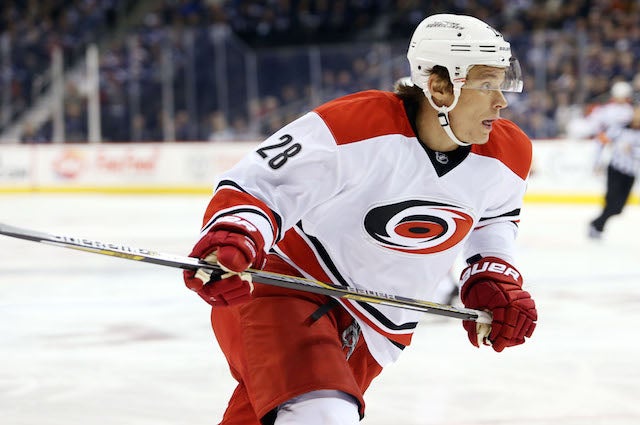
Alexander Semin, Carolina Hurricanes
Contract remaining: Three years, $21 million ($7 million against the cap per year)
Would a buyout make sense: No way. As it stands, Semin's contract is not a good one. He's expensive, he is 30 years old and his production fell off the map this past season. But the Hurricanes are not a team that has a bottomless pit of money to work with, and if they were to buy out the remaining three years of his contract he would count more than $2.3 million against their salary cap every year through the 2021 season. That ... would not be good, especially for a team that usually works against its own internal cap rather than the league salary cap. Plus, I think Semin can still be a useful player in the NHL. Maybe not a $7 million-per-year player, but somebody who can still contribute. Because of that, there still might even be some trade value there, even if it means taking on another team's bad contract in return.
Vincent Lecavalier, Philadelphia Flyers
Contract remaining: Three years, $13.5 million ($4.5 million against the cap per year)
Would a buyout make sense: Yes. The Flyers are once again trying to trade him but that might be easier said than done. He's 35 and is a shell of his former self. But stranger things have happened in the NHL. If the Flyers can't make a trade work, a buyout may not be the worst option. It would save them roughly $2 million in cap space over the next three years (when Lecavalier would cost them more than $4 million against the cap if he continued to play for them) and then drop down to $880,000 per year over the three years that followed.
Rob Scuderi, Pittsburgh Penguins
Contract remaining: Two years, $5.7 million ($3.75 million against the cap per year)
Would a buyout make sense: Penguins general manager Jim Rutherford already told Seth Rorabaugh of the Pittsburgh Post-Gazette that the team does not have any plans to use a buyout this summer. But it should when it comes to the 36-year-old defenseman. One of the final blunders from the Ray Shero era in Pittsburgh, Scuderi's contract could be described as questionable at best from the very beginning due to the length and dollar amount for a player who had clearly already played his best hockey in the NHL. Given the Penguins' salary cap situation, their need for more depth up front and their stated desire to go with a youth movement on defense, a buyout of the remaining two years of Scuderi's contract not only makes sense, it should be a requirement for their off-season to begin. Even though it would cost between $1.2 million and $1.7 million against the cap over the next two years, that is still better than Scuderi counting more than $3.7 million against the cap to be a third-pairing defenseman when the team has so many internal options at the position and so many other areas of need throughout the lineup. With contracts for Christian Ehrhoff and Paul Martin coming off the books (and freeing up $9 million in salary cap space) a Scuderi buyout would give them more than $11 million in money to search for forward help.
Contract remaining: Four years, $19 million ($4.25 million per year against the salary cap)
Would a buyout make sense: Probably. Hodgson has been a disappointment since signing a six-year extension with the Sabres, and general manager Tim Murray has already said the team is considering using a buyout on the 24-year-old winger after his 13-point (in 78 games) season. Because Hodgson is under the age of 26, the Sabres would only be responsible for paying one-third of his remaining player salary over double the years remaining on his current deal. That means Buffalo would be on the hook for less than $800,000 per year through 2023. That's a long time, but it's not a completely damaging number.
David Clarkson, Columbus Blue Jackets
Contract remaining: Five years, $25.9 million ($5.25 million against the salary cap)
Would a buyout make sense: No. The contract is pretty much buyout proof as any buyout would only save the team about $1 million per season over the next five years. The Blue Jackets are better off letting him play out the contract and seeing what they can get out of him.
Mike Richards, Los Angeles Kings
Contract remaining: Five years, $22 million ($5.75 million per year against the cap)
Would a buyout make sense: Probably not. Richards has been a key part of two Stanley Cup-winning teams in Los Angeles thanks to his two-way play, but offensively he is a shell of his former self as his production has steadily declined for three years now. But a buyout would be costly, and even though it would save the Kings a few million over the next couple of years, the savings would be minimal at best in 2019 and 2010 (the buyout that year would only save them $1 million against the cap).
Stephen Weiss, Detroit Red Wings
Contract remaining: Three years, $16 million
Would a buyout make sense: Yes, it probably would. At one time -- not that long ago -- Weiss was an outstanding player, averaging 60 points per season over a four-year stretch and playing a strong two-way game. Had he played on better teams he would have been more well known throughout the NHL for just how good he was. But injuries and age have unfortunately crushed his career over the past few seasons, to the point where he has managed to play in just 95 out of a possible 212 games since the start of the 2012-13 season and record just 33 points. A buyout would save the Red Wings between $2 million and $3 million against the cap over the next three seasons before counting $1.6 million against the cap for three additional years.