Ohio State vs. Clemson, Sugar Bowl 2021: Five keys to help you pick the playoff semifinal game
The Buckeyes and Tigers are squaring off for the third time in a College Football Playoff semifinal

•
8 min read
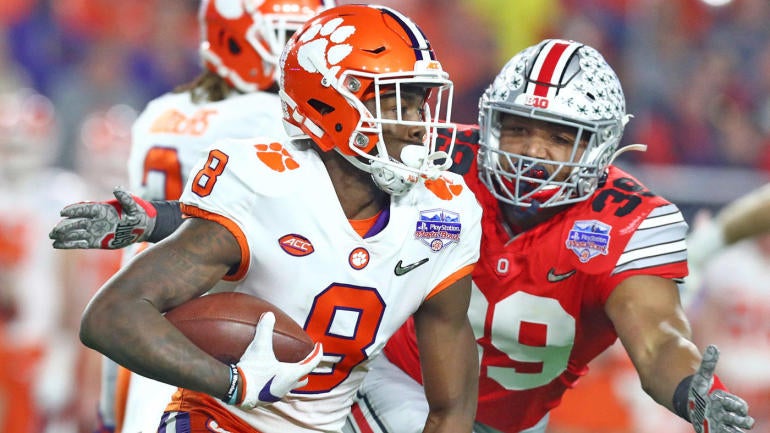
The top-heavy nature of college football should not make it as much of a surprise, so instead we should the modern rivalry that's unfolding when No. 2 Clemson takes on No. 3 Ohio State in the Sugar Bowl semifinal of the College Football Playoff. The series between the programs started with a bang, or rather a punch, when Ohio State coach Woody Hayes socked a Clemson player at the end of the 1978 Gator Bowl.
The teams did not meet again until the 2014 Orange Bowl when Dabo Swinney announced the Tigers' arrival as a college football power following a 40-35 win against Urban Meyer's Buckeyes. Clemson went on to become one of the two most successful programs of the College Football Playoff era, including two wins against Ohio State in CFP semifinals.
Now set for a rematch of last year's Fiesta Bowl, Clemson looks to return to the CFP National Championship for the third year in a row while Ohio State hopes to notch its first-ever win against the Tigers. With so much on the line for both teams and both programs, here are five keys to the Sugar Bowl.
1. Justin Fields has to play well
The battle of quarterbacks, featuring two players who ranked as the top prospects in the country and will be compared to each other as NFL Draft debates heat up, is an easy place to start. This game and this matchup against Clemson's defense is a chance for Fields to show the gap between him and Clemson's Trevor Lawrence is as close now as it was when they were those highly-touted high school prospects. Fields had his worst passer rating of the year in last season's Fiesta Bowl semifinal, and after throwing just one interception all season, he gave away two in the loss, including the game-clincher for Clemson in the end zone during Ohio State's final drive.
Now, Fields shows up in New Orleans coming off one of the worst performances of his career, completing just 12-of-27 passes for 114 yards with no touchdowns and two interceptions in the Big Ten Championship Game against Northwestern. Some of those struggles can be attributed to a thumb injury and the Wildcats' stellar pass defense, as well as the absence of wide receiver Chris Olave, who missed the game because of COVID-19 protocols. But while Ohio State's defense and a record day for running back Trey Sermon were able to guide the Buckeyes to victory through Fields' struggles, that will likely not be the case against Clemson.
A big reason for that will be Lawrence. The Tigers quarterback has thrown eight touchdowns and zero interceptions in four College Football Playoff starts, and Clemson has fully unleashed his talents here at the end of the 2020 season. Lawrence threw for 322 yards and two touchdowns with 90 rushing yards and a score on the ground against Notre Dame in the ACC Championship Game.
2. Ohio State must convert in the red zone
The Buckeyes "won the box score" in last year's Fiesta Bowl with more total yards and first downs ... so what happened? Well, Ohio State's first three trips into the red zone all resulted in field goals, allowing Clemson to hang in the game and negating the impact of the Buckeyes' fast start. The fumble return touchdown that wasn't and a targeting call on Lawrence were no doubt huge swings in this heavyweight bout, but touchdowns on those three red zone visits instead of field goals more than makes up the six-point difference on the scoreboard at the end of the game.
Unfortunately for Ohio State, this is part of Clemson's identity and not an area where the Buckeyes have excelled this season. Ohio State ranks No. 101 nationally in red zone conversion rate and No. 67 nationally in red zone touchdown conversions, while Clemson's defense ranks in the top 30 nationally in both opponent red zone conversions and opponent red zone touchdown rate this year. Look no further than the last time out as Notre Dame moved the ball well early in the game, getting inside the 30-yard line on each of its first three offensive drives. The results of those drives were field goal, missed field goal and turnover on downs. Instead of having three touchdowns on the board, Notre Dame found itself down 24-3 at halftime. If Ohio State can't convert in scoring position, it will face a similar fate on Friday.
3. Clemson must stop the run, Fields included
The second part first, because the inability to keep contain and limit Notre Dame QB Ian Book's ability to get outside of the pocket and make plays was one of the biggest factors in Clemson's only loss this season. Book used his legs to extend plays for throws downfield and contributed to the running game as well as the team's second-leading rusher, exposing the value of multiple key contributors who were missing for the Tigers defense in the loss. Now, while Clemson's defense may be as healthy as its been all year, there is a step up in the challenge of limiting Fields, who does all of those same things but at an even higher level.
Ohio State's offense ranked in the top 10 nationally largely because of Fields and his ability to evade pressure, make throws on the run and even take off running for first downs and scores. Clemson will likely try to blitz fields in obvious passing situations, but those pass rushers have to get home and avoid missed tackles that create open space for Fields to pick up chunk yardage.
Now the first part, which is more about Ohio State avoiding those third-and-long situations with a ground game that needs to be productive on early downs. Fields playing hero ball can be a feature but it should not be the entire game plan against Clemson because the Buckeyes are so much more effective when they are balanced. It opens up the downfield passing game, creates more opportunities for Fields in designed runs and generally keeps opposing defenses on their heels and easier to dissect from the quarterback position. Of course, establishing that ground game is going to be difficult against a Clemson defense that ranks No. 5 in the country allowing just 2.79 yards per attempt and No. 8 nationally allowing just 99.8 yards per game.
4. Clemson's WRs vs. Ohio State's DBs
Of all the positional matchups, Clemson's pass game against Ohio State's pass defense narrowly takes the edge as the biggest key over the Tigers' offensive line against the Buckeyes' defensive front. Much of that is a result one very troubling performance: 491 passing yards and five touchdowns allowed in the 42-35 win against Indiana. If Ohio State had a larger body of work then maybe that game, which was notable for how the Hoosiers were able to storm back from a 35-7 deficit late through the passing game, would not carry as much weight. After all, the Buckeyes did not allow 300 yards passing against any other opponent and the team's pass defense statistics against everyone but Indiana includes just four touchdowns to five interceptions.
One of the biggest questions for Clemson coming into the year was how the team would respond following the loss of Tee Higgins and Justyn Ross, and the response from Trevor Lawrence and a pair of senior wide receivers (Cornell Powell and Amari Rodgers) has resulted in one of the best passing attacks in school history. The Tigers' passing attack is averaging 343.8 yards per game, which is the best in the ACC and No. 7 among all FBS teams. Even more, it's 10 yards per game ahead of the school-record mark of 333.9 passing yards per game set by Deshaun Watson and the national championship-winning Tigers in 2016. If Clemson plays up to that standard against Ohio State, and the Buckeyes cannot limit the explosive plays through the passing game, it's going to be a long evening in the Superdome for that secondary.
5. Chess match in the booth, on the sideline
Clemson offensive coordinator Tony Elliott did not make the trip because of COVID-19 protocol. That might not have a huge impact on the opening frame of the game since I'm sure he'll still be heavily involved in the script, but not having him in the booth to participate in some of those in-game adjustments in the same way is going to be something to watch. Elliott's presence in the stadium might only be the difference between two or three play calls, but in a game of this magnitude, those could be the difference between winning and losing. Also of note: Elliott is the running backs coach and has a unique relationship with Travis Etienne. Clemson needs Etienne to be a factor, and he'll need to do that without Elliott in the locker room.
Additionally, what might current Boston College coach Jeff Hafley have to say about the game? The Eagles did a great job of threatening the upset early in the season in the first game without Lawrence in the lineup, and Hafley was a huge part of Ohio State's efforts to limit Clemson in last year's Fiesta Bowl as the Buckeyes defensive coordinator. Would Hafley help out his old team or stick up for the ACC? My thoughts are he's going to favor the former rather than the latter.
Ultimately, this chess match will be about who makes the right adjustments once we get into the flow of the game, when do they decide to take risks and what happens in key third down and red zone situations. Games come down to players making plays, but execution alone won't be enough if the scheme isn't helping give them an edge in this high-stakes showdown between college football's elite teams.