World Series 2022: How the Phillies built their NL champion roster through trades, free agency and the draft
Philadelphia snapped the NL's longest postseason drought this year and won its first pennant since 2009

By
Mike Axisa
•
10 min read
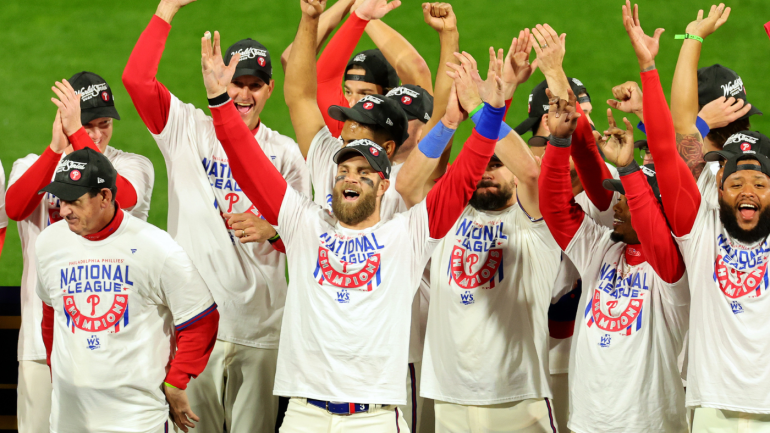
For the first time since 2009, the Philadelphia Phillies are National League champions. It is their first postseason trip since 2011, snapping the NL's longest postseason drought, and they ousted the St. Louis Cardinals, defending World Series champion Atlanta Braves, and San Diego Padres en route to a World Series date with the Houston Astros. The Phillies will look to win their first World Series title since 2008 and only their third all-time (1980 and 2008).
Like every team, the Phillies were assembled through all sorts of different methods. No team is built exclusively through the draft, or trades, or free agency. It's not possible. Successful teams acquire talent through every avenue available. Here is how the Phillies constructed their 26-man postseason roster:
- Trades: 10
- Draft: 8
- Free agency: 5
- International free agency: 2
- Other: 1
The Phillies only have five major league free agents on their roster but four of the five were major signings, and to some extent the signings were made to paper over player development failures. Between Cole Hamels (2002) and J.P. Crawford (2013), the Phillies had a lot of first-round picks flame out or turn into only minor contributors, hence their decade-long postseason drought.
The player development tide has begun to turn, and the Phillies have supplemented their roster well through trades these last few seasons. Let's take a deeper look at how the Phillies built the roster that carried them to the 2022 World Series.
The draft

In a perfect world, teams would draft and develop their entire 26-man roster into superstars, meaning they never have to spend money on free agents or give up players in trades. That world does not exist. Not even close. That said, the draft remains the best (and most cost effective) way to acquire talent, and the Phillies acquired several current core players after a decade of draft and player development misfires.
Most notably, World Series Game 1 starter Aaron Nola was Philadelphia's first-round pick in 2014 (No. 7 overall selection) and he was in the big leagues to stay a little more than a year later. Nola has since developed into a bona fide workhorse who is fourth in innings (1,150 2/3) and fourth in WAR (28.3) since 2016. He doesn't get enough credit for being an ace, but make no mistake, Nola is a top of the rotation starter. He is also Philadelphia's longest-tenured player.
Third baseman Alec Bohm (No. 3 pick in 2018) and shortstop Bryson Stott (No. 14 pick in 2019) were selected in the first round in back-to-back drafts and now form the Phillies' left side of the infield. Bohm has had some defensive misadventures over the years, though he's turned himself into a competent defender, while Stott's improving contact rate puts him on track for a 2023 breakout. Prior to Bohm, the last position player selected in the first round by Phillies to play 300 MLB games for the Phillies was Chase Utley in 2000, if you can believe that.
In the later rounds, the Phillies hit a home run with first baseman Rhys Hoskins (fifth round in 2014), who improved his approach in the minors and had a breakout 38-homer season in Double-A in 2016. He is the team's longest-tenured position player. Fellow mid-rounders Dalton Guthrie (sixth round in 2017) and Matt Vierling (fifth round in 2018) are on the bench and righty Connor Brogdon (tenth round in 2017), who got seven enormous outs in Game 4 of the NLCS, is in the bullpen. Lefty Bailey Falter (fifth round in 2015) made a start in the NLCS as well.
The first-round picks get all the attention and that's understandable, but the mid-to-late rounds are where organizational depth is built. Turning a fifth-round pick in Falter saves you from spending $10 million on a No. 5 starter in free agency. Utility guys like Guthrie and Vierling contribute in platoon roles. Nola and Hoskins are cornerstone players. Bohm and Stott aren't there yet but are trending that way. After years of poor draft results, the Phillies have begun to crank out high-end talent.
Trades

The Phillies acquired three starting position players and three of their four best relievers through trades. Most notably, they landed three-time All-Star catcher J.T. Realmuto in a four-player blockbuster when the Marlins held their most recent fire sale during the 2017-18 offseason. Righty Sixto Sánchez, the main piece who went to Miami in the trade, had an impressive rookie season in 2020, though he has not pitched since due to ongoing shoulder issues. The Realmuto trade has proven to be a steal, and Philadelphia brought him back on a five-year, $115 million contract two years ago.
After being a first-round pick in 2013, J.P. Crawford made it to the big leagues in 2017, though he struggled initially and spent 2017-18 shuttling back and forth between Triple-A and MLB. The Phillies eventually cashed him in as a trade chip, sending him to the Mariners with Carlos Santana for second baseman Jean Segura and two relievers no longer in the organization. The trade was part of Seattle's rebuild and also shuffled some salary around. Since the trade, Crawford has out-WAR-ed Segura (9.7 to 8.4), though I don't think the Phillies regret this one. Segura's had some huge moments this postseason.
Center fielder Brandon Marsh was acquired at this year's trade deadline in a fun and rare young player-for-young player trade when catching prospect Logan O'Hoppe, Philadelphia's No. 1 position player prospect at the time, went to the Angels. Marsh hit a big three-run home run in the NLDS and his center field defense alone makes him a massive upgrade over the guys the Phillies have run out there the last few years. Marsh was a subtle pickup who drastically improved the team. That's three players at crucial up-the-middle positions -- Marsh, Realmuto, Segura -- acquired via trade.
Hard-throwing lefty José Alvarado came over in a three-team, three-player trade with the Dodgers and Rays in December 2020. Alvarado was eligible for arbitration and rarely do the Rays keep arbitration-eligible relievers, seeing them as too volatile, too expensive or both. So, Alvarado went from the Rays to the Phillies, fellow lefty reliever Garrett Cleavinger went from the Phillies to the Dodgers, and minor league first baseman Dillon Paulson went from the Dodgers to the Rays. Alvarado has been utterly dominant the last few weeks.
For most of his Phillies tenure, righty Zach Eflin was a starter and a good one, but a late season knee injury forced a move into the bullpen late this year, and he quickly assumed a high-leverage role. Eflin is well-traveled -- originally a Padres' draft pick in 2012, he went from San Diego to the Dodgers in the Matt Kemp/Yasmani Grandal trade in December 2014, and the very next day the Dodgers flipped him to the Phillies as part of the Jimmy Rollins trade. Nifty little rebuild trade for the Phillies.
Righties David Robertson (Cubs) and Noah Syndergaard (Angels) were acquired at this year's trade deadline and fellow righty Kyle Gibson (Rangers) was acquired last trade deadline. The Phillies gave up Mickey Moniak, the No. 1 pick in the 2016 draft, to get Syndergaard, though Moniak's star as faded significantly, while righty Ben Brown went to the Cubs in the Robertson trade and still has a chance to be a player. Injuries and ineffectiveness have limited Robertson's, Syndergaard's, and Gibson's roles this postseason, though Robertson and Syndergaard could still make a difference in the World Series. Maybe the Phillies miss Brown down the road. They certainly don't right now though.
Backup catcher Garrett Stubbs is one of two players in the World Series to have played for both the Astros and Phillies (Houston reliever Hector Neris is the other) and he went from the Astros to the Phillies in a minor trade last offseason. "I'm going to try to do everything I can to beat them," Stubbs said after the NLCS. Utility infielder Edmundo Sosa came over in a minor deadline deal with the Cardinals this summer. Marsh, Robertson, and Sosa raised the floor of the roster while Alvarado, Eflin, Segura, and particularly Realmuto are legitimate difference-makers for a World Series contender. That some nice tradecraft by the Phillies.
Free agency
Generally speaking, free agency is the least efficient way to acquire talent in terms of cost vs. production. The Phillies have been fairly aggressive in free agency the last few years because they've had to be. The farm system didn't provide enough players to get the team moving in the right direction, so they papered over their player development shortcomings with free agents. Now those free agents are among Philadelphia's best and most important players. It has been money well spent.
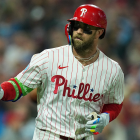
Most notably, the Phillies landed wunderkind Bryce Harper with a 13-year, $330 million contract in March 2019 and he's been more productive with Philadelphia (150 OPS+) than he was with the Nationals (139 OPS+). Harper was named NL MVP last season and last weekend he slugged a titanic NLCS-winning home run. It is one of the greatest moments in franchise history, truly.
Following Harper's first season with the team, the Phillies imported right-hander Zack Wheeler with a five-year contract worth $118 million that has proven to be a steal. Wheeler battled injuries throughout his tenure with the NL East rival Mets, though he had obvious untapped potential, and the Phillies have unlocked it: 437 1/3 innings with a 2.82 ERA with Philadelphia. Wheeler has a 1.78 ERA and a 0.51 WHIP this postseason. This has not aged well:
"[We] helped him parlay two good half-seasons over the last 5 years into $118 million"
— SNY (@SNYtv) February 14, 2020
Brodie Van Wagenen took a jab back at Zack Wheeler https://t.co/0IUMO7XwAj pic.twitter.com/sHFv2yv2Lb
Last offseason, the Phillies went offense over defense, signing Kyle Schwarber (four years, $79 million) and Nick Castellanos (five years, $100 million) in the span of three days. Schwarber led the National League with 46 homers this year and had a monster NLCS. Castellanos had a down regular season around an oblique injury, though he drove in five runs in the four-game NLDS win over the Braves. In terms of production vs. dollars, yeah, Schwarber and Castellanos are overpaid. But the Phillies are in the World Series. Do you really think they care they're paying more per WAR than other teams?
The fifth MLB free agent on Philadelphia's postseason roster is lefty reliever Brad Hand (one year and $6 million). Like his last few seasons, Hand was up and down this year, but largely reliable in the middle relief role. Hand will likely be the guy who gets to face Yordan Alvarez in the World Series whenever Alvarado is unavailable. Harper and Wheeler are the Phillies' best hitter and pitcher, and they were both signed to large free agent contracts. You would be hard pressed to spend money better than that in free agency. Castellanos, Hand, and particularly Schwarber have also contributed to the cause in 2022.
International free agency
There are two ways to acquire amateur talent: the draft and international free agency. The Phillies haven't always knocked it out of the park on the international market, thought their two recent hits are big ones: Seranthony Domínguez and Ranger Suárez. Domínguez has been Philadelphia's best reliever this postseason and really all year. He's struck out 15 of the 26 batters he's faced in October and will be tasked with getting the biggest outs against the middle of the Astros lineup in the World Series.
Hardcore prospect hounds still marvel at Suárez's breakout season in the Venezuelan Summer League in 2014 (78 strikeouts and one walk!) and these last two years he's emerged as a reliable ground-balling No. 3 starter behind Wheeler and Nola. Domínguez recorded the final out of the NLDS and Suárez came out of the bullpen to get the final out of the NLCS. Philadelphia's international success is not on par with Houston's (few teams are) but they landed their top reliever and No. 3 starter for matching $25,000 bonuses back in the day. Domínguez and Suárez are massive player development success stories playing huge roles for a pennant winner.
Other
There aren't many other ways to acquire players in this sport and the Phillies have just one player on their postseason roster who was not drafted, signed as an international or MLB free agent, or acquired in a trade first: Andrew Bellatti. The well-traveled righty reliever is with his fifth organization in the last six years, and he joined the Phillies on a minor-league contract last November. He was called up in mid-April and threw 54 1/3 innings with 78 strikeouts and a 3.31 ERA. Bellatti had thrown 26 2/3 big league innings in his career prior to 2022. Turning a zero-risk minor-league contract into a steady middle reliever is certainly not a sexy move, but it's the kind of move that helps teams win and reach the postseason.
Like every good team, the Phillies have built their 2022 NL championship roster through every available avenue. They landed key contributors through the draft (Hoskins and Nola) and international free agency (Domínguez and Suárez), they spent on free agents (Castellanos, Harper, Schwarber, Wheeler), and they also did fine work on the trade market (Eflin, Marsh, Realmuto, Segura) over the years. There is no right way to build a team. The right way is the way that works, and this is working for Philadelphia.