Texans vs. Colts pick, how to watch: Colts O-Line, Watson-Hopkins connection to play big roles in AFC Wild Card
Inside the key matchups that will determine who wins this playoff game between AFC South squads

By
Jared Dubin
•
10 min read
The opening game of the first round of the 2018 NFL playoffs features a battle between two teams from the same division. After spending years toiling as the worst division in football, the AFC South has two teams in the postseason for the second-consecutive year. Naturally, they are the two teams that did not make it a year ago: the division champion Houston Texans and the Indianapolis Colts.
The two teams ended up in the playoffs in extremely similar fashions. Houston began the season with three-consecutive losses, only to then reel off nine-straight wins to stake themselves to a division lead. They lost twice more down the stretch, but those two losses were by a combined five points, and both to teams that made the playoffs. The Colts began the year 1-5, then won five straight, lost in embarrassing fashion to the Jaguars, and finally reeled off four-consecutive wins to end the season, including a playoff play-in game against the Titans in Week 17.
Stream Saturday night's and Sunday's playoff games on fuboTV, try it for free, and stream the CBS games on CBS All Access.
The Texans finished the year 11-5 and the Colts 10-6, but the two teams had virtually identical resumes. Houston had a point differential of plus-86 to Indy's plus-89. Both teams went 6-2 at home, 4-2 in the division, 7-2 indoors, and 3-2 on grass fields. The only thing separating them in the standings is that, well, the Colts played for the win instead of the tie in Week 4, and the Texans ended up with a win because of it. That's why Houston, not Indianapolis, is hosting this game.
In other words, these two teams are incredibly evenly-matched, even if not necessarily stylistically similar. And because they are, it should make for one entertaining playoff opener.
Texans pass rush vs. Andrew Luck and the Colts offensive line
For years, Andrew Luck was one of the most heavily-pressured quarterbacks in the NFL. If there was one thing that was consistently true about the Colts' offense during the first five years of Luck's career, it was that their offensive line struggles meant Luck was constantly dealing with defenders in his face and on his body. That was not the case at all during the 2018 regular season. Luck was pressured and sacked far less often in 2018 than at any other point in his career.
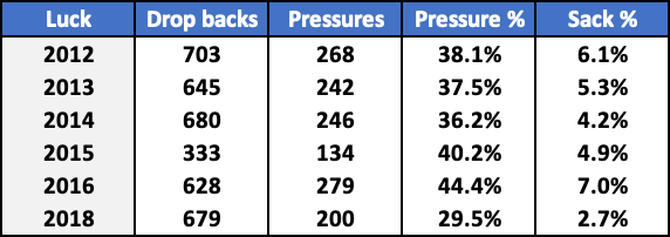
Luck's 29.5 percent pressure rate, per Pro Football Focus, was the sixth-lowest among qualified quarterbacks. His sack rate of 9.0 percent on plays where he was pressured was the lowest in the NFL, as was his 2.7 percent overall sack rate. All three of those figures were also easily the best of his career.
Colts offensive coordinator Nick Sirianni, offensive line coach Dave DeGuglielmo, quarterbacks coach Marcus Brady, and offensive linemen Anthony Costanzo, Quenton Nelson, Ryan Kelly, Mark Glowinski, and Braden Smith deserve the lion's share of the credit here. Linemen Matt Slauson, La'Raven Clark, Evan Boehm, and Joe Haeg, who each filled in at one spot or another along the line throughout the year when one of the starters was injured, should be credited as well.
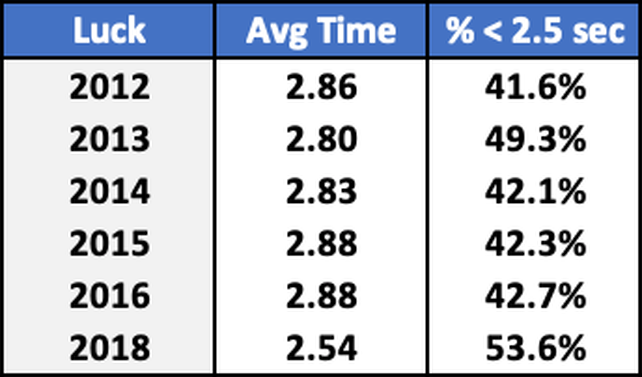
But Luck himself also deserves plaudits for speeding up his delivery. According to Pro Football Focus, Luck allowed an average of only 2.54 seconds to tick on by between the snap and his average pass. That time-to-throw average was eighth-fastest in the NFL, but it was also by far the fastest of Luck's career. He had previously taken at least 2.80 seconds, on average, before throwing, in every single season of his career. And after seeing his percentage of throws that came within 2.5 seconds of the snap hover in the low-40s for most of his career, Luck threw considerably more than half his passes inside of that window this year.
Will the Texans be able to break through with pressure on Luck come Saturday? Presumably not. Despite employing a few of the best pass-rushers in the game, Houston did not have an especially high pressure rate this season. They got to the quarterback with a sack, hit, or hurry on 32.2 percent of opponent drop backs this season, per PFF, a slightly below-average rate. If J.J. Watt (75 pressures), Jadeveon Clowney (59 pressures), or Whitney Mercilus (42 pressures) didn't get to the quarterback, then it's likely that nobody did. The three players with the next-highest pressure totals (D.J. Reader, Christian Covington, Antonio Blackson) combined for fewer pressures (51) than Clowney.
In the two games they played against the Colts this season, the Texans pressured Luck on 34 of 113 drop backs, per PFF, a rate of 30.0 percent that checked in below their season-long average (32.2 percent) and was almost exactly equal to Luck's own average (29.5 percent). The pressure was almost equally split between the two games, with Luck feeling heat on 28 percent of his drop backs in the first game (a three-point Texans win) and 33 percent in the second game (a three-point Colts win). And based on the way Luck performed when under pressure and when throwing from a clean pocket in those two games (as well as the balance of the season), the Texans better hope they can figure out a way to get to him during the teams' third matchup of the season.
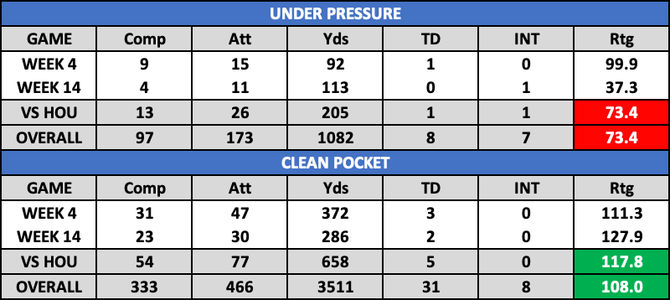
With numbers like those, one might think it's advisable for the Texans to send extra rushers after Luck in order to ensure they get pressure. But that's not necessarily the case. First, the Texans blitz at only an average rate (27.7 percent of opponent drop backs), so they'd be making a pretty stark change from their typical strategy if they began heavily blitzing in Round 1. Throwing a changeup like that can catch an opponent by surprise, but it can also backfire as the team would suddenly be executing a far different system than usual. Second, the Texans sending just one extra rusher did not often result in them getting more pressure. It typically necessitated sending two or more extra rushers, which leaves only five players in coverage against T.Y. Hilton, Eric Ebron and company. And third, Luck was even better against blitzing defenses (104.5 passer rating) than he was against standard defenses (96.9) this season.
Instead, the Texans are going to have to rely on their guys up front to win their individual battles. Watt and Clowney and Mercilus and Reader and Covington winning straight up against Costanzo, Nelson, Kelly, Glowinski, and Smith is their key to the game.
Colts' back seven vs. Deshaun Watson and DeAndre Hopkins
The Indianapolis defense improved this season by almost as great an amount as the team's offensive line. The Colts ranked 11th in yards allowed, 10th in points allowed, and 10th in Football Outsiders' defensive DVOA. Those rankings were up from 30th, 30th, and 27th in 2017. Defensive coordinator Matt Eberflus and rookie linebacker Darius Leonard have gotten much of the credit for the team's improvement, and those two absolutely deserve it. What concerns us for this game, though, is that while the Colts' run defense has gone from above-average to elite (improving from 10th to fourth in run defense DVOA), their pass defense has merely gone from atrocious to below-average (30th to 20th in pass defense DVOA), which means there should be room here for the Texans to make some plays in the air on Saturday.
The Houston pass offense has gone through a whole bunch of changes this season. Will Fuller began the year as the No. 2 wideout and a significant contributor in the pass offense. After sitting out Week 1, Fuller returned and scored in three-straight games, catching 17 of 25 throws in his direction for 263 yards and three scores. Then he began being affected by hamstring injuries and had a series of subpar performances while playing banged up. He totaled 10 catches for 116 yards and did not score from Week 5 through Week 7. Taken off the injury report for the team's Week 8 game against the Dolphins, Fuller exploded for five catches, 124 yards, and a touchdown ... only to tear his ACL while drawing a pass interference penalty.
During this time, rookie slot man Keke Coutee was in and out of the lineup due to injury issues of his own. Coutee missed the first three games of the season with a hamstring injury, returned to the lineup with one of the best debut games in NFL history (11 catches, 109 yards), followed that up with a six-catch, 51-yard, one-touchdown performance against the Cowboys, and then promptly had to leave each of the next two games due to injury. He returned in Week 11 and caught five passes for 77 yards, then got injured again in Week 12 and has not played since. He is, however, expected to be available for the wild-card game.
With Fuller done for the year and Coutee intermittently injured, the Texans swung a trade for Demaryius Thomas. The former Broncos wideout played against the Broncos in his first game, caught passes on the first two plays from scrimmage, and then disappeared from the offense for several weeks, resurfacing only to catch two red-zone touchdowns in a win against the Titans. He then ruptured his Achilles during a Week 16 loss to the Eagles.
The Texans have also cycled through three tight ends throughout the season, seemingly favoring a different one of them at different times. The veteran Ryan Griffin has played most often, but rookies Jordan Thomas and Jordan Akins have factored in on occasion, as well.
The lone constant, of course, has been DeAndre Hopkins. He is one of just three Texans, along with Deshaun Watson and center Nick Martin, to start every game this season. He put together what was likely his best season as a pro, catching a career-high 115 passes for a career-high 1,572 yards and 11 touchdowns. His 70.6 percent catch rate was also a career-high figure, and this was the first season ever where he did not drop a single pass. (He had one lonely drop as a rookie back in 2013.) There were 40 receivers in the NFL that were targeted at least 85 times this season; among that group, Hopkins ranked fifth in passer rating generated on throws in his direction, at 117.8.
Hopkins was not shadowed by the Colts in either of the teams' matchups during the regular season, and I don't expect that he'll see shadow coverage on Saturday either. He lines up at the left wide receiver spot more often than anywhere else (47 percent of his snaps, per PFF) so he will see Pierre Desir a lot, but he also spends plenty of time on the right side (31 percent) and in the slot (22 percent) so he'll also spend time wrangling with Quincy Wilson and Kenny Moore. The Colts also seem likely to roll safety coverage toward Hopkins, mostly because they would have to be insane not to. And that means Malik Hooker and either Clayton Geathers or whoever is on the field in Geathers' place (his status is currently up in the air; George Odum got most of the playing time last week) will have coverage responsibilities on Hopkins, as well.
During those two games against the Colts, Hopkins had very different performances. He exploded for 10 catches, 169 yards, and a score in the first contest, but had only four catches for 36 yards and a score in the second game. The latter game was arguably Hopkins' worst of the season, in terms of his production. Hopkins has been on a crazy roll the past few weeks, though, exploding for 10-170-2, 9-104, and 12-147 over the final three games of the year despite playing with an ankle injury. And it's not as though the Colts have a corner or even a tandem of players who really has the advantage over him in coverage.
Hopkins had 12 deep catches (defined by PFF as throws that traveled 20-plus yards in the air) this season, for example, and three of them came against the Colts. He gained 84 yards on those plays, and Watson completed two of his three other deep passes against Indianapolis, gaining 49 additional yards. Watson did not throw deep quite as often this year as he did a year ago, nor was he quite as productive on those throws, but he did do well with them against the Colts, who ranked 17th in DVOA against deep passes this season, per Football Outsiders.
For the Colts to pull off the road upset, they'll have to keep Watson's downfield passing game in check. That means slowing down Hopkins. It's easier said than done.
Prediction: Colts 30, Texans 24