College basketball grades: Duke, North Carolina, Michigan headline top frontcourts in America, re-ranked
A baker's dozen worth of dominant frontcourts have emerged, plus why the double-big lineups have become a trend.

•
9 min read
College basketball is in its supersized era. This season is shaping up to feature the tallest iteration of the sport with jumbo lineups in places like Florida, Michigan, Arizona, Duke and Illinois here to stay.
According to KenPom, there are 94 teams in America with an average height of 6-foot-6, measured by who is on the floor. Ninety-four! It's a whole new world compared to 2019-20, when only 35 teams had an average height north of 6-foot-6.
The reasons are obvious. To steal a football analogy, "big people move little people." Controlling the glass and the paint has become a way to extract a high-floor outcome.
Double big line-ups are back in a big way in college basketball, especially among the nation’s top programs.@Isaac__Trotter & I discussed on this week’s show and then I dove into the numbers for a deeper dive.
— Adam Finkelstein (@AdamFinkelstein) December 9, 2025
📺 https://t.co/GSLBJ8bSVM
📝 https://t.co/vllmmBgK1C pic.twitter.com/1LyMuZezp7
The special sauce kicks in when your big men can splash treys. Illinois' top 3-point shooter this season has been 7-foot-2 center Zvonimir Ivisic (38% on 34 attempts). Wisconsin specifically honed in on 6-10 forward Austin Rapp because he drilled 80 triples a season ago for a 12-win Portland club. College big men taking more 3s isn't a fad, it's a trend, and the terrific Jordan Sperber has the data to prove it.
Guard play may be the separator in March, but 2025-26 is shaping up to be a year of dominant frontcourts that tilt outcomes with brute force.
In the preseason, Florida and Purdue were presumed to be the best frontcourts in the nation, per CBS Sports' Kyle Boone. Where do things sit just over a month later? Let's dive in.

1. Michigan
Dusty May loves his big men, and this may be his best collection yet. The Yaxel Lendeborg, Aday Mara and Morez Johnson trio is helping fuel undefeated Michigan's rise to national championship favorite on Dec. 11 by every predictive metric.
Michigan isn't just winning the paint battle -- it's embarrassing folks. At one point in Tuesday's 89-61 rout of Villanova, the Wolverines outscored the Wildcats 30-2 in paint points. The defense is a fortress, blending switchable athletes with terrifying enforcers on the back line. Opponents are shooting a mind-boggling 36.5% at the rim when 7-foot-3 Mara is on the floor. That's absurd.
For all the fuss about playing Lendeborg, Mara and Johnson together, it's settled in nicely as a piece, not the whole piece. To borrow a baseball reference, May uses the jumbo lineup as an opener to get three quick outs. Michigan's big men play the first three or four minutes together, build a four- or five-point lead by the first media timeout and are rarely seen together again for the rest of the half.
It's unrealistic to expect Michigan to be this dominant all year, but this frontcourt is a problem and the envy of plenty in coaching circles. First-month frontcourt grade: A+

2. Arizona
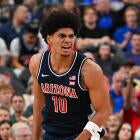
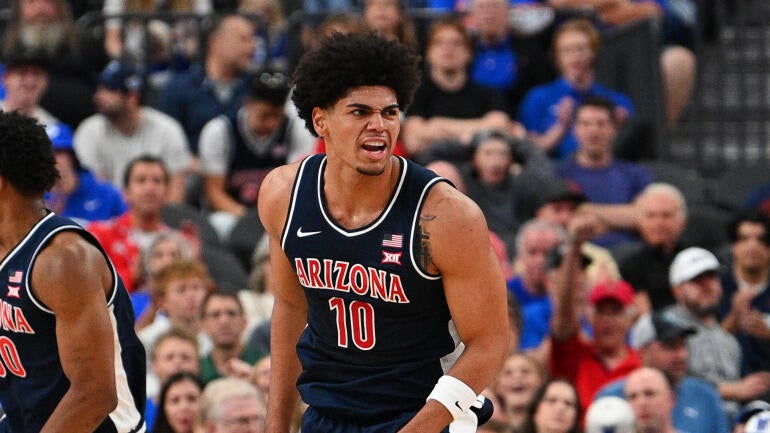
Arizona is a battering ram. The Wildcats have made 72 more 2s than their opponents this year, ranking ninth in the nation, according to CBB Analytics, and illustrating the paint-dominance ethos Tommy Lloyd demands. Arizona's primary three bigs -- Koa Peat, Tobe Awaka and Motiejus Krivas -- have combined for just one 3-pointer, and it hasn't mattered.
The Wildcats are simply overwhelming. They tilt the math in their favor with a barrage of offensive rebounds that boost efficiency and punish teams trying to run in transition. Arizona has found the perfect balance between elite offensive rebounding and elite transition defense. These hard-playing bigs are a huge reason why. Peat is a future first-round pick, and Awaka is the top backup big man in America. First-month frontcourt grade: A+

3. Duke
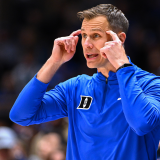
Duke's frontline has both a superstar and some spirit. Out-rebounding Michigan State on the road is a Herculean feat, and Cameron Boozer has a unique ability to claw his way to dominant stat lines almost every night. Boozer's skill at playing turnover-free basketball while dominating the glass and drawing fouls at an absurd rate (6.6 per 40 minutes) tilts all the shot-volume math in Duke's favor.
Jon Scheyer can also rotate Patrick Ngongba and Maliq Brown depending on the matchup. Ngongba has started showing real improvement as a rim protector, and Brown remains a deflections machine. Duke's defense has been stout regardless of who is at the 5-spot, even if the look can change drastically schematically.
Scheyer's frontcourt has every tool in the toolbox. First-month frontcourt grade: A+

4. Gonzaga
Gonzaga has made 135 more 2s than its opponents. Read that again. No other team has more than 92. Michigan had the personnel to match up with Graham Ike and Braden Huff, but when the Zags don't face a historically good shot-blocking team, this frontline dominates. Ike is a tornado of elbows and muscle down the paint, and Huff has one of the premier runners that somehow always finds the bottom of the net.
Huff and Ike combined for 48 points against Kentucky, 39 against Alabama and 34 against Creighton. They are an unrelenting duo in an offense that will feed the big men until they are stopped.
This pound-the-paint mindset also helps Gonzaga be virtually upset-proof, even with some lingering rim protection concerns. First-month frontcourt grade: A

5. Florida
Florida wants to be better than 5-4, but it's hard to be frustrated with this front line. Tommy Haugh has transformed into a star who looks every bit the part of a first-round pick. Rueben Chinyelu has overtaken Micah Handlogten as Florida's top option at the 5, thanks to improved offensive skill alongside his ability to dominate the boards and impact the game defensively. Chinyelu's second-half defensive performance against Boozer was as good as any showing against the Player of the Year favorite all season.
Alex Condon has struggled to find his 3-point stroke and had some frustrating ball-handling gaffes early in November, but everything else is there. The rebounding, rim protection, effort and motor are constants, and he's improved his touch in the paint and at the free-throw line.
So many teams would still want their frontcourt to look like Florida's. First-month frontcourt grade: B

6. Iowa State
Iowa State's front line isn't the deepest, but Joshua Jefferson is playing like an All-American. No high-major big man averages more assists than Jefferson (5.4), and he ranks second in KenPom's National Player of the Year race behind Boozer. Blake Buchanan's emergence as a legitimate weapon has given Iowa State even more staying power. The Virginia transfer has been one of the nation's elite offensive rebounders while adding rim protection and athleticism.
In five games against high-major competition, opponents are shooting just 51% at the rim when Jefferson and Buchanan share the floor. That interior defensive bite, combined with a defense that forces turnovers at a sky-high rate, is a formula T.J. Otzelberger can use to win big.
Keeping Jefferson from entering the portal and landing a piece like Buchanan has been instrumental. First-month frontcourt grade: A+

7. Purdue
Purdue's front-line trio of Trey Kaufman-Renn, Oscar Cluff and Daniel Jacobsen is giving Matt Painter 35 points and 24.4 rebounds per game. You'll take that all day, every day.
Kaufman-Renn has adjusted to a smaller offensive workload, which has allowed him to become an utter menace on the boards. His offensive rebound rate has nearly doubled now that he's a full-time 4-man, and he should still be in the All-American mix.
Purdue is still ironing out some defensive kinks. Kaufman-Renn and Cluff aren't gazelles or trampoline-like leapers, so Purdue must be sharp with positioning and attention to detail. Eventually, the best version of Purdue may feature Jacobsen's shot-blocking and occasional floor-stretching ability, but Cluff has been the better option so far with his dominant work cleaning the glass. Purdue corrals an absurd 52% of its misses when Cluff and Kaufman-Renn share the floor, according to CBB Analytics. First-month frontcourt grade: B+

8. Michigan State
This Michigan State frontline has a nastiness you can't duplicate. Jaxon Kohler and Carson Cooper have become anchors of one of the nation's best defenses. They're big, tough, strong, reliable and trustworthy -- qualities that give the Spartans staying power in the Big Ten. To top it off, they get rim-rattling dunks from Coen Carr, who keeps this group energized.
Tom Izzo has also gotten everything he could want from backups like Cam Ward, a high-energy, mismatch-hunting force, and Jesse McCulloch, who can step out and hit a three.
Michigan State ranks eighth nationally in rebounding margin. That will play. First-month frontcourt grade: A

9. North Carolina
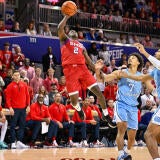
The Henri Veesaar–Caleb Wilson combination gives UNC real appeal. Veesaar and Wilson are fast, hyper-athletic and have developed a near mind-meld in this offense. Wilson, the passer, to Veesaar, the finisher, has generated 19 points this year, according to CBB Analytics -- the third-best mark for an assister-scorer combination for the Tar Heels.
Veesaar, the passer, to Wilson, the finisher, isn't far behind, producing 14 points.
They simply make each other better, and UNC is reaping the rewards. First-month frontcourt grade: A-

10. Illinois
No frontcourt has made more 3-pointers than Illinois. Tomislav Ivisic, Zvonimir Ivisic, Ben Humrichous and David Mirkovic have combined for 51 treys in 10 games. The barrage of 3s from the big men fuels an Illini offense ranked fifth nationally, opening the paint for Keaton Wagler, Andrej Stojakovic and Kylan Boswell to attack mismatches and get downhill.
Illinois' bigs have also shown more versatility this year. Mirkovic is a force on the boards and someone offensive coordinator Tyler Underwood can run mid-post backdowns or pick-and-pops through. Humrichous has become a secondary rim protector and gritty-play contributor. Zvonimir Ivisic (13.4% block rate) can erase shots at the rim, and Tomislav Ivisic is showing more thump as an interior mismatch killer. Illinois scored 14 points directly off Tomislav Ivisic's post-ups in Saturday's win over Tennessee -- the most points from that action in his 39-game sample. First-month frontcourt grade: A

11. St. John's
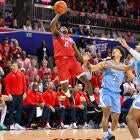
If St. John's wants to be a Tier 1 national championship contender, its guards need to pull the same weight as the bigs. Zuby Ejiofor, Bryce Hopkins, Dillon Mitchell and Ruben Prey have all delivered strong stretches for Rick Pitino. The size, speed and athleticism of the Johnnies' frontline presents a unique challenge. It's impossible to keep them off the offensive glass and hard to defend them without fouling.
Once Pitino can shore up some of the weak links in this armor, St. John's should elevate back into a nasty defense that dominates the boards thanks to this star-studded quartet of forwards. First-month frontcourt grade: B

12. Texas Tech
JT Toppin is still pillaging. The Texas Tech All-American stacks 20-and-10 lines in his sleep and occasionally erupts for a 35-and-11 performance against Illinois. Toppin is inevitable, and Texas Tech's vision for this front line is starting to take shape. Elite shot-blocker Luke Bamgboye is finally healthy and beginning to coalesce into the lineup. Bootyball menace LeJuan Watts is integrating into the mix better by the day.
Grant McCasland knew that building a bigger, better front line was essential if Texas Tech wanted to win a title. This group isn't there yet, but by March, it can go toe-to-toe with anybody. First-month frontcourt grade: B

13. UConn
Tarris Reed's breakout season hasn't fully arrived yet, mostly because of a few nagging leg injuries. While he's been on the mend, freshman Eric Reibe has had a chance to show his worth. The 7-foot-1, 260-pound freshman is going to be a very, very good player in time.
Alex Karaban is back to balling now that he's in a smaller-usage role. He'll give up some size in certain matchups, but makes up for it with a feathery jumper, excellent cutting and a competitive streak. UConn doesn't have the two-big lineup that some teams can trot out, but its frontcourt is potent and dangerous — with room to grow if Reed can stay healthy. First-month frontcourt grade: B+