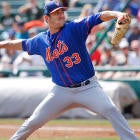
Mets right-hander Matt Harvey made his 2018 spring debut on Wednesday against a Braves lineup that was something close to full strength. In his two innings, Harvey struck out a pair, walked one, and allowed a run. That alone is encouraging enough for a beleaguered hurler who in the past has undergone Tommy John surgery and Thoracic Outlet surgery -- either can be a career-ender -- and also battled a scapula injury that laid him up for 10 weeks or so last season.
Here, though, is something even more encouraging ...
Harvey's first inning: 13 pitches, two backwards Ks, a fastball that touched 96.
— Tim Britton (@TimBritton) February 28, 2018
Harvey last season averaged just 94.4 mph with his fastball. That's an above-average heater in terms of velocity, but it's down from Harvey's peak. Of course, Harvey had good radar-gun readings in 2016 and still struggled badly. It's about velocity, yes, but it's also about having a live fastball. With that in mind, here's an uplifting word regarding Wednesday's outing from Harvey's new manager Mickey Callaway (via Danny Abriano of SNY) ...
"He had that extra gear, that extra life on his fastball."
Need more? How about legendary former Braves manager and current special assistant Bobby Cox, who was on hand for the Grapefruit League encounter (via Kevin Kernan of the New York Post) ...
"He looked like the old Harvey for me. He looked like a No. 1. The velocity was really good. He's in great shape. He looked super."
The "old" Harvey -- the one who finished fourth in the NL Cy Young balloting as a 24-year-old and entered the 2016 season with a career ERA+ of 146 -- hasn't been with us for some time. Consider the trends as Harvey enters this, his age-29 campaign (recall that he missed all of 2014 while recovering from Tommy John surgery) ...
Season | ERA | FIP | K/BB ratio |
2013 | 2.27 | 2.01 | 6.16 |
2015 | 2.71 | 3.05 | 5.08 |
2016 | 4.86 | 3.47 | 3.04 |
2017 | 6.70 | 6.37 | 1.43 |
(FIP stands for Fielding Independent Pitching, which is scaled to look like ERA but reflects just those outcomes that have nothing to do with fielding -- i.e., strikeouts, walks, and home runs allowed. As such, it's a better measure of raw pitching skill than ERA is.)
As you can see, everything is trending in the wrong direction for Harvey. That makes the 2018 season a pivotal one for him one a couple of levels. First, the Mets want to get back to the postseason after an active-by-Wilpon-standards offseason and with a new manager in the dugout. A Harvey renaissance is vital to that goal.
On another level, Harvey is also entering his walk year. If he wants to position himself for that life-changing payday on the market, then he needs to be healthy and effective. He can do that by disinterring his old stuff and velocity (consider Wednesday's effort a promising first step) or prove that he can still get major-league hitters out with something less than vintage offerings. If he gets back even to 2016 levels, when he didn't keep runs off the board but showed stronger underlying indicators, then he's going to make a lot of money. If he's injured and terrible, as he was in 2017, then he may be staring down an NRI in the spring of 2019.
That's something to watch the rest of the camp. We all know the dangers of reading too much into spring performance, but in Harvey's case, when you're looking for any cause at all for forward-looking optimism, maybe you pay a bit more attention. Let's see if the Harvey reviews remain as glowing as we work our way toward Opening Day. In a real way, the next seven months or so will determine the rest of Harvey's career.