NBA contract extension candidates: From Giannis Antetokounmpo's supermax to Markelle Fultz's rookie extension
The 2020 offseason is upon us, and contract extensions have already become a major storyline

•
12 min read
With a flurry of transactions about to take place and the NBA Draft just a day away, don't forget about contract extensions. Teams can officially offer extensions at 6 p.m. ET on Friday, the same time that free agency begins, and there will likely be several completed right around that time. The most relevant extensions, though, are often the ones that don't happen.
On Monday, ESPN's Adrian Wojnarowski reported that the Houston Rockets have pitched James Harden on a two-year, $103 million extension that would keep him signed through the 2024-25 season. He turned it down and reportedly wants to be traded to the Brooklyn Nets.
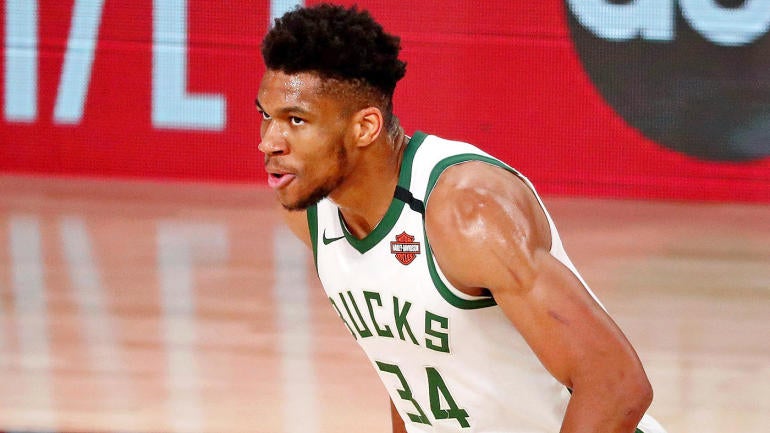
If he wants, Giannis Antetokounmpo can sign a five-year extension worth about $220 million. His decision hangs over not just the Milwaukee Bucks, but several other franchises that have positioned themselves to try to lure him away next summer. The Bucks' trades for Jrue Holiday and Bogdan Bogdanovic can be interpreted as either a sign that they're confident he'll sign or part of their effort to convince him to do so.
Decisions that aren't as obviously significant can have ripple effects, too. P.J. Tucker has wanted an extension since the summer of 2019, and if the Rockets are indeed headed for a teardown, their reticence to pay him will be framed as one of the factors that led them there. The Bucks would not have felt such immense pressure so soon had they signed Antetokounmpo to a five-year "designated rookie" extension in 2016.
Here's a primer for the extension market:
The supermaxes
This is the feature of the collective bargaining agreement meant to give a superstar's current team an advantage -- the salary can start at 35 percent of the cap. The extensions must be signed before the beginning of the regular season.
Antetokounmpo and Utah Jazz center Rudy Gobert sat near each other at Barclays Center during the 2013 NBA Draft, in which the Bucks selected a future MVP with the 15th overall pick and the Jazz stole the second-best prize with the 27th pick. Now they're both eligible to sign supermax extensions, but their situations are drastically different.
Everybody knows the Bucks would love to pay Antetokounmpo as much as they're allowed to. The question is whether there's anything they can do, roster-wise, to convince him to commit before the season starts. Antetokounmpo has been a bit vague about his future, but he has always maintained that his preference is to stay in Milwaukee and compete for championships. The moves the front office has made -- and the ones they need to make to fill out the roster -- will be analyzed both on their merits and in terms of how they do or do not move the needle for its franchise player.
Gobert would surely love to sign a $220 million deal, but there is no indication that Utah is willing to offer him one. It could very well, however, be willing to pay him more than he can get anywhere else. If Gobert cares deeply about the distinction of being a "supermax" player, he could theoretically sign a five-year deal that starts at 35 percent of the cap and decreases each year.
Veteran extensions: The trade candidates
One of the reasons there has been speculation about Gobert being traded is that his extension negotiations have the potential to go sideways. He is among many extension-eligible players whose names have been thrown around the rumor mill.
Like Antetokounmpo and Gobert, Holiday can hit free agency in 2021. He is on the move, but he's also eligible for an extension. This means the Bucks could negotiate an extend-and-trade with Holiday, so that when the deal becomes official, they'll have him under team control for more than one season. The Los Angeles Lakers could theoretically do the same thing with Dennis Schroder.
Andre Iguodala and the Miami Heat arranged an extend-and-trade in February. This scenario is extremely rare, though, because the CBA stipulates that the extensions can be for a maximum of three years with annual raises of no more than five percent.
Other extension-eligible players who are expected to be free agents in 2021 include Gordon Hayward, Victor Oladipo, Josh Richardson, Evan Fournier, Steven Adams, DeMar DeRozan, LaMarcus Aldridge, Will Barton, Andre Drummond and Tucker. All of them have been mentioned in trade rumors, in some cases precisely because extensions seem unlikely.
Other popular trade candidates eligible for extensions include dunk contest legends Zach LaVine and Aaron Gordon. Unlike the first group, they are two years away from free agency. Their teams can offer them an additional three seasons, and if they don't work anything out, expect the trade speculation to continue.
The rookie extensions
After three seasons, players on rookie-scale contracts can sign four-year extensions. The best ones -- i.e. those that teams deem worthy of being a "designated rookie" -- can sign five-year extensions, and the select few that have a legitimate shot of making an All-NBA team next season can negotiate to receive a higher starting salary should they do so. Like the supermax, this type of extension must be signed before the start of the regular season.
There isn't a whole lot of suspense surrounding Jayson Tatum and Donovan Mitchell's potential extensions. They'll all but certainly get the rookie max, with "Rose Rule" language built in. De'Aaron Fox is probably in that same category, and Bam Adebayo would be, too, if the Miami Heat team were not trying to preserve its 2021 cap room.
Adebayo's situation is interesting because his team's situation is interesting. He is already an All-Star and something of an avatar for Heat culture. If Miami pivots from its 2021 plan, then it should have no hesitation in committing to him. If it doesn't, then it needs to try to get him on board with the plan.
If not for his injury history, Jonathan Isaac might be in line for the rookie max, too. Between his knee injury on New Year's Day and his torn ACL in the bubble, Isaac has had a brutal 2020. When he was healthy, though, he was an all-world defender with a growing offensive game. The simple part of this is that the Orlando Magic need to extend him. The complicated part is finding a number -- or a series of incentives -- that satisfies both sides.
John Collins is in a similar place, although the concerns about him are not injury-related. They are about how he fits next to Clint Capela on offense and his need for continued growth on defense. He has been incredibly productive, but if Atlanta can't work out an extension, then the rumblings that he might be available in a trade will get louder.
OG Anunoby is normally the type of player his team would want to extend as quickly as possible, but he's in a similar situation to Adebayo, as the Toronto Raptors have managed their cap sheet so they can potentially be in the Antetokounmpo business next summer. If Antetokounmpo extends with the Bucks, it would seem to make an Anunoby extension more likely.
From there, I have all sorts of questions about this class:
- How confident are the Spurs that the Derrick White we saw in the bubble -- shooting 3s at a high volume and a good clip -- is for real? That version of White is worth a hefty extension.
- What are the chances the Nets will trade Jarrett Allen in a Harden deal? If he's as good as gone, extending him can't be high on their list of priorities.
- Is Lonzo Ball expendable? I would hate to see the Pelicans take Lonzo-Zion Williamson alley-oops away from us, but if we're assuming they find playing time for Nickel Alexander-Walker next season, then having Ball, JJ Redick, Eric Bledsoe and George Hill on the roster is a bit much. All of this adds up to an extension being possible, but not necessarily likely -- they can't pay everyone.
- How does Luke Kennard fit into the Pistons' plans? They have the No. 7 pick, cap space to spend and another guard up for an extension. Kennard played the best basketball of his career last season, but was limited to 28 games because of a knee injury. If they see him as a core piece, they'll have to pay him like one.
- Have Lauri Markkanen and Zach Collins shown enough? These two bigs haven't quite proven they are the players they have the potential to be. It's possible they work out extensions, but their teams might take a wait-and-see approach, giving Markkanen a chance to show what he can do under Billy Donovan and Collins a chance to prove he can stay on the court.
- How much does Kyle Kuzma love being a Laker? The 25-year-old forward is coming off a championship season and a genuine celebrity, but the only way an extension makes sense for the team is if it's at a relatively low number, perhaps in line with his 2021-22 cap hold of $8.9 million. If Kuzma plays defense like he did in the bubble and shoots at a better rate for a full season, then he could raise his value going into restricted free agency.
- Is there any incentive for the Pelicans to extend Josh Hart? He's the kind of player who can fit anywhere, and I'm sure new coach Stan Van Gundy will love him. I imagine they'll be comfortable keeping their options open until he's a restricted free agent, though, unless they can negotiate a team-friendly -- i.e. tradable -- contract.
- Will there be any rookie extensions out of left field? I'm not expecting a Tony Bradley extension in Utah, but I wouldn't be shocked by one. Same goes for Frank Ntilikina, whose tenure with the Knicks has been all over the place.
- What in the world should Orlando do with Markelle Fultz? I've saved the most fascinating rookie-scale player for last because I have no idea how one is supposed to evaluate Fultz's upside at this point. His shooting isn't close to what it was in college, but he did take a meaningful step forward, especially from the midrange and the free throw line. The safe thing to do is see what happens this coming season, but there's a case for paying him like a below-average starter and hoping he becomes more than that.
The second-round picks
These are not rookie-scale extensions because these players were never subject to the rookie scale.
Mitchell Robinson is a tricky one because he signed a four-year contract with a $1.8 million team option on the 2021-22 season. The Knicks could decline that option now and sign him to a four-year extension starting in 2021, or they could offer him a three-year extension that begins in 2022-23. If they don't come to an agreement this offseason, then next summer New York will have a choice: Make him a restricted free agent by declining his option, or risk losing him as an unrestricted free agent a year later.
Based on Robinson's per-minute production, the Knicks might be willing to sacrifice some financial flexibility to secure him for the next several seasons. The same could be true of bubble star Gary Trent Jr. in Portland and sharpshooter Svi Mykhailiuk in Detroit.
Of this group, Monte Morris is the most likely to sign an extension because he'll go straight to unrestricted free agency next summer if he doesn't. This is a result of a two-way contract he signed in 2017, per ESPN's Bobby Marks. Morris, 25, is one of the better backups in the league, and the CBA allows Denver to pay him up to approximately $54 million on a four-year extension. I'm not sure he'll get all of that, but he'll surely try.
Charlotte's Devonte' Graham is eligible for that same extension. The difference is that signing it would be a massive win for his team. He can likely make more in restricted free agency next summer.
Don't be surprised if the Wizards bet on Isaac Benga's upside and the Nets show their confidence in the newly acquired Bruce Brown with extensions.
Veteran extensions: Wait, he can sign an extension now?
If the news about Harden turning down more than $50 million a season came out of nowhere, it's probably because you weren't even thinking about the possibility of him signing an extension. Some other stars who are extension-eligible: LeBron James, Stephen Curry, Joel Embiid and Paul George.
Curry could sign an extension that keeps him in Golden State through the 2024-25 season, during which he will turn 37 years old. It might seem like an obvious move to make in the name of loyalty, but the Warriors would have to be comfortable paying him more than $55 million in his 16th season. George and Embiid are interesting to think about because of their respective injury histories. James has a $41 million player option for 2021-22, but could choose to remove that option and sign a two-year extension that would run through the 2023-24 season, in which he will turn 40.
Mike Conley, 33, is also eligible for an extension in Utah. Technically, Blake Griffin, John Wall, Russell Westbrook and Andrew Wiggins are eligible for enormous contract extensions, too, but there's no reason to expect any of them will get one.
Veteran extensions: Sneaky candidates
There are a few other names worth mentioning.
If Tim Hardaway Jr. exercises his player option in Dallas, as he's expected to do, he'll be eligible for an extension. In an ordinary circumstance, you might think this would be a good time for him to cash in on a career year, but this will only be possible if the Mavericks decide they don't need to preserve their 2021 cap space.
Marcus Smart and T.J. Warren have two years left on their respective contracts, and they could both sign three-year extensions. They are limited in what they can earn on those deals, though, because they're on team-friendly contracts. The extension can start at a maximum first-year salary of $15.2 million for Warren and $17.2 million for Smart. Is that enough?
Jusuf Nurkic is in the same position, as his extension would have to start at a maximum of $15.9 million. Other under-the-radar extension candidates include Doug McDermott, Nemanja Bjelica, Patty Mills, Lou Williams, Justise Winslow, Kyle Anderson and Cody Zeller, none of whom I'd categorize as likely to sign one.