
NEW YORK -- When Kendrick Perkins sees the headlines and the dramatic phrases scroll across his TV screen or cell phone, a couple of thoughts come to mind.
The first is: Are they talking about the same team I'm playing on every day?
And then: If you think this is drama, you should've been around the Boston Celtics of the Big Three era.
"What people don’t understand is that this is not a place that requires you to be best friends," Perkins told CBSSports.com before the Cleveland Cavaliers practiced at Baruch College on Thursday. "I think sometimes people don't realize that this is work for us. So when you go to work every day, that doesn't mean your co-worker has to be your best friend. This is our job. You don’t have to be best friends to come out here and work together."
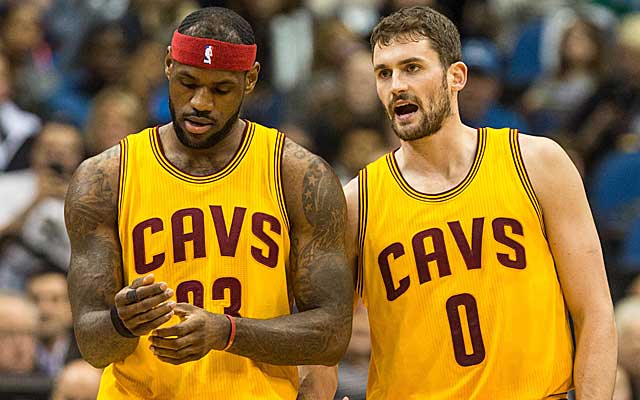
Every day, there is a new headline, a new story about the dysfunctional relationship between LeBron James and Kevin Love. Whether it's a supposed Instagram snub from James, Love's awkward crowning of Russell Westbrook as his MVP pick over his own teammate (even though he doesn't have a vote) or anonymous sources saying that James is "frustrated" with Love, the Cavs' soap opera rolls on.
So, too, does their team. With only four losses since the All-Star break, the Cavs just keep winning -- establishing themselves as the consensus pick as the biggest threat to come out of the East and ride James to his fifth consecutive trip to the NBA Finals.
"It's been a tough stretch with all the games we've had, but we've faired extremely well," James said. "Better than anyone could have anticipated."
For all the awkward moments and perceived tension between James and Love, Perkins hasn't seen it -- at least, not on the level that he witnessed as a member of the Celtics' 2007-08 championship team. It was those Celtics -- built around Kevin Garnett, Paul Pierce and Ray Allen, with the combustible Rajon Rondo in the mix -- that spawned the very superteam trend that sent James fleeing from Cleveland to Miami in the first place, to team with Dwyane Wade and Chris Bosh. Now, James is back in Cleveland with two new musketeers. Regardless of the climate, with so much talent and so many egos involved, there are bound to be issues.
On great teams, there always are. Has everyone already forgotten that Kobe Bryant and Shaquille O'Neal won three titles together and couldn't stand each other?
"I turn on ESPN and I see, 'No Love for K-Love,' or something like that, and it’s kind of silly to me," Perkins said. "I haven’t seen anything to the point that it’s drama. ... I don’t think Ray and KG were best buddies in Boston. I was best friends with Rondo. I hung out with KG a little bit, but I wasn’t best friends with him."
In some ways, the rules put in place in the 2011 CBA to discourage superteams from forming have escalated the tension surrounding James' latest version of a Big Three. When the Celtics acquired Garnett from Minnesota in July 2007, KG agreed to a three-year extension as part of the deal. The rare provision, used only one other time when Carmelo Anthony was traded to New York, was not available to Love under the new rules because he was entering what could be the final year of his contract with a player option after the season. Thus, the threat of Love's looming free agency hangs over the team.
The fact that James pushed for the trade, which sent No. 1 pick Andrew Wiggins to Minnesota, has only raised the stakes and escalated the tension.
James, knowing a windfall is coming when the NBA's $24 billion broadcast and digital rights deal kicks in, opted for a two-year deal when he left Miami and returned home this past summer. The deal includes a player option after this season, giving James the flexibility to opt in for one more season and then score a massive pay increase in 2016-17.
But with all that flexibility comes drama, to the point of absurdity at times. When James posted an Instagram pic of himself and several teammates after a 108-90 victory over Milwaukee this past Sunday, Love's absence in the scene was widely noted. So was the fact that Love again didn't play in the fourth quarter -- though it wasn't so widely noted that neither did Kyrie Irving or Timofey Mozgov.
"Nobody said anything about that," Perkins said. "It was just the lineup that they had on the court at the time that was going well. If you look at a team like San Antonio, you'll see games in the playoffs where [Gregg] Popovich will bench Tony Parker or bench [Manu] Ginobili and finish the game with Patty Mills. It ain’t nothing personal; it’s about the lineup that’s rolling at that time."
The old Celtics had a couple of factors in their favor as they mostly handled this kind of drama without allowing it to carry over to the floor. First, they had a coach, Doc Rivers, with a strong enough voice to drown out the noise and enough authority to extinguish smoldering egos, if not disputes.
"Doc wasn’t scared to challenge people, wasn’t scared to call people out and correct things when tension was going on," Perkins said. "He wasn’t scared to tell a guy who was wrong that he was wrong or tell a guy who was right that he was right -- in front of the whole group."
Deer-in-the-headlights David Blatt, in his first season as an NBA coach, is still growing into that role and finding that voice.
There also was another factor that emerged as those Celtics teams matured, reaching the Finals twice in three years.
"I just know there was a time where the Big Three actually put their pride aside and kind of gave Rondo the team – let him be the facilitator, let him do everything and just kind of played off of him," Perkins said.
The same script ultimately could be followed in Cleveland, with James and Love sacrificing more of their own games to give a wider swath of responsibility to Irving. Though James has more 30-point games than Irving (15-8) and more 40-plus-point games (3-2), Irving's 55- and 57-point performances this season have shown what is possible when he becomes, as James calls him, "the head of the snake."
Funny, that's what James used to call his old Boston rival, Rondo.
"I think he’s grown every single day," James said. "I think each month has been a learning experience for him. He’s gotten more serious with the game, and he understands what this moment can be for himself and for us as a team. ... Early on it was tough for him for sure, but he’s definitely figured it out."
So have the Cavs, to the tune of a 14-4 record since the All-Star break heading into Friday night's game in Brooklyn. Everyone, that is, except Love, who still seems as confused about his role as the Cavs' locker-room leaders are about all the attention his relationship with James is getting.
"I haven't even seen them have an argument or anything like that," Perkins said. "... You’ve got LeBron, who’s arguably the greatest player ever, and he really only wants to win; he wants to win titles. And you’ve got K-Love, and this is all new to him. He comes from a team where he was the man and he put up his numbers and stuff like that, and he’s doing a lot of sacrificing.
"But when you’re trying to win a title," Perkins said, tapping me on the knee as we sat on the Baruch College court, "you have to do a lot of sacrificing. The teams that don’t sacrifice are the teams that go home in April."
And no matter what comes across whatever screen Perkins has in front of him, he understands this: These Cavs were not built to go home before the job is done.
The example is right there in the rear-view mirror. As with the Boston Big Three that sent James on his championship quests -- first in Miami, and now in Cleveland -- winning cures all.