Agent's Take: The definitive Super Bowl 2021 tale of the financial tape for Chiefs vs. Buccaneers
A big disparity exists between the two Super Bowl LV teams when you look at adjusted salary caps
By
Joel Corry
•
9 min read
There isn't a specific blueprint for constructing a championship caliber roster within the constraints of the salary cap. Financial resources can be allocated in a variety of ways.
Super Bowl teams have been built with quarterbacks having small cap numbers. That's the case with the Chiefs of the last two seasons. Kansas City is attempting to become the first team since the 2004 Patriots to repeat as Super Bowl champions. Teams devoting significantly more of the salary cap to the quarterback position, such as the 2016 Falcons and 2019 49ers, have also gotten to the Super Bowl. A big disparity exists for Super Bowl LV.
Super Bowl LV is almost here, and you can watch it for free on the CBS Sports App.
The following chart outlines the salary cap charges for the Buccaneers and Chiefs key contributors at each position and on special teams. That's 31 players for the Chiefs and 30 for the Buccaneers. Both teams have 16 players on defense. The Chiefs have one more player on the offensive side of the ball than Buccaneers, who utilize 14 players.
Dead money, a salary cap charge for a player no longer on a team's roster, is tracked as well. The NFL Collective Bargaining Agreement's $235 daily amount for participating in a team's voluntary offseason workout program is included in the cap numbers.
Financial tale of the tape
| Buccaneers | Chiefs | |
|---|---|---|
QB | $25,007, 520 | $5,354,058 |
RB | $4,428,707 | $2,614,201 |
WR | $12,447,121 | $36,460,176 |
TE | $14,264,100 | $11,218,400 |
OL | $35,330,246 | $32,175,028 |
EDGE | $33,961,330 | $25,616,183 |
DT | $14,684,743 | $16,655,621 |
LB | $17,514,670 | $18,827,020 |
CB | $4,377,528 | $4,935,686 |
S | $2,256,157 | $22,138,837 |
ST | $4,140,040 | $4,830,740 |
Dead money | $3,513,208 | $14,324,722 |
Each NFL team's actual salary cap (known as adjusted salary cap) is typically different from the NFL's set amount because unused cap room can be carried over from one year to the next year and other adjustments can further increase or decrease cap space. The actual salary cap is currently $198.2 million.
Only the Browns have a larger adjusted salary cap than the Chiefs, which is $223.019 million, according to NFLPA data. The league-wide average is $210,845,791. The Buccaneers are below this figure with an adjusted salary cap of $204.782 million.
The Chiefs have the NFL's third most total cap expenditures with $217.922 million while the Buccaneers approximate the $200,995,166 league wide average. Tampa Bay is at $200.2 million.
Kansas City's key contributor cap spending is distributed almost evenly on offense ($87.82 million) and defense ($88.17 million). Tampa Bay's skews heavily to the offense. It's just under $91.5 million offensively to slightly over $78.5 million defensively.
Offense
Quarterback
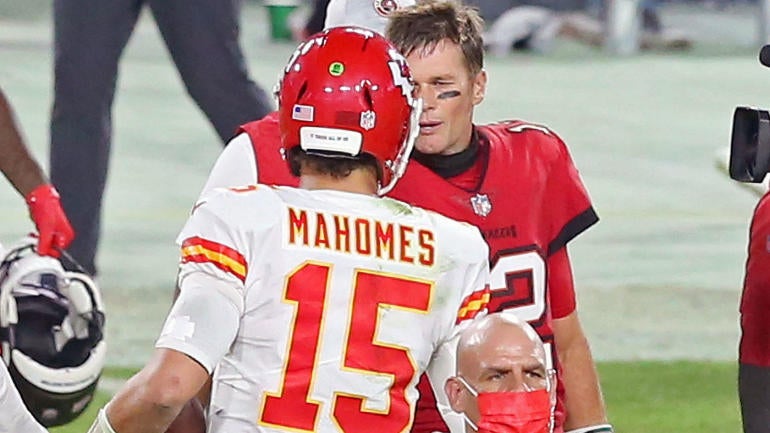
Patrick Mahomes becoming the NFL's highest paid player was expected. Landing the most lucrative contract in American team sports history at $450 million over 10 years (worth up to $500 million with incentives) took practically everybody by surprise. Mahomes' 2020 cap number remained practically the same after signing his blockbuster contract extension. This is the final year for the Chiefs being able to take advantage of a small cap number with the 2017 10th overall pick. It's scheduled to take a dramatic jump next season.
Buccaneers head coach Bruce Arians was intent on upgrading at quarterback after going 7-9 in 2019 with Jameis Winston. Tom Brady ended his 20 year tenure with the Patriots to join the Buccaneers. He signed a fully guaranteed two-year, $50 million deal worth up a maximum of $59 million with incentives. The Buccaneers used a "pay as you go" contract structure where a player's cash and salary cap numbers are the same in each contract year because there isn't a signing bonus that would be prorated over the life of the contract (for a maximum of five years).
There are $4.5 million of annual incentives in Brady's contract. $2.25 million are for individual performance. The remainder are based on Tampa Bay's playoff success.
Brady earned $562,500 each for ranking in the NFL's top five in touchdown passes (or throwing at least 25 touchdowns) and passing yards. Because Brady participated in least 75 percent of Tampa Bay's offensive plays (95.43 percent playtime) during the regular season, he made $500,000 for the Buccaneers qualifying for the playoffs, another $250,000 for the team beating the Washington Football Team in a Wild Card playoff game, an additional $500,000 by eliminating the Saints in the Divisional Playoffs and an extra $500,000 by winning the NFC Championship Game. A Super Bowl LV victory is also worth $500,000. Brady has earned $2.875 million of the $4.5 million in incentives to date.
Running back
Neither team is making much of an investment at running back. The biggest cap charge is Leonard Fournette ($2.5 million), who signed a one-year, $2 million deal (worth up to $3.5 million through incentives) with the Buccaneers after being released by the Jaguars at the roster cut down. The Chiefs used the 32nd overall pick in the 2020 NFL Draft on Clyde Edwards-Helaire ($1,970,799 cap number). He is Kansas City's leading ball carrier.
Wide receiver
Kansas City's biggest offensive cap expenditures are at wide receiver. Nearly three times as much is being allocated by the Chiefs although the Buccaneers have the more talented receiving unit.
Tyreek Hill and Sammy Watkins have the third and fifth highest 2020 cap numbers for wide receivers with $17.74 million and $15,879,200 respectively. The Buccaneers collective wide receiver cap expenditures are less than either number. Watkins took a $5 million pay cut to $9 million with the ability to make a total of $16 million because of incentives for this season to remain in Kansas City.
Mike Evans' cap number was right up there with Hill's before an early September salary conversion to create $9,562,500 of cap space to lower his figure to $8,394,080 for the Buccaneers. Chris Godwin ($2,338,561 cap number) is in the final year of his rookie contract. He should be a hot commodity in free agency provided the Buccaneers don't designate him as a franchise player. The Buccaneers signed Antonio Brown to a contract with a base value of $1 million ($750,000 in base salary and $31,250 for each game on the active roster) worth up to $2.5 million through incentives for the remainder of the season after missing the first eight games serving a suspension for violating the NFL's Personal Conduct Policy.
Tight end
Tight end features the previous standard at the position, Rob Gronkowski, and the current standard, Travis Kelce. Gronkowski ended his one-year retirement to join Brady in Tampa. The Buccaneers had to give the Patriots a 2020 fourth round to get Gronkowski (and a 2020 seventh round pick) since New England still held his rights. The final year of the six-year, $54 million extension he signed in 2012 with a $10 million salary, which had tolled during retirement, was reinstated.
Kelce signed a four-year, $57.25 million extension averaging $14,312,500 per year with an extremely team friendly structure in August to become the league's second highest tight end. His $11,218,400 2020 cap number, which was second among tight ends, remained the same in the extension.
Offensive line
Both teams have prioritized the offensive line. Kansas City will be without both starting tackles, which has their biggest financial investment, in the Super Bowl. Left tackle Eric Fisher ($15,231,666 cap number) tore an Achilles against the Bills in the AFC Championship Game. Mitchell Schwartz ($10.82 million cap number), arguably the game's best right tackle, has been out since the middle of October with a back injury. The Buccaneers have three offensive linemen (center Ryan Jensen, left guard Ali Marpet and left tackle Donovan Smith) making more than $10 million per year.
Defense
Edge rusher
Each team's most significant defensive cap charges go towards generating a pass rush. Chiefs defensive end Frank Clark has the NFL's fifth largest 2020 cap number for an edge rusher at $19.3 million. He signed a five-year, $104 million contract with $62.305 million in guarantees ($43.805 million fully guaranteed at signing) when he was acquired from the Seahawks for a 2019 first round pick and a 2020 second round shortly before the 2019 Draft.
The Bucs placed the $15.828 million linebacker franchise tag on Shaquil Barrett after he led the NFL with 19.5 sacks in 2019. Jason Pierre-Paul was Tampa Bay's lone Pro Bowler this season. He took a two-year, $25 million deal worth up to $27 million through incentives last March to remain with the Buccaneers.
Defensive tackle
The interior defensive line cap charges are relatively equal. Kansas City's mostly come from one player, Chris Jones ($15.001 million). Jones, who was given as a $16.126 million franchise tag, signed a four-year, $80 million contract containing $60 million in guarantees (worth up to $85 million with incentives) right before the July 15 deadline for franchise players to sign long term. The Chiefs are the first NFL team to ever have two $20 million per year defensive linemen. Ndamukong Suh, who signed a one-year, $8 million deal with an additional $2 million in incentives to return to Tampa for a second season, has the Buccaneers' biggest cap charge for an interior defensive lineman.
Linebacker
There is a significant talent gap at linebacker between the two teams. Lavonte David's $10,754,700 cap number is the fifth largest on the Buccaneers. 2019 fifth overall pick Devin White ($6,759,970 cap number) is a future Pro Bowler. Anthony Hitchens has a $12,692,500 2020 cap number although he was only on the field for 55.95 percent of Kansas City's defensive snaps. He started all 14 games he played. By contrast, David and White took 99.34 percent and 93.23 percent of Tampa Bay's defensive snaps.
Cornerback
Neither team has a big financial investment at cornerback. Tampa Bay's top three cornerbacks, Carlton Davis (2018 second round pick), Jamel Dean (2019 third round pick) and Sean Murphy-Bunting (2019 second round pick), are on rookie contracts. Bashaud Breeland's one-year deal with the Chiefs for $3 million has the biggest average yearly salary among the cornerbacks. Chiefs 2020 fourth round pick L'Jarius Sneed earned all rookie honors.
Safety
Tyrann Mathieu has 2020's largest safety cap number at $16,333,333. He is tied with Landon Collins (Washington Football Team) as the NFL's fourth highest paid safety at $14 million per year. Mathieu received a three-year, $42 million contract containing $26.8 million fully guaranteed from the Chiefs in 2019 free agency.
Special teams
The Chiefs have slightly more special teams cap expenditures than the Buccaneers ($4,830,740 to $4,140,040). Buccaneers kicker Ryan Succop is a tremendous bargain. He signed a one-year, $1.05 million veteran salary benefit contract at his league minimum salary, which allows him count on Tampa Bay's salary cap at the $750,000 second year player minimum salary. Succop made 28 of his 31 field goal attempts (90.3 percent) this season. The Chiefs were proactive in signing kicker Harrison Butker to a long term deal in 2019 averaging $4.055 million per year even though he was an exclusive rights player scheduled to make $645,000.
Dead money
Dead money exists because of how salary cap accounting rules operate. Signing bonuses, option bonuses and certain roster bonuses are prorated or spread out evenly over the life of a contract for a maximum of five years. When a player is released, traded or retires, the remaining proration of these salary components immediately accelerate onto his team's current salary cap.
There are two major exceptions to this general rule of bonus proration accelerating. Only the current year's proration counts toward the salary cap with transactions occurring after June 1. The bonus proration in future contract years is delayed until the next league year beginning in the following March. A team can also release two players each year prior to June 1 (known as a Post-June 1 designation) that will be treated under the salary cap as if they were released after June 1. With a Post-June 1 designation, a team is required to carry the player's full cap number until June 2 even though he is no longer a part of the roster. The player's salary comes off the books at that time unless it is guaranteed.
This means dead money is typically a sunk cost where money isn't owed to a player. Only if there are salary guarantees when a player is released will there be a payment associated with dead money.
Kansas City's only major dead money charge comes from safety Eric Berry's ($8 million). A Post-June 1 designation was used on him in March 2019. Tampa Bay's only dead money charge over $1 million belongs to safety Justin Evans ($1,074,845).