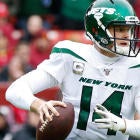

Sam Darnold 2020 outlook: Evaluating the Jets' young passer and how he can take next step
A full examination of Darnold's game and what he and the Jets must do in 2020

•
7 min read
If you scroll through NFL Twitter, Sam Darnold is one of the most polarizing quarterbacks in the league. Seriously. Half think he still has serious franchise quarterback ability but has just been held back by the Jets organization. Half think because he hasn't been very good in his first two NFL seasons, he's bound to flame out as a legitimate starter.
With the fate of the Jets firmly in Darnold's hands, let's explore everything about his environment with in New York and what Darnold needs to do to take the next step as a quarterback.
Previous installments in this young QB outlook project: Daniel Jones, Dwayne Haskins, Kyler Murray, Drew Lock, Jarrett Stidham, Gardner Minshew, Baker Mayfield.
How Darnold has improved since he was a prospect
These positive developments in a quarterback's game are noteworthy because they indicate the distinct possibility of future growth.
Here's a snippet of what I wrote about Darnold before the draft, and my pro comparison for him was Jameis Winston/Philip Rivers:
Going with a floor and ceiling comparison with Darnold, because he's a volatile quarterback prospect. Not as volatile as Josh Allen, but the second-most volatile quarterback in this draft class. And, even so, his floor being Winston is far from a criticism. The Tampa Bay Buccaneers signal-caller exploded onto the scene as a redshirt freshman at Florida State then regressed in his redshirt sophomore season despite demonstrating clear NFL starting quarterback traits. Sound familiar? Darnold had a similar experience in college and, like Winston, proved to be capable of making outstanding anticipation and bucket throws, but his gun-slinger attitude got him into trouble by way of bad interceptions. If, somehow, Darnold's forces, misreads, and wayward tosses after poor footwork can be corralled, he can be Rivers-like at the next level ... an unafraid pocket passer with an unorthodox delivery. Darnold is much more athletic than the Chargers quarterback.
He finished with the 10th-highest grade in my season-long evaluation of all the plays of first- and second-year quarterbacks (out of 17 who played). Darnold had two F grades, three contests in the D range, two B outings, and one A.
Darnold is yet another young quarterback who, from a style perspective, has played almost identically to what we saw in college. His hype train erupted away from the station after an ridiculously good, out-of-nowhere redshirt freshman season in 2016 but his volatility in 2017 was a major concern. For as many NFL franchise quarterback type anticipation dimes he dropped in his final season at USC as a 20-year-old, he seemingly made a careless play with the football.
And the high-end moments from Darnold have absolutely been there through two seasons, the real jaw-droppers. But so have the moments -- and long stretches -- when he looks foolishly overaggressive or simply unaware of his surroundings altogether.
Trapasso joined Will Brinson on the Pick Six Podcast to talk about what young QBs must do to take the next step; give it a listen below and be sure to subscribe on your favorite podcast platform.
Supporting cast
The Jets haven't done much to build around Darnold in his initial pro seasons, a strange occurrence for a player in which they traded three second-round picks to move up three spots to select him in the 2018 draft.
The pick of monstrous Mekhi Becton, truly a freak athlete for his size, is the foundation of the entire offseason for the Jets from the perspective of boosting Darnold. The Louisville tackle simply mauled people in college while demonstrating light feet and outstanding balance in pass protection.
Also up front, new GM Joe Douglas signed steady but unspectacular center Connor McGovern and the underrated Greg Van Roten to man a guard position. The Jets also signed athletic tackle George Fant, who was coming along nicely in Seattle as a developmental blocker before getting injured last season. In addition to Becton, the draft yielded powerful but raw tackle (and possible future guard) Cameron Clark out of Charlotte in Round 4.
Clearly, Douglas wanted to upgrade the offensive line, and although he didn't hook a big fish, there's no doubting New York has significantly more quality depth than a season ago.
Wideout Denzel Mims, the most impressive all-around athlete at his position in his class, was picked in Round 2, and his game caters well to Darnold's assertive tendency down the field. At 6-foot-3 and 207 pounds with 4.38 speed and 6.66 three-cone agility, Mims isn't limited physically whatsoever and has a my-ball mentality in traffic.
The reliable underneath weapon Jamison Crowder is back. So is Le'Veon Bell. Frank Gore's still going. And Florida back Lamical Perine was picked in the fourth round. Similar to the offensive line, there were no big-ticket additions to the skill-position group, but there's no doubting it's a better overall contingent than in 2019.
Scheme
Adam Gase is still the head coach and play caller for the Jets, and frankly, that's not good. Outside of two seasons in Denver with Peyton Manning, Gase's track record isn't too shiny.
Even in 2015, when Jay Cutler had one of the better seasons in the NFL career in Gase's offense, the Bears' passing offensive finished 16th in Football Outsiders' DVOA, which happens to be his best pass-offense finish during his time as the head coach in Miami. In 2017 and 2018, the Dolphins' aerial attacks finished 23rd and 27th, respectively, in DVOA.
Watching every Darnold play from last season was like hearing nails on a chalkboard, and not just because of Darnold's struggles. Gase's offense was routinely hyper-conservative and overly reliant on Bell behind a blah offensive line. In the season-opening loss to the Bills, Crowder had the first game from a receiver with 14 or more catches but fewer than 100 yards since at least 1950 in the NFL, which was sign of things to come for the Jets offense.
Improving his weaknesses
This is tricky because the good comes with the bad with Darnold. I can't write that I want to him to frequently take the easy checkdown and never let it rip on an anticipatory corner route from the far hash. That's where the flashes reside.
But, would I advise that he takes more, let's say, calculated risks in Year 3. Per Pro Football Focus, Darnold's turnover-worthy play percentage (4.5%) was higher than his big-time throw percentage (4.1%).
He too must speed his process against the blitz, where I thought he really struggled -- and made some really poor decisions -- in 2019.
Strengthening his strengths
Darnold is a young quarterback who can almost directly point to his porous offensive line for the routine pressure he faced in his sophomore NFL season, a campaign in which he was under duress 42.1% of the time, one of the highest rates in the league.
Why, you ask? Well because PFF also charges pressures to quarterbacks if they move into pressure or invite it by holding the ball for far too long. On his 485 dropbacks, 204 were pressured, and PFF credited Darnold with just 14 of those pressures himself, a rather low rate of 6.8%. To compare, Baker Mayfield accounted for 16.6% of his pressured dropbacks last season. Yikes.
Darnold's low charged-pressure rate suggests the young quarterback moved well inside the pocket when chaos was mounting or was smart about getting rid of the football quickly as he felt oncoming defenders winning their assignment in the trenches. That's huge.
The lower his pressure rate can get for Darnold, the better; with a presumably stronger offensive line, it should drop.
Also, he needs to keep letting it rip at the intermediate level, through tight windows and to areas of the field that, at the time of release, don't have any receivers occupying them. His big-time throw rate from 10-19 yards was 9.3% in 2019, according to PFF, almost double the league average.
Season outlook
To put it succinctly, I think we see a similar -- but improved -- Darnold in 2020 compared to what he's been in his first two NFL seasons. The wow throws are going to be there. They've popped on film since 2016. But I don't think the Jets have done enough skill-position wise (and up front to a lesser degree) to elevate Darnold to a level at which he'll believe he doesn't needs to go above and beyond to make everything happen for the Jets. And that's when the bad will arise.
While we do have to remember Darnold just turned 23 years old, he's played a heck of a lot of football over the past four years, and I really think he's pretty close to being who he is in the NFL at this point because in 2017, 2018 and 2019 I've seen nothing but a turbulent quarterback who takes you on a roller-coaster ride every season.
He'll rebound from what I thought was a discouraging 2019 because the talent is better around him, but I think Gase will hinder him once again. Darnold's natural talent will allow him to do enough to retain the starting gig in 2021 (likely with a new coach), but in my estimation, a legitimate chance for a "breakout" year is most likely a year away.