There is perhaps no aspect of hockey that inspires a more passionate debate than the role of fighting.
Depending on what side you fall on, you probably think it is either a necessary part of the game that allows the players to police themselves and keep the game from descending into anarchy on ice, or that it is an archaic, savage element of an era that no longer exists and serves no real purpose in the modern game.
No matter where you fall as a fan, NHL teams are speaking loud and clear and through the first month of the 2015-16 season — fights are going away.
And fast. Maybe not entirely, at least not yet, but it’s pretty clear that it doesn’t play the same role that it did 10 or 20 years ago. Or even five years ago.
Including Tuesday’s slate of games, the NHL has had just 40 fights this season. On its own, that number doesn’t mean anything until you look at it the context of what those numbers looked like in previous seasons. Back on Oct. 29, TSN’s Gary Lawless noted that the NHL had seen a 40 percent decrease in fights this season compared to the same point last season, and an even bigger decrease from the same point two years ago when the league had 87 fights through the first 136 games. He also noted that high-sticking penalties have also decreased over the same period, something that was always argued would be on the rise if fighting were to be legislated out of the game.
The numbers on their own are pretty staggering.
What is even more staggering is when you look at each individual fight that has happened and try to put some context around them. The NHL isn’t just seeing a decrease in fights, the ones that are still hanging around are almost always completely pointless and don’t fit any of the narratives as to why fights still exist.
I looked at every fight that has taken place in the league so far this season in an effort to identify not only when they happened during the course of a game, but also the events that preceded them.
Was it in response to an earlier incident? Did it involve two players that had some sort of history with one another? A heat of the moment fight when two players involved in a battle along the wall just became frustrated with one another and started punching?
The results might be a surprise and go against the traditional arguments.
Holding players "accountable" and "policing the game"
Let’s start with this one because it’s one of the biggest pro-fighting arguments that is out there, and it’s the belief that it holds players accountable for the things they do on the ice and deters them from taking runs at players, Or, if that fails, requires them to answer for their actions.
Deliver a big hit or a cheap shot to an opponent? Then you better be prepared to have somebody get in your face and challenge you, and if you don’t, then somebody will just attack you. That’s the idea, anyway. It’s simply not the reality anymore. At least not this season.
Of the 40 fights that have taken place in the NHL this season, only six of them have involved a player coming to the defense of their teammate after they were on the receiving end of hit, legal or otherwise. That is … not a lot. What is even more surprising is that of eight incidents so far this season that have resulted in a player being suspended or fined for an on-ice incident by the league — in theory, the worst hits on players in the league — not one of those players was immediately challenged to a fight for their actions. Not later in the game. Not as soon as the incident happened. Not once. And that includes San Jose Sharks forward Raffi Torres who was suspended 41 games for his latest incident when he delivered a cheap-shot on Jakob Silfverberg in the preseason.
There is no evidence to suggest that having a fighter or a tough-guy in the lineup deters players taking runs at opponents (because it still happens, usually when a team has a tough-guy in its lineup) and nobody really does anything after the fact anymore.
Almost nobody fights in important situations
Before he was hired in an analytics role by the Edmonton Oilers last season and had to close off all of his online writings at Mc79hockey.com, hockey blogger Tyler Dellow had a fascinating look at when fights happen during the course of a game and noted that nobody ever fights in important moments. We know there is a decrease in fights during the playoffs, but he also found that expands to almost any meaningful part of a game during any point in the season.
You almost never see fights in the third period of a game when the score is close. You almost never see them in overtime. You never really see them outside of the first few minutes of a game. And that makes a ton of sense. If the score is close late in a game, no coach is going to send a guy over the boards to start a fight because he’s still trying to win the game and wants his best players on the ice and isn’t going to want to risk a penalty or anything that would hurt their chances of winning.
That obviously leads to an important question: If it’s such a vital part of the game, why does nobody do it when it matters the most? And this season, nobody is doing it when it matters the most.
Of the NHL’s 40 fights this season, 22 of them have come in the first period of games, including 15 that have come in the first 10 minutes (and nine in the first five minutes). In other words, thirty-five percent of the NHL’s fights through the first month of the season have come in the first 10 minutes of a game.
Only 13 fights have taken place in the second period, and out of those fights only five of them have come in the final 10 minutes of the second period. There have only been five third period fights, with three of them coming in games where a team was facing a three-goal deficit and the outcome was already pretty much in hand. Two of those games involved Columbus in the final three minutes of a loss.
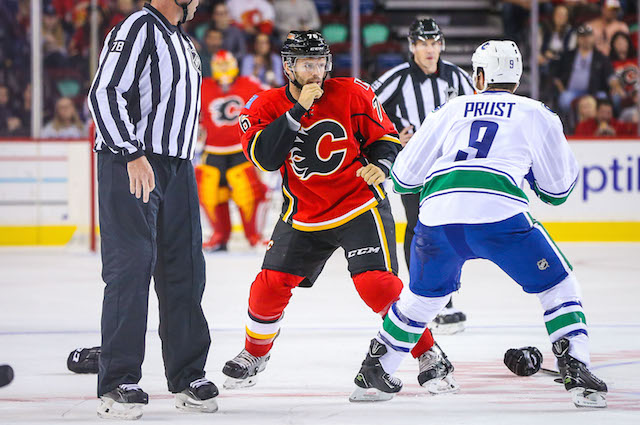
Seven fights this season have come right off of a face-off (including one off the opening face-off of a season-opening game between the Vancouver Canucks and Calgary Flames) when nothing preceded them while another 10 happened behind the play in a completely different zone from where the game was currently being played at that moment.
Another five fights happened for no apparent reason at all, including this Mike Brown-Gregory Campbell fight on Tuesday night. Brown makes a fine defensive play to block a shot, and then for some reason decides that because he is Mike Brown and he is in the game, he has to fight somebody.
If the intent was to fire up his team and the home crowd, it didn’t really accomplish that goal because they lost 5-2.
Another example from just last week involved Anaheim Ducks forward Chris Stewart seeking out Dallas Stars defenseman Jamie Oleksiak just 1:27 into a scoreless game.
We've seen a decrease in the "staged fights" that used to take place between two designated fighters, and players don't seem to be fighting as much after big hits, whether they're legal or illegal. There is going to come a point when fights like this join them on the endangered list. It has to be frustrating for a skill guy to be playing 100 feet away with the puck on his stick and have a potential chance negated or the flow of the game interrupted because two guys are fighting away from the play.
Teams are making fighting go away on their own
I don't know that we're ever going to reach a point where the league legislates fighting out of the league, or how it would even go about doing that. It's already a five-minute penalty, so it's not like it's a legal play now, and outside of automatic ejections there really isn't any way to do away with it.
But there is going to come a point where the NHL's 30 teams make it go away based on the rosters they construct and the way players are developed at lower levels before they reach the NHL.
The role of the NHL enforcer is pretty much extinct outside of a small handful of players that are still floating around the league, and even they are seeing their roles reduced or completely done away with.
As general managers and coaches put more of an emphasis on skill and actual hockey ability throughout their lineup that role is only going to further decrease.
Teams are simply too evenly matched and points are too important, even in Octobor and November, to use up roster spots on players that serve no purpose other than to drop the gloves for the occasional fight. Especially when so few teams around the league employ another player just like them that gives them a potential partner.
Fights are still going to be popular among a significant portion of the NHL's fan base, and they will bring fans out of their seats when they happen. But you're simply not going to see them as often as you used to, and they're only going to continue to go away.