Grading the College Football Playoff Selection Committee's final bracket: Were the right calls made?
Evaluating the committee on Sunday's final playoff bracket after combing through the decision-making process

•
5 min read
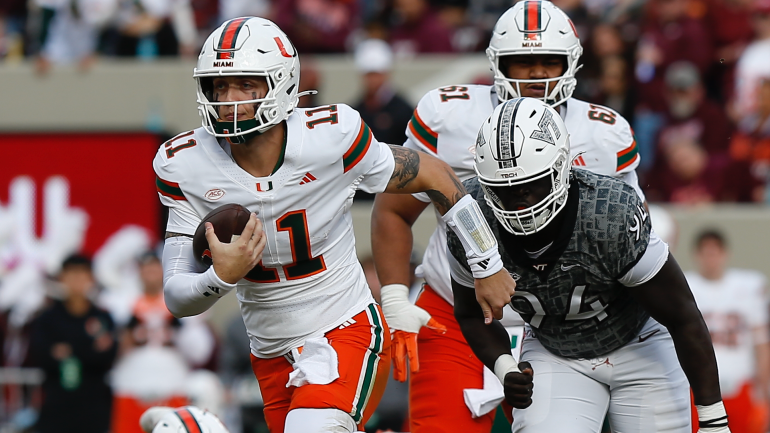
The College Football Playoff Selection Committee this weekend had the unenviable task of deciding which team to exclude among three worthy options --Alabama, Miami and Notre Dame. All had favorable at-large cases, but one had to be squeezed out and this is where we stand with the the Crimson Tide and Hurricanes being the final two selections.
The adage "when you try to please everyone you will please no one" rings true here. The fable of the old man, the boy and the donkey illustrates this point. A father and son are walking through town with a donkey and are immediately criticized for not using the animal as a ride. After the father lifts his son on the donkey, the child is scolded by onlookers for making his elderly parent walk.
Tired of being scoffed at, the pair tied the donkey up and carried the animal the rest of the way. As they crossed a bridge, they lost their grip and the donkey fell into the water to peril.
Nobody wins.
The selection committee was never going to get this year's final bracket exactly right. The head-to-head argument involving Notre Dame and Miami along with Alabama's blowout loss to Georgia in the SEC Championship Game wouldn't allow it.
They're not going to receive a failing grade from me, not after their original committee chair stepped down two weeks into the rankings and Arkansas athletic director Hunter Yurachek was thrust into a speaking role and tossed into the gladiator ring when he never saw it coming.
Let's get into these final decisions and determine if the right calls were made.
Notre Dame vs. Miami
The committee made it painstakingly clear through their first five sets of playoff rankings that Notre Dame was viewed as superior to Miami despite the head-to-head result in the season opener. The Hurricanes closed the initial eight-spot gap in the first rankings on Nov. 4 to now and then leaped the Fighting Irish on Sunday.
Did the ground swell of national support for Miami over the last 72 hours and change alter the committee's viewpoint on the Hurricanes? Surely, much of the noise emanating from coaching staffs who played Miami and Notre Dame this season along with Nick Saban's outcries and others was heard by those gathering in Grapevine, Texas.
"We felt like, the way BYU performed in their championship game, a second loss to Texas Tech in a similar fashion, was worthy of Miami moving ahead of them in the rankings," Yurachek explained. "Once we moved Miami ahead of BYU, we had that side by side comparison. … The one metric we had to fall back on was the head to head. We charged the committee members to go back and watch that Miami-Notre Dame game."
On one hand, the committee understandably assessed the head-to-head win for the Hurricanes and that was enough to push Miami to the final seed. That's the correct move when using a ranking "process that distinguishes among otherwise comparable teams" according to protocol.
However, why was that not determined over these final five weeks of play? What was the data point gained during conference championship weekend that reflected this change when both teams were idle?
The narrative is that since Notre Dame and Miami were finally next to each other in the rankings following 11th-ranked BYU's loss to Texas Tech, head-to-head finally came into play. It's almost as if the committee was trying to correct a previous wrong for slotting Miami at No. 18 in its debut rankings back on Nov. 4 before the Hurricanes won four straight -- convincingly -- to end the campaign.
If that's the case, it's time for a new selection process, or at least a better explanation of how these teams are tiered and power-rated each week, leaving nothing up to assumptions.
Yurachek said Saturday morning that the committee would re-rank teams after conference championships were decided while factoring in potential strength of schedule and strength of record changes involving common opponents. Only one team -- Boise State -- was in action that played either Notre Dame or Miami this season, and beat UNLV in the Mountain West Conference Championship.
How much of an impact did that make on the Fighting Irish's final ranking? It appears not much at all.
My verdict: The committee rightfully included the head-to-head metric in favor of Miami. However, this should've been a conclusion weeks ago, not on Selection Sunday due to a BYU loss.
Alabama's late-season fade
The Crimson Tide did not look like a playoff team the final few games of the regular season, much like Notre Dame failing to pass the eye test early with consecutive losses to start. However, these rankings are made through the scope of an entire schedule and various important metrics are taken into account including strength of record, schedule strength and game control.
The committee had a choice to make with their final rankings: was it time to drop a potential era-changing hammer and devalue conference championship games by omitting the SEC's runner-up from the field for simply playing a bonus game as a 13th data point? In last year's playoff, we saw SMU drop two spots as the last at-large selection in the final rankings after losing to Clemson in the ACC title game.
Pushing Alabama out would've led to immediate discussion points on torching the idea of future championship games for the SEC, especially if there was a chance in an expanded playoff that a loss in Atlanta would lead to being outside of the bracket.
Yurachek's comments leading up to the final reveal alluding to the possibility of a bubble team being left out following a loss in a conference title game generated unnecessary worry for the Crimson Tide. And it certainly made Sunday's selection show likely ESPN's most-watched finale in the playoff era.
However, Alabama's multiple ranked wins during the regular season -- namely the 24-21 victory at eventual SEC champion Georgia, the beginning of a challenging gauntlet the Tide ran through -- trumped anything Miami and Notre Dame had on their respective resumes.
My verdict: Alabama's regular-season success showed the Crimson Tide were worth of inclusion. Had the committee excluded Alabama, the SEC Championship Game would have been devalued. I do not agree that Alabama was not docked at all for the loss, though. Crimson Tide should've been ranked No. 10.