2023 World Baseball Classic: Four reasons Team USA won't win the WBC, even with Mike Trout and Mookie Betts
The defending champions have a tough hill to climb against the international competition

•
6 min read
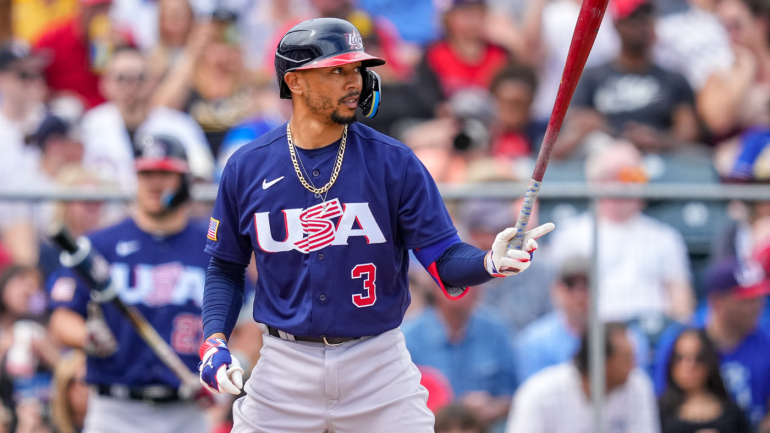
Team USA will begin play in the 2023 World Baseball Classic on Saturday night, taking on Great Britain at Chase Field, home of MLB's Arizona Diamondbacks. (You can check out the full WBC schedule and format by clicking these links.) Adam Wainwright, long an anchor for the St. Louis Cardinals rotation, will get the nod for the Americans, who are hoping to repeat as WBC champions.
It's easy to forget that Team USA won the most recent WBC, all the way back in 2017. The follow-up tournament was scheduled for 2021, but the COVID-19 global pandemic forced its postponement until now, creating the longest gap between tournaments in WBC history. (The tournament is supposed to be played every four years, though the next will occur in 2026.)
The Americans enter the tournament with a stacked lineup that features Mike Trout, Mookie Betts, and Nolan Arenado, among other MLB All-Star types. Yet we here at CBS Sports are not ready to crown them the favorites -- indeed, none of our staffers picked the Americans in a recent roundtable.
Of course, no one knows how the tournament will play out. It shouldn't surprise anyone if the Americans end up winning the whole thing again. That said, below we've identified four reasons why we're down on their chances.
1. Muted home-field advantage
In theory, the Americans should have an advantage with respect to the venue. Every other country has to win at least a couple games on foreign land in order to win the WBC. The Americans never do. The United States always serves as a host to their pool, and later as the exclusive host for late-round play.
Home-field advantage is still a thing in MLB. Hosts have won about 53 percent of the games the last two seasons. Even if the home-field advantage effect doesn't transfer in whole to the WBC setting for various reasons -- most players aren't intricately familiar with these stadiums the way they would be with their club teams' stadiums; the fan atmosphere can even favor the opponents; and so on -- you would think that it would transfer a little.
If it does port, it hasn't made a difference for the Americans. In the previous four tournaments, Team USA has made it to the finals just once (that being in 2017). They've otherwise failed to finish in the top three in the other three tournaments, with their next-best finish coming in 2009, at fourth.
Maybe the Americans' results would be even worse if they were forced to play a few games in another country or another continent, so we can't state with certainty that there's zero impact from being the host nation. We can say that it doesn't appear to be a free pass to the proverbial medal rounds.
2. Questionable pitching staff
There's no denying that the Americans have an impressive lineup. The aforementioned Trout, Betts, and Arenado will be joined by Paul Goldschmidt, Tim Anderson, J.T. Realmuto, and Trea Turner, among others. Their pitching staff, though, would seem to leave something to be desired.
To be fair, the Americans suffered a pair of notable losses during the spring, as New York Yankees lefty Nestor Cortes (hamstring injury) and Los Angeles Dodgers ace Clayton Kershaw (reportedly insurance issues) had to bow out. Here are the 15 pitchers Team USA will roster heading into the tourney:
- Jason Adam, Rays
- Daniel Bard, Rockies
- David Bednar, Pirates
- Kyle Freeland, Rockies
- Kendall Graveman, White Sox
- Merrill Kelly, Diamondbacks
- Lance Lynn, White Sox
- Nick Martinez, Padres
- Miles Mikolas, Cardinals
- Adam Ottavino, Mets
- Ryan Pressly, Astros
- Brooks Raley, Mets
- Brady Singer, Royals
- Adam Wainwright, Cardinals
- Devin Williams, Brewers
If that group appears underwhelming relative to what it could be, that's because it is. There's no Max Scherzer or Shane McClanahan or even Spencer Strider. There's no surefire ace type, in other words.
Still, to test our priors and quantify the point, we resorted to taking each pitcher's ERA and innings projection from the ZiPS system. We then weighed the projected ERA by the projected innings total to form an aggregate staff ERA. That aggregate projected staff ERA, 3.85, would've ranked 13th in the majors last season -- or, you know, about middle of the pack.
Team USA's pitching staff certainly isn't as good as it should be, but we do feel obligated to note that it'll probably perform better than people expect. That's because MLB's overall competition level is higher than the WBC's, meaning that an average MLB pitching staff is likely to fare better in this tournament than they would if they were to partake in a similar run against MLB teams. That may sound counterintuitive given the domestic versus worldwide dynamic, yet MLB is the best league in the world only because it draws in the top talent from across the globe. The world's other top leagues, Nippon Professional Baseball and Korea Baseball Organization included, often have several of their top players make the leap to MLB. The reverse is never true.
Even so, we think it's fair to have reservations about this part of Team USA's roster. Team Japan -- with a rotation that includes Shohei Ohtani, Yu Darvish, Roki Sasaki, and Yoshinobu Yamamoto -- it's most certainly not.
3. Underestimated competition
As we noted above, MLB is a great league in large part because of the global aspect. Baseball may be America's pastime, but the best baseball players increasingly hail from outside America's borders. A 2016 SABR study by Mark Armour and Daniel R. Levitt found that about 29 percent of MLB players were either Latin or Asian. That percentage had been 20 percent as recently as 1996. And it's not just the quantity of foreign-born players, but the quality.
Put another way, take a look at the FanGraphs leaderboards for hitting and pitching Wins Above Replacement. Four of the top 10 individual positional performers last year will suit up for non-American WBC teams: Manny Machado (Dominican Republic), Freddie Freeman (Canada), Francisco Lindor (Puerto Rico), and Jose Altuve (Venezuela); Yordan Alvarez (Cuba) would have made it five. Meanwhile, the same is true for two of the top 10 pitchers: Shohei Ohtani (Japan) and Sandy Alcantara (Dominican Republic). Astros left-hander Framber Valdez, for his part, chose to sit out the WBC, otherwise he would've made it three.
For those not keeping count, that means eight of the top 20 individual performers were from elsewhere. It shouldn't surprise anyone, then, that other countries have proven to be powerhouses in international play. Japan has won two WBC and finished top-three in all four tournaments; the Dominican Republic, the only non-Japan and USA country to win a WBC, also has a fourth-place finish; and Puerto Rico and the Netherlands have finished top four in the last two tournaments, with the former serving as the runner-up twice.
4. Sheer probability
Longtime readers surely sensed this was coming. The reality is that anytime the question is "X or the field," and X doesn't have an ungodly advantage over everyone else, then you would be wise to choose the field.
Think about it this way: Assuming the Americans advance past pool play, they would still need to win three single-elimination games to hoist another trophy. Even if they possess a 70 percent probability of winning each game -- and that is, fair to say, an overzealous estimate -- their odds of winning all three games is just 34 percent. That's a highly desirable number in this case, but the point we're making is that the overall odds would still favor the field.
Anyone who has watched baseball on a consistent basis knows that good teams have off nights. Sometimes good teams go on losing streaks. The WBC structure doesn't offer much room for recovery. If you have a bad night at an inopportune time, you're likely to find yourself on the outside looking in.
That's part of what makes the WBC fun: it doesn't matter what country you're from, the dangers of single-elimination baseball eventually come for us all.