Mike Slive's legacy: What his 13 years in the SEC taught college sports
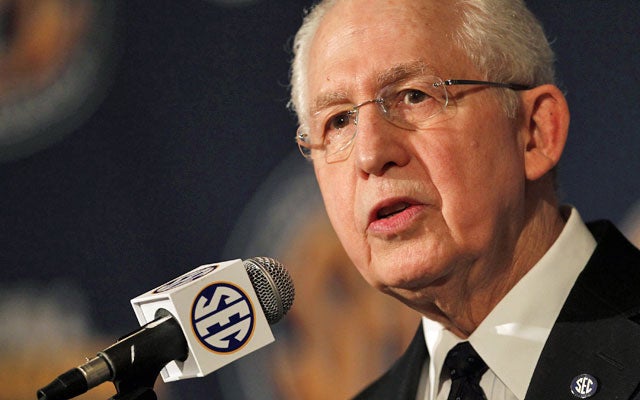
Longtime SEC commissioner Mike Slive leaves behind a lasting legacy not only for his conference but all of college sports.

By
Jon Solomon
•
16 min read
Mike Slive sounded embarrassed at the question of how he developed his leadership style. Slive has never been inclined to tout himself so discussing leadership models through the only method he knows how -- talking through his thoughts out loud until they crystalize into a point -- provided an awkward moment for him last week in between cleaning out his SEC office in Birmingham, Ala.
"I don't think I've ever read a leadership book," Slive said. "I've never read books on management. I never thought of the concept of leadership. Maybe I have some intuition that has served me very well. I just try to be me, you know? I think all of us want to be treated a certain way so I try to treat people the way I want to be treated."
For 13 years as SEC commissioner, Slive built consensus in a highly competitive league with large egos by methodically vetting good or bad ideas. He oversaw the SEC as it won seven straight football national titles and developed from a regional conference into a national giant as the league you either love or love to hate.
There will be a void in college sports now that Slive has stepped down as commissioner. Few people's words carried more weight across college sports than Slive's during an era when NCAA leaders struggled to react proactively to a changing landscape.
This doesn't mean Slive was perfect or always got what he wanted. Nor should it imply that other capable leaders, such as Slive's SEC successor, Greg Sankey, can't help navigate the NCAA through a turbulent present and future. But as Slive departs, his approach to leadership -- even if there are no books to describe it -- is worth reflecting on.
"He's probably the greatest combination of intelligence and empathy that I've ever come across," said South Carolina senior associate athletic director Charles Bloom, Slive's former spokesman at the SEC.
Slive's personal touch "makes everyone feel important," Georgia athletic director Greg McGarity said. "He can recall everybody's name. He doesn't big-time anyone. It could be very easy for him to do that. When you call, he'll return your calls. He's always like two or three steps ahead in his thinking."
Missouri chancellor R. Bowen Loftin marveled at how Slive built consensus with other prominent commissioners who have bigger personalities, such as the Big Ten's Jim Delany and the Pac-12's Larry Scott.
"I'm not sure anybody before or after Mike will ever come close to what he accomplished if you really total all of his achievements up," Loftin said. "So many things he's done aren't even known that well because he's a quiet, unassuming guy, doesn't want headlines, doesn't want to be known as the person who gets these things done but actually gets them done. Maybe that's part of his success. He doesn't seek the limelight and say, 'Look at what I did.' It's always, 'Look at what we did.' "
Look at what a Jewish Yankee who had never visited an SEC campus until 2002 helped accomplish in the South.
Lack of in-fighting, more diversity propelled SEC
Slive doesn't particularly care for the legacy question about him. Others can decide, he says, not him.
The obvious legacies have been and will be linked to Slive: leading the creation of the College Football Playoff, adding Missouri and Texas A&M to the SEC, creating the SEC Network, achieving unparalleled football success, and accumulating lots of money for SEC schools. The league's revenue was at $95.7 million when Slive arrived in 2002 and stood at $455.8 million upon his departure on May 31, after becoming the SEC's longest-tenured commissioner since Boyd McWhorter from 1972 to 1986.
It's impossible to say that the SEC wouldn't have exploded under anyone else after Roy Kramer retired as commissioner in 2002. But Slive mastered the behind-the-scenes politics and changed the SEC's image by tackling two key issues that he cherishes as accomplishments: ending the SEC in-fighting over NCAA violations and improving the league's diversity.
When Slive joined the SEC, conference schools were turning each other in left and right for NCAA violations. Who needed to beat the SEC? The SEC would just beat itself. The SEC decided to stop investigating NCAA allegations in the conference office that resulted in public bickering and self-inflicted problems. Slive came with a deep background in NCAA compliance. He served as the first chair of the NCAA infractions appeals committee for nine years.
"There were a lot of people on probation, a lot of people sort of talking about things that created a negative image for our league," said Alabama coach Nick Saban, who was at LSU when Slive arrived. "(Slive) has done a marvelous job of cleaning that up as well as sort of elevating the image, marketing, TV, and he's done it in a way where he's very diplomatic in how he treated all of the folks he had to deal with."
For 13 years, Slive worked in the SEC with 41 university presidents and chancellors, 40 football coaches and 29 athletic directors. People came and people left. Slive became the constant for a conference that eagerly sought more national exposure.
At orientation with new SEC coaches every year in Birmingham, Slive would end his speech with two points. "If you inadvertently break a rule, handle it properly. If you intentionally break a rule, I hope you get fired and I'll do everything in my power to make that happen."
Ask Bruce Pearl, Bobby Petrino and Lane Kiffin about the chilliness of landing on Slive's bad side.
"We were making it clear to everybody in this league that we worked so hard to take care of those issues and we wouldn't tolerate someone coming in and trying to undermine us," Slive said.
What if the SEC hadn't stopped shooting itself in the foot by getting hit with significant NCAA penalties? "This point can be debated over and over, but do we get the contracts with ESPN and CBS (in 2008) if the league was in compliance trouble?" Bloom asked.
Half of the SEC's 14 members have been found to have committed a major NCAA violation since 2009. The SEC hasn't had a postseason ban in any sport since 2004. Among current Football Bowl Subdivision conferences, only the Big 12 and MAC have gone longer than the SEC without one of its universities getting a postseason ban.
In-fighting resurfaced in a very public way in 2010 during the Cam Newton pay-for-play scandal involving Auburn and Mississippi State. Newton was allowed to keep playing as Auburn won the national championship after the NCAA determined that his father sought money from Mississippi State during Cam's recruitment. The NCAA later broadened the definition of agents to include parents in instances when someone sought money on behalf of a player.
The Newton case brought different public stories over when Mississippi State reported to the SEC office information about Newton's recruitment. Another element to the turbulent equation was Newton previously played at an SEC school, Florida, before returning to the league after junior college.
"The Cam Newton situation was probably one of the most trying times we had at the conference," Bloom said. "It tested us. The situation was playing out in real time so fast there were times it was difficult to know what was going on. The commissioner provided superior leadership internally as well as helping navigate the issue with our institutions."
Slive would only say in recalling the Newton case, "I thought we handled it properly. I thought the end result was correct, not withstanding outside criticisms. One of the things that comes with sitting in this chair is not everybody will agree with everything that you decide upon."
Such was the case early in Slive's tenure over diversity. Slive remembers a TV reporter kept asking him when the SEC would finally have a minority head football coach. Slive said it will happen; the reporter kept asking when. On Dec. 2, 2003, Sylvester Croom became the first black head football coach in SEC history upon his hiring at Mississippi State.
"It was such a monumental decision, not just athletically but a historical decision that made national news that was so important," Slive said. "It meant so much to the league that that barrier was finally broken. That was so crucial. I like to pride ourselves as a league of opportunity. Those two things (diversity and limiting SEC in-fighting) have always been the most satisfying to me."
Without the SEC becoming more diverse and staying off major NCAA penalties, "I don't think we'd be as popular," Slive said. "Those are two fundamental issues that we needed to handle and do in the right way."
Mastering the SEC message
Leadership requires coffee, especially if you're an early riser like Slive. For years, SEC administrators have often held meetings for a couple hours while drinking coffee at a Starbucks in Mountain Brook, an affluent community in Birmingham.
The tradition started on the road when Slive and SEC consultants Larry Templeton and Chuck Gerber would find themselves looking for coffee in strange cities at 6 a.m. They called themselves "The Coffee Boys" and even had mugs made with the name. Soon, early-morning coffee talks turned into meetings with some SEC staffers or even interviews with reporters when Slive's mind was sharpest in the morning.
"It was a good way to just talk and have conversations to get things done," said Sankey, the SEC's new commissioner.
Or as Slive put it in a way reminiscent of Casey Stengel, one of his favorite baseball managers: "I don't know what I think until I hear myself talk."
The juxtaposition could be striking. For someone who carefully crafts his public words, the wheels are always turning in Slive's head to figure out a thought simply by saying words out loud.
"One colleague once said if he asked me a question, he could think about something else for the first two or three sentences because by the third or fourth sentence, that's what I thought," Slive said. "I've always tried to have a good idea, understanding that in order to make a good idea work that it took a village. I never thought the conference office could do X by itself. We have an idea, we have to take it to our people, make sure it passes muster, and make sure we develop a consensus. That's the best way to find out if you have any holes in your thinking."
It was also the best way to vet Slive's feistiness and occasional temper. For example, the Big Ten's Delany got under Slive's skin in 2007 by writing an open letter with a back-handed compliment about the SEC's football speed while in the same sentence questioning the conference's academic standards.
Bloom, then the SEC's spokesman, said Slive was "furious" about Delany's letter. Slive and Bloom met the following morning on a Sunday to consider how to respond, with each writing a draft so they could compare.
"I told him, ‘'Commissioner, the tone of your draft would drown out the message you're trying to send,' " Bloom recalled. "At the end of the day, we agreed on that and we worked together on a softer, kinder message and it worked."
In 2011, Slive pushed for national reform in academic standards -- and he reminded reporters of those efforts earlier this year after the Big Ten suggested the idea of freshman ineligibility. Slive's desire to communicate the message he wanted people to have of the SEC was often on his mind. He often reads what's written about the SEC -- Bloom used to send him a clips package each week, some of which Slive disagreed with and couldn't stand -- and Slive acknowledges he sometimes was influenced by what reporters wrote.
"He is so good at messaging," said Arizona athletic director Greg Byrne, a former Mississippi State athletic director. "It's not what you say, it's what you don't say and read between the lines. I learned a lot of that from him. I really admired that about him."
When Texas A&M looked to join the SEC in 2011, many Big 12 schools threatened litigation against the SEC and the school. Loftin, then the president at Texas A&M, spoke every morning with Slive at 7:15 a.m. to discuss how to take each day one at a time to work through the threat.
"I owe him a great deal," Loftin said.
Remarkably, less than a year after Texas A&M and Missouri left the Big 12 for the SEC, the two conferences produced a lucrative partnership to create the so-called Champions Bowl (the conferences' ownership of the game was later rolled into the Sugar Bowl). The bad blood got put aside for a new opportunity as if the recent past never happened.
"I think maybe the answer is to focus on issues and not on personalities," Slive said. "I tell people I have a good memory, but it's short. I don't carry animosity and I don't believe in retribution and all of that. … If we had done that, we would have lost out on a great opportunity. Now we have a Sugar Bowl in primetime, which is something I've always wanted to elevate a bowl game to the level of the Rose Bowl. To have the Sugar Bowl with the Rose Bowl as a lead-in, when your boys get of age, they might not know the difference between those two bowls."
Those who become close to Slive are intensely loyal to him. Sankey, who became Slive's key confidant at the SEC office, decided early in his career to get to know Slive. The relationship started when they served together on a Division I Management Council meeting in Kansas City in 1997. They gained common ground because Sankey was born in Utica, N.Y., where Slive grew up as a child.
Slive once told Sankey to stop at Joe's, an Italian restaurant, if he ever went through Utica again. Slive has been frequenting Joe's since he was 8 years old. Sankey visited the restaurant in 1999 with his wife and eagerly told Slive he had been to Joe's. "I thought that was maybe my most important career decision ever, eating at Joe's, because Mike just smiled and we've always had that between us," Sankey said.
In 2004, Sankey was set to become athletic director at Colgate. He had told Slive he was leaving the SEC office but then changed his mind at Colgate because Sankey said some things didn't feel right. "I called him and we had a really personal, emotional moment," Sankey said.
Said Slive: "It's interesting because Greg had the same sort of wanderlust in his career that I once had so I could identify with him. I was driving to the office early one morning, turned to Starbucks, and the phone rang and it was Greg. He said he was rethinking. I said, 'Hang up and come home.' "
Slive welcomed input from people in the SEC office on ideas and often trusted them to speak publicly on their own. Still, very few of them called him "Mike." Slive was "Commish" or "the Commissioner" or "Commissioner Slive," largely out of respect more than anything else.
Those who know him well didn't want to let him down. Bloom learned that the hard way in 2011 when draft pages on the SEC website accidentally revealed Missouri would join the conference before either party had publicly stated the marriage would happen.
"It was a vendor error, but I felt very, very bad that I had failed him," Bloom said. "I took it pretty hard. You wanted to do what you could when you worked for him because he was so good to you. He's like a second father to me."
While battling cancer, 'I never say why me'
As Slive neared his SEC farewell, the emotions poured out of him. Coaches, athletic directors and presidents toasted Slive and offered words of praise during his final SEC spring meetings in Destin, Fla.
The past two months gave Slive a reprieve from battling prostate cancer. Slive could enjoy a victory lap of sorts in a year that has been very difficult for him, even though he tries not to show how hard it has been.
Slive underwent chemotherapy and radiation treatment at MD Anderson Cancer Center in Houston. He lost some hair, had trouble walking for a while and didn't have the same quick wit during treatment. Doctors gave him two months off to recover and he returns this week for the next battery of tests followed by the decision of what to do next.
"I learned about myself that no matter what it is, it doesn't change my spirit," Slive said. "Even when I'm in the middle of chemo, I never feel sorry for me, I don't get down, I never say why me. I tell (his wife Liz) you just live half a day at a time. You do what you can do and look good and feel good and look forward to noon. What I learned about cancer is that it's a formidable foe, it has a mind of its own, and then one of the best ways to fight it is not let it become something that gets the best of you. You have to stay on top of it psychologically."
Legacy? Slive just enjoys living.
So allow Sankey, who joked that he's "a young Jedi, but I learned well" from Slive, to try to capture his former boss's legacy. Sankey said Slive leaves behind a very strong SEC with an expanded reach nationally and a level of expectation of how SEC schools should work with each other despite being competitors.
"And I hope I'm part of his legacy," Sankey said. "I hope when you're having this conversation with someone else at the conclusion of my tenure there's a bit of a positive connection over time over how I've been able to grow and develop because of him."
College sports is changing. Sankey's concerns will be different than many Slive faced. The explosion of money in college sports dramatically changed the national conversation to the point that the NCAA's amateurism model faces serious threats to allow players to be paid.
Ten years ago, Slive made $480,000 as SEC commissioner. Last year, he made $2.1 million -- a figure surpassed by several other major conference commissioners. The compensation for many major commissioners has doubled in just five years as the value of media rights deals escalated.
At his final news conference last month, Slive launched into a soliloquy about the future of college sports. One sentence rolled into another, his thoughts flowing out until they crystallized into his main point: Slive's desire for college sports to become more focused on what's best for athletes than what's best for universities.
"Obviously the winds are blowing, the forces are out there," Slive told the media. "Sooner or later, we'll deal with all that. In the final analysis, do we in American society believe that what we're doing for students who have great athletic talent, is it worth saving? I think it's worth saving and I think we'll figure out a way to do it. We haven't been very successful in getting our message out. Many of the other forces have been more successful than we have been. We need to fix that."
This last speech was classic Slive the messenger combined with Slive the empathizer. Slive the recovering lawyer avoided specific opinions on litigation threats, always careful not to give red meat to plaintiffs' lawyers.
Don't expect Slive to ever strongly weigh in again publicly about college sports with his voice. That's not his style.
"We've had presidents in this country who have been at institutions and done their thing and then all of a sudden when they become ex-presidents they're going to tell us what's wrong with everything, but they don't tell us what was wrong when they were presidents," Slive said. "I'm not going to be one of those guys."
We heard Slive talk, in his understated way, for 13 years. He spoke volumes.