
'People should be very scared:' How Texas Tech kicked the door in, and why the Red Raiders are here to stay
Now that NIL regulations have tightened, however, can the Red Raiders continue to build upon the playoff foundation that's been built in 2025?

•
10 min read
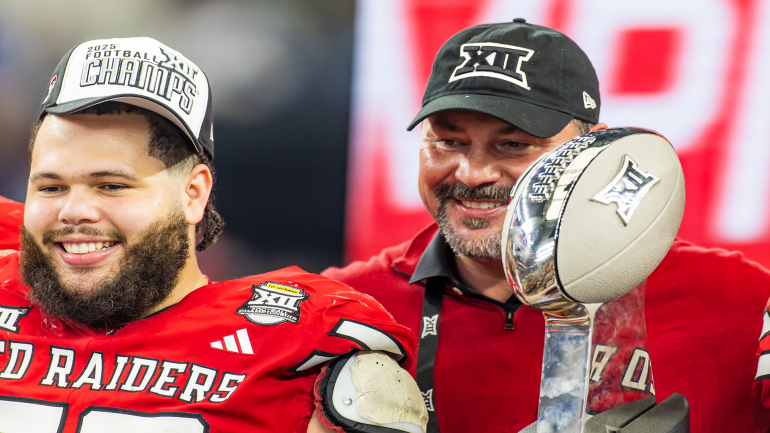
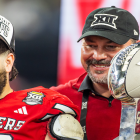
A few hours after Texas Tech won an outright conference championship for the first time since Dwight Eisenhower was in office, the billionaire architect behind the playoff-bound Red Raiders' multimillion-dollar transformation was already looking ahead.
That's because the rules could change -- and possibly fast. New guardrails could soon restrict the kind of unlimited spending that allowed Texas Tech to assemble the most formidable roster in the Big 12. Critics have already questioned whether the Red Raiders' all-in push for 2025 is sustainable, especially with another wave of roster turnover looming and at least four defensive players projected as early-round NFL Draft picks.
"You know," said Cody Campbell, the soft-spoken billionaire oil tycoon, "our analytics folks think we're going to be better next year than we are this year. So that answers your question."
Kicking the door in
After a year of building and sometimes boasting about the best roster money could buy, maybe it's time college football starts listening to Texas Tech. If they aren't by now, they're sure to hear more if No. 4 Texas Tech defeats No. 5 Oregon on New Year's Day to move into the College Football Playoff's semifinals.
"Texas Tech kinda kicked the f----ing door in this year," Tech general manager James Blanchard told CBS Sports. "We told y'all this is what we were doing. We didn't hide from it. We didn't run from any interviews. We didn't duck any calls. Yeah, we did it. We did it better than anybody in history. It works."
The Red Raiders weaponized their NIL resources last offseason, assembling the most talented roster in the Big 12 by importing elite pass rushers and run stoppers from the transfer portal, complemented by a generational linebacker in Jacob Rodriguez. Four players in the front seven earned All-America honors. Two were consensus selections. Rodriguez swept five national awards, including the Bednarik Award and Bronko Nagurski Trophy.
The results were staggering. Texas Tech (12-1) enters the CFP as just the fifth FBS team to win 12 games by 20 or more points since 1888 -- the previous four either won the national title or finished runner-up. The Red Raiders are allowing 23.9 fewer points per game than in 2024, the most significant year-over-year defensive improvement in the FBS over the last 50 years, and they lead the nation with 31 forced turnovers.
"We didn't miss on anybody. We invested our money effectively and that's the biggest key," Campbell said. "It's not how much you spend, it's how well you spend it. We are the biggest example of that. I'm not sure we were the biggest spender, but I think we were the most effective spender."

Proof of concept
The Red Raiders spent nearly $30 million on NIL contracts, in addition to the school's revenue-sharing program (estimated at $15.4 million), sources told CBS Sports. Anticipating rule changes from the newly formed College Sports Commission, the program front-loaded multi-year deals and paid some players in full before the season, Campbell said.
The spending spree was intentional -- a proof-of-concept -- first pitched to donors more than a year ago by athletics director Kirby Hocutt in a presentation titled Opportunity Amid Chaos. Five mega-donors pledged seven-figure contributions, and at least 3,500 boosters joined in, helping amass an estimated $55 million NIL war chest across the athletic department for the 2025-26 academic year.
"It was a bet, a gamble for this one year," Blanchard explained. "We went over the (revenue-sharing) cap this year and we went out and showed everybody if you come here, your draft stock will go up. We're going to win the Big 12 Championship. We're going to the playoffs. We had done our research on everything and knew if we got X, Y and Z to come and love it, this would be the result."
"The look was that if this works out this year, then going forward, we don't have to do much of a proof of concept. Guys will come here and guys will take less money to come here. We're running into that this year. Guys will take less to come to Texas Tech because they know we'll up their draft stock and get them to the NFL."
Money up front
Tech primarily invested along the defensive line, spending roughly $7 million, while snagging 21 players from the portal to rank No. 2 nationally, according to 247Sports' transfer portal ratings. Blanchard boiled the Big 12 formula down to two things: an elite quarterback and a dominant defensive line.
"Each Big 12 team is going to have one or two NFL offensive linemen and then the rest of them are going to go coach high school football or do something else with their lives. That is the glaring weakness about this conference as a whole," Blanchard said.
Blanchard and three scouts spent the 2024 season grinding film, targeting standout defensive linemen at mid-tier power programs, elite Group of Six schools and FCS programs. He wasn't chasing first-round traits. His research showed the NFL hit rate in the middle rounds favored players from those backgrounds, not blue bloods. The belief was that Tech's coaches could develop mid-round players into early-round prospects.
So Texas Tech hunted production: defensive tackles and linebackers from top-50 rush defenses, defensive backs from top-50 pass defenses and stars from top-30 overall units.
"At a blue blood, the guy to the left of me and to the right of me is a draft pick," Blanchard said. "All I really have to do is my job and we're going to be successful as a program, whereas if this guy is at a G5 school or mid-tier Power Five school, he has to do his job, his teammate's job and improvise. Those guys had higher hit rates in rounds four through seven than the blue blood guys. We implemented that with the college system."
The results backed the theory. "The proof is in the pudding," Blanchard said.
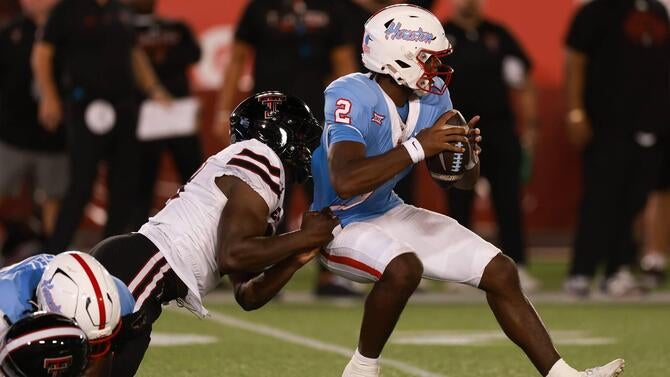
Pass rusher David Bailey leads all power-conference players with 13.5 sacks, nearly matching his three-season total at Stanford. Romello Height has nine sacks, surpassing his combined output from four seasons at Georgia Tech and Auburn. A.J. Holmes tallied 4.5 sacks, matching his three-year total at Houston.
Each saw his draft stock skyrocket in a single season. Bailey is projected as a first-round pick, potentially top-10, after generating 65 quarterback pressures. Nose tackle Lee Hunter, Height and Rodriguez are also expected to go early. Bailey, Hunter and Height rank among the 55 best players available in the upcoming draft, according to CBS Sports analyst Mike Renner.
"Nobody was talking about all these guys as first-round picks or top 50 picks before the season," Blanchard said. "We had people saying that we missed in the portal. It was a whole bunch of film study, and a whole bunch of analytics, and then an amazing coaching staff led by Joey McGuire, who is the king of culture."
The long haul
McGuire, a legend in Texas high school coaching circles, is the "most critical ingredient" to the Red Raiders' enterprise, Hocutt said.
"Dollars alone don't win. Outbidding someone in the portal does not equal success," Hocutt told CBS Sports. "... I've worked in this business a long time and the way Joey and his wife Debbie pour into these young men is special and it's real."
Still, money matters. Texas Tech spent $242 million to renovate and expand its football facility over the last two years. Texas Tech spent $242 million renovating and expanding its football facilities over the past two years. Patrick Mahomes helped broker a 10-year apparel deal with Adidas that includes exclusive uniforms and his personalized logo. The school also poured millions into scouting and analytics, sports psychology, nutrition, sports performance and academic support.
Campbell and mega-boosters John Sellers, Dusty Womble and Gordon Davis took a hands-on role in shaping the long-term football plan.
"People should be very scared," Blanchard warned.
Even if NIL oversight tightens further in 2026, the architects are prepared.
"They don't become successful businessmen at the level they have by planning for the first quarter of the business cycle," Blanchard said. "These guys have planned this out for the next three to 10 years. I don't think you're going to see Texas Tech go anywhere anytime soon."
Campbell is the most plugged-in booster in the country. The chair of Texas Tech's board was appointed in July to President Trump's Council on Sports and is actively campaigning to regulate college athletics. His primary charge is to convince Congress to amend the Sports Broadcasting Act of 1961 so that conferences can pool their TV rights into a single group, which he believes would fetch more money for all 10 FBS conferences and help save ancillary sports at risk of being cut. He has spent millions on commercials campaigning to "save college sports."
Though he has been the poster boy for big spending on football rosters, he wants national standards.
"We have, essentially, unlimited donor money, but we can't use all of it now, which is fine. There need to be rules, there need to be restrictions. That's good for the game of football," Campbell said. "Whatever opportunity there is for [Texas Tech] to take advantage of whatever the rules end up being, we'll remain within the rules, but we will take full advantage of them."
Meanwhile, on the ground, general managers swap intel daily, trading notes and countering agents' leverage tactics. The revenue-sharing cap of $20.5 million could increase to $23 million next year as outside deals are increasingly scrutinized.
Tech and many others have refused to sign the CSC's participation agreement, citing conflicts with state law and more legal risks for public institutions. Conference commissioners continue to negotiate a new document to present to their members in the near future.
"If it comes back and looks familiar to the draft we were part of editing, Texas Tech is ready to sign it," Hocutt said. "We want rules, we want enforcement and I'm confident we'll get there. At the same time, I would expect it's not going to get there overnight. We're setting up a new system and it's going to take time."
Until then, the concern is that back-room deals outside the CSC's umbrella will be made across the sport.
"I think people are doing everything they can to cheat. We're not," Campbell said. "We always do things the right way at Texas Tech. We're not going to be one of those groups that cheat. But we positioned ourselves and thought forward and did the right things to help ourselves in the next year. We'll be in a great position next season. Our staff feels like we'll be even better next year. And that's kind of amazing. You're looking at a program in Texas Tech that's going to be a force for many years in the future. We've built our brand significantly."
Up next is a CFP quarterfinal against No. 5 Oregon (12-1) in the Orange Bowl on New Year's Day. In a sense, Texas Tech borrowed from Oregon's blueprint implemented 20 years ago, which was fueled by billionaire Nike found Phil Knight's resources, cutting-edge facilities and the branding genius of endless uniform combinations. Oregon's emergence was the product of long-term consistency. Texas Tech skipped the slow burn, accelerating straight to the national scene on a surge of NIL investment.
"They've just done it for a little bit longer," said McGuire, "and that's what we're trying to do."
The question is whether other Big 12 teams can adapt to the Red Raiders' plan. Texas Tech executed its blueprint before NIL rules tightened in July, making a copy-and-paste approach nearly impossible. Now, Blanchard said, players are accepting less money to play at Texas Tech, drawn by elite facilities, deep resources and a coaching staff that has shown it can fast-track players into early-round draft picks.
"We're about to run this conference. We're about to be the bullies of the Big 12," Blanchard said. "BYU and Utah have the resources capable of competing with us year in and year out, and they're great programs run by great coaches, but, man, we are the cream of this crop; we are the class of the Big 12, and it's not about to change anytime soon."