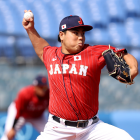
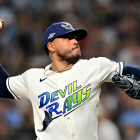
For the next several days, we at Eye On Baseball will be breaking down the cases of each candidate on the BBWAA Hall of Fame ballot for 2015. We'll present the pros and cons of each player as they relate to existing Hall of Fame standards and then wager a guess as to whether or not the candidate in question makes it in this time around by earning the necessary 75 percent of votes. Up now is Lee Smith ...
Though the new rules on the Baseball Hall of Fame ballot limit players to 10 years, Lee Smith has been grandfathered in under the previous rules and is still eligible. This is his 13th year on the ballot, so he'll have three more tries including this one. Given the trend of his voting tallies, that's not going to matter.
Smith's vote total peaked in 2012 at 50.6 percent, but he dropped to 47.8 the following year and then plummeted to just 29.9 percent last year. With the three Hall inductees from last year's ballot being replaced by Randy Johnson, Pedro Martinez and John Smoltz in addition to the loaded group of holdovers, it's pretty difficult to see Smith faring any better this time around.
Still, the big man deserves his due in this space, so let's run down his case.
Much of Smith's Hall of Fame case doesn't even have that much to do with him. That is, one's opinion of closers and the save stat will probably drive one's opinion on Smith being a Hall of Famer.
A seven-time All-Star, Smith was long one of the better closers in baseball. He led the league in saves four times and he retired with a then-record 478 saves. Since then, both Trevor Hoffman and now-record-holder Mariano Rivera have gone past 600, but Smith still sits in third place in history.
Now, there are layers of caveats to that, of course. The save wasn't an official stat until 1969 and the modern use of the "closer" has evolved moderately ever since. Generally speaking -- especially nowadays where most closers only get the final three outs -- the save is a very overrated stat. Given the parameters, there are times when a pitcher only needs to record three outs before coughing up three runs. Hypothetically speaking, he could also enter with a five-run lead and two outs in the bottom of the ninth with the bases loaded (tying run on deck), give up a grand slam and then get the final out en route to a save. That's hardly an impressive outing, but woo hoo, save!
Now, obviously, there are higher-leverage saves out there and many big-league pitchers say the final three outs are harder than the previous 24. I'm willing to take their word, but the closer is still a specialization and doesn't see nearly as much time on the field as others.
Take Smith. He was in the majors for parts of 18 seasons and one of the best his craft for a good portion of it. He still only worked 1289 1/3 innings in his career. That's an average of 86 innings pitched per every 162 games his teams played -- or just over a half of an inning per team game over the course of his career. That's not much impact on the whole.
Given that, the standards among Hall of Fame relievers are a bit higher than other positions, for the most part. Rollie Fingers, Bruce Sutter, Hoyt Wilhelm and Goose Gossage are the only predominant relievers in the Hall (Dennis Eckersley's case was helped by his 361 career starts). Rivera and Hoffman probably join them, sure, but it feels like it stops there.
For example, is Billy Wagner a Hall of Famer? I feel like I'd be met with laughter in many quarters for asking that, but he ranks fifth in career saves at 422 and is across the board better than Smith on a rate basis. In fact, it's not close. Look:
ERA
Wagner 2.31
Smith 3.03
ERA+
Wagner 187
Smith 132
WHIP
Wagner 1.00
Smith 1.26
K/9
Wagner 11.9
Smith 8.7
BB/9
Wagner 3.0
Smith 3.4
K/BB
Wagner 3.99
Smith 2.57
Does 56 saves make up for that significant gap all over the place above? If you believe Lee Smith is a Hall of Famer, you probably need to say Billy Wagner is, too, is the point. I'm fine with that, I'm just saying to take note.
As for postseason resume, there isn't much here. Smith only went to the playoffs twice, appearing in four games. He gave up nine hits and five earned runs in 5 1/3 innings, good for an 8.44 ERA and 1.88 WHIP. He did pick up one save, but also took the loss on a walkoff Steve Garvey homer in Game 4 of the 1984 NLCS, which the Cubs entered with a 2-1 lead in the best-of-five series.
In sum, Smith was a very good closer and stocked up a lot of saves in his career, but if the standard is higher for the specialization -- which I believe it should be -- then Smith's rate stats just aren't good enough, especially with this crowded ballot.
Expect another drastic dip in vote totals. He'll stick around for a 14th chance next year and then probably a 15th, but after that he'll be waiting until a Veterans Committee gives him a shot.