As Game 6 of the NBA Finals descends upon us, a series that 10 days ago looked like a laughable mismatch is on the verge of becoming a classic. By now most of us have heard the stat about teams going down 3-1 in the Finals. Thirty-two have tried to come all the way back, 32 have failed. On paper, the Cleveland Cavaliers are already dead. Yet here they are. Still breathing. Still fighting. One win from forcing what would undoubtedly be one of the most-hyped Game 7s in NBA history.
In theory, the Cavs winning this game seems like a pretty decent bet. Vegas has them as slight favorites, and my dad tells me Vegas didn't build all 'dem casinos by being wrong. Plus, the game is in Cleveland, where the Cavs have lost just once this entire postseason.
In reality, there's only one way it's going to happen.
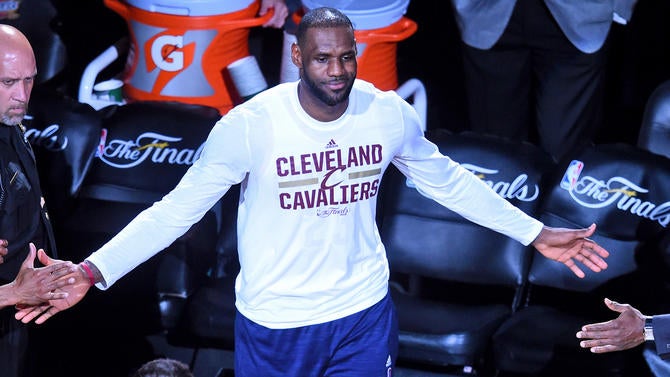
LeBron James has to be the best player in the world.
He still is that, you know. For all the talk about Stephen Curry, LeBron is still the best player in the world when he decides to be. The key part of that statement, of course, is when he decides to be. From where I'm sitting, he seems to pick and choose his spots to be really, truly great, which is fine in the regular season. But all Finals games are created equal.
In these Finals, LeBron has been the unequivocal best player in the world only when he has absolutely needed to be -- first in Game 3 when his team was down 2-0 and in an effective must-win game, then again in Game 5 when his team was down 3-1 and in a literal must-win game. I do not find that to be a coincidence. LeBron, after all, is the leading scorer in NBA history in elimination games -- ahead of Michael Jordan, Wilt Chamberlain, Kevin Durant and Allen Iverson.
"I don't know what happens in elimination games," he said on Wednesday. "I just go out and play. I know how much I put into the game. I know how true I am to the game. I know how much work that I put into the game when no cameras are around. So I'm able to try to just bottle that and live with the results."
LeBron can say this, but I'm guessing he knows it's not entirely true. He knows exactly what happens in elimination games. He knows exactly when it's time to go to another level. Don't kid yourself. And so my question is: why wait? Why not play with the same sort of desperate aggression in Games 1 and 2 -- when he was relatively hesitant, or passive, or whatever to want to call it -- as he did in Games 3 and 5 when he was a monster? Why wait until your back is against the wall to put your foot down?
I asked some of my colleagues this question over the last couple days. I got a few different answers. A few said the difference in Games 1 and 2 was the defensive presence of Draymond Green, who of course was suspended for Game 5, though this would fail to explain the 32-11-6 line that LeBron dropped in Game 3 when he was diving on the floor and throwing down alley-oops like something out of a comic book.
It was also suggested that LeBron really didn't play all that differently in Games 3 and 5, but rather, his shots were just going in. But that's not really true, either. In Games 1 and 2, LeBron shot a combined 18 for 38, or 47 percent. In Games 3 and 5, he shot 30 for 56, or 53 percent. He shot better in the latter games, yes, but the much more appreciable difference is that he simply shot more, which, in turn, spoke to his overall urgency.
Listen, we all understand and appreciate, or at least we should, that LeBron is an efficiency-conscious superstar. He doesn't impose his will on games by jacking up shots, particularly when he's not red-hot. He's not a solo act, but rather a conductor by nature, and over the course of a season, and certainly a career, that has proven to be an effective approach to winning a whole lot of basketball games.
But for one game, one series, a lot of things that play out over the long haul go out the window. Just as teams often have to change their natural tendencies and gameplans when faced with certain matchups, so too do individual players. The Cavs can't beat the Warriors with LeBron being his normal, equitable self. One of his "I can do this in my sleep" triple-doubles -- which we've all shamefully come to take for granted -- isn't going to cut it.
For this game, and in Game 7 if it gets that far, LeBron has to score. A lot. If I had to put a number on it, I'd say, at the very least, 30. If he hits that mark, or preferably a little higher, the Cavs should be in the game with a chance to win it at the end. If he doesn't, it's parade time in the Bay.
After all, for all the talk about what a different series this was going to be compared to last year, what a different team the Cavs were with a healthy Kyrie Irving and Kevin Love, as it turns out, it hasn't been all that different. The Warriors still have nearly every matchup advantage on the court. They score better. They pass better. They defend better. They have better depth and versatility, more championship experience. You can go position by position up and down the rosters, and there is only one clear advantage on the side of the Cavs, one chance to neutralize, and possibly cancel out, the Warriors' collective superiority.
LeBron. He remains the one ace up Cleveland's sleeve, and he has to get 30-plus. The Cavs, in fact, are yet to beat the Warriors in the Finals, this year or last, when he doesn't.
So the question is: will he decide to become that ruthless scorer that at times seems to go against the fiber of his basketball DNA? He better. Some may think it's crazy to suggest a player can simply decide to get 30-plus in an even halfway efficient manner, and in a way, I agree. Even a player of LeBron's caliber can't simply decide to make shots. But he can absolutely decide to take shots. He can trust his jumper, even if the first few don't go in. He can go hard to the rim whether Draymond Green is back or not. He can fight his instincts to defer to the flow of the game and make the "right play" and come out gunning from the opening tip like his basketball life is on the line. Because it is.
Personally, I think he will. I think this thing's going seven. I think we're going to see something closer to the LeBron we saw in Game 5, the LeBron we saw in the 2013 Finals when he put a 32-11-10 triple-double on the Spurs to force a Game 7, the LeBron who dropped 48 on the Pistons in the 2007 conference semis, including 29 of the Cavs' final 30 in what remains the most jaw-dropping stretch of scoring many people have ever seen.
But with LeBron -- who, let's face it, has chosen to let off the gas at some pretty peculiar times in his career -- there's always the threat of the guy who scored 8 points and was all but invisible in the fourth quarter of a tight Game 5 in the 2011 Finals. That guy hasn't shown up as much, if at all, in recent years. But reputations die hard.
After Monday's Game 5, our NBA Insider, Ken Berger, was standing outside the Cavs' locker room talking with some of LeBron's people. You know, friends. Confidants. People very close to LeBron. After James had just hung 41 points, 16 boards and seven assists on the Warriors, they were anticipating the media squawking to come. They knew people were going to ask: Why doesn't he play like this all the time?
Berger tells it like this: "I thought they would laugh at the the question, but they didn't. They said, 'It's an interesting question. I don't know why he doesn't.' Even those close to LeBron are perplexed by how, and when, he picks his spots. He's exceedingly cerebral in his approach to the game, they said. Sometimes to his benefit. Sometimes to his detriment."
Tonight, if he doesn't pick his spot, or if he picks the wrong spot, or if he's anything other than spot-on all night long, it won't just be to his detriment. It will be to the Cavs' detriment. It will be the city of Cleveland's detriment. One could argue that this is the most important game LeBron James has ever played. This is what he came back for. This is the game for which he was Chosen. If he lost Cleveland with his first Decision, he can officially win it back with a different one in Game 6. He can decide to be full throttle for as long as it takes. To hunt shots like a true killer. To be the best player in the world.
He can decide, back in the city where he belongs, that it's not yet time to go home.