Teddy Bridgewater's efficiency plus speed and youth on defense are the keys to Panthers surprising 2-2 start
Most thought the Panthers were bound for a top 5 draft pick, but they've won two straight without Christian McCaffrey

•
7 min read
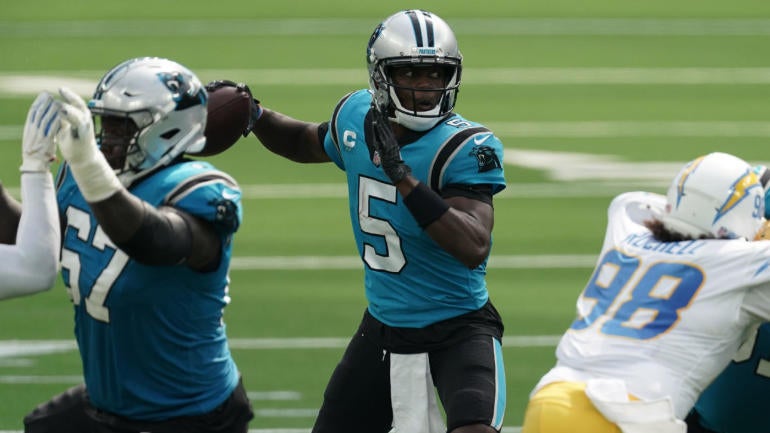
I will not question your NFL fandom if you've overlooked the Panthers. With the massively hyped Tom Brady-led Buccaneers, the three-time defending division champion Saints, and the lead-squandering Falcons all in the NFC South with them, it's a cinch to forget about Carolina. This past offseason, Luke Kuechly retired, Cam Newton was released, and they hired a head coach from the collegiate ranks. This article should serve as a notice alerting you to pay attention to the Panthers, a youthful upstart club probably a year or two away from seriously contending that will not be fun to play as it ascends to that status.
Before the 2020 NFL season kicked off, the Panthers were tied with the Bengals for the third-worst Super Bowl odds according to William Hill Sports Book at 200/1. Through four weeks of the season, they're 2-2 and have won both games after Christian McCaffrey went down with an injury in Week 2. How have they gotten off to a solid start? Let's dive headfirst into the Panthers' formula before they head into a critical stretch of their schedule with three of the next four and four of the next six against division opponents.
Offense
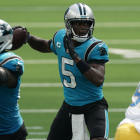
Former first-round pick turned mini journeyman Teddy Bridgewater hasn't thrust himself into the MVP race early on, but he's efficiently operated Joe Brady's spread offense through four weeks. The proof? Bridgewater's completed 73% of his throws at 8.1 yards per attempt. While neither stat is perfectly telling, they both typically indicate how efficiently a quarterback is playing, and Bridgewater's figures eclipse desired thresholds in the modern-day NFL.
Remember, this isn't a Cinderella story of a quarterback. Bridgewater left Louisville an excellent pocket-passing quarterback prospect. Very polished with his decision-making, maneuverability when pressured, and most importantly, accuracy. He was gradually becoming a plus QB with the Vikings early in his NFL career before suffering a devastating knee injury before the 2016 campaign.
And Carolina's offensive line has done its job protecting Bridgewater. While he can create with his legs as a last resort, it's not a strength of his game, and because he doesn't have a cannon arm, he's not particularly impactful throwing on the run. Check these splits for Bridgwater -- and his blocking -- through four games.
| Percentage of Drop Backs | YPA | Passer Rating (Rank out of 33) | TD | INT | |
|---|---|---|---|---|---|
Under Pressure | 24.8% | 5.15 | 36.4 (31st) | 0 | 2 |
Kept Clean | 75.2% | 8.81 | 111.3 (12th) | 4 | 1 |
The under-pressure play from Bridgewater hasn't been pretty. But only seven quarterbacks are being pressured less frequently than him. And that 8.81 yards-per-attempt average while kept clean is tied for ninth in the league with Dak Prescott. Surprising, right? And impressive.
Typically an ultra-conservative passer -- Bridgewater had the lowest Intended Air Yards (6.2) among qualifying quarterbacks last year per Next Gen Stats -- Brady has cranked the aggressiveness with his veteran quarterback in 2020. Bridgewater currently sits between Baker Mayfield and Ben Roethlisberger in 17th place with 19.1% of his throws being made 15 or more yards down the field.
And his young receivers have been the beneficiaries of Bridgewater's accuracy and uptick in aggression. Robby Anderson is averaging 11.1 yards per target, which trails just D.K. Metcalf and Stefon Diggs among the 26 wideouts who've seen at least 25 targets in the first four contests of the season.
And while D.J. Moore and Curtis Samuel have started somewhat slowly, it's all good in Brady's offense because likes to feature his running back in the pass game, as we all saw last season at LSU with Clyde Edwards-Helaire. And Mike Davis has picked up the slack for the injured McCaffrey the past two games.
Davis, now on his fourth team after going in the fourth round of the 2015 draft, currently resides only behind Alvin Kamara in missed tackles forced on receptions (eight) among running backs entering Week 5. He's averaging 4.4 yards per rush on his 30 attempts too.
For a cherry on top on this rather effective offense, the Panthers have converted on 45.8% of their 3rd and long (six-plus yards) opportunities this year, the best rate in the league, according to NFL Network's Ben Fennell.
Defense
Carolina famously used all seven of its 2020 draft picks on defenders, which to some initially seemed like overkill but was probably a necessity after the team's 26th place finish in defensive DVOA last season, and Kuechly's retirement.
While the youth movement led by Matt Rhule hasn't created a top-flight defense yet, of course, the Panthers have begun to show glimmers of how good that group could be in the not-so-distant future. And it all starts with 2019 first-round selection Brian Burns. After playing just below 220 pounds at Florida State (!), he bulked to 249 before the combine and now is playing closer to 260.
Before the draft, I compared Burns to Aldon Smith and wrote the following on that comparison:
Smith had more weight on his frame when he came into the league out of Missouri than Burns does now. Stylistically, they're nearly identical. Smith could dip low underneath tackles as flew tightly around the edge. While he was aware he needed to use his hands, he wasn't particularly polished utilizing them. His speed rush was his most dangerous move. All that is true for Burns, a long, Gumby-like rusher who will threaten most pro tackles with his explosive first step, long arms, and ability to dip around the corner. If he develops go-to pass-rushing maneuvers with his hands to counter his outside rush, Burns can be an All-Pro type.
Burns currently has 13 pressures on 108 pass-rush snaps, good for a 12% pressure-creation rate, which happens to be the 12th-best rate among all edge rushers entering Week 5.
Burns' bookend edge rusher Yetur Gross-Matos, one of the team's two second-round picks in 2020, has appeared in three games and hit the ground running with five pressures on just 35 pass-rush snaps. Small sample size, yes, but a 14.2% pressure-creation rate is a phenomenal building block for a rookie at his position. While neither boasts upper-echelon offensive lines, Gross-Matos was dominant at the point of attack against the Chargers and Cardinals.
I compared him to Jason Pierre-Paul before the draft and wrote this after giving the Panthers an A for picking him at No. 38 overall:
Outstanding size, length, and strength. Three-down defensive end. Ascending pass-rush move arsenal. Solid athlete. Some bend too. Fun pairing with Brian Burns in Carolina.
Over the past two weeks, Burns and Gross-Matos have combined for 15 quarterback pressures on 98 pass-rush snaps, which equates to a 15.3% pressure-creation rate. They've really been getting after it. And Burns is actually two months younger than Gross-Matos. They're both 22. Goodness gracious.
On the interior, top 10 pick Derrick Brown was blown off the ball repeatedly against the Raiders and Buccaneers to begin his NFL career. It was ugly. But he too turned the corner against Los Angeles and Arizona, providing Carolina's defense with hyper-disruptive run-stopping efforts. Eventually, I want to see Burns, Gross-Matos, and Brown thrive against elite blocking units, but there's nothing wrong with destroying more vulnerable fronts as you find your footing early in your NFL career. And that's precisely that triumvirate did.
Lastly, I need to praise Jeremy Chinn, Carolina's second Round 2 selection in April. He currently leads the team with 35 tackles. Watching his film has been nearly as enjoyable as it was during the pre-draft process just a few months ago, minus a higher frequency of missed tackles now than he had at Southern Illinois in 2019. Chinn's been everywhere. And by that I mean he's aligning everywhere before the snap and showcasing his electric athleticism getting to the football in a hurry. Thus far, he's played 89 snaps in the box as a linebacker/strong safety, 85 snaps as a slot corner, and 53 snaps as a free safety. Chinn's even taken 18 snaps on the defensive line, and seven as an outside corner.
I had Chinn graded as a first-round talent, compared him to Justin Reid before the draft, and wrote this after giving the Panthers an A for selecting him at No. 64 overall.
Panthers defensive reconstruction continues. Chinn is Isaiah Simmons-lite, and he might be more twitchy. Do-everything safety/linebacker with made-in-lab type athleticism. Will help Carolina's defense in many ways.
And he's gotten off to a much better start than Simmons. Chinn is a 6-foot-3, 221-pound defender with 4.45 speed who had a 41-inch vertical and placed in the 98th percentile in the broad jump among safeties in officially recorded combine history. He'll need to wrap up better to emerge as a star, but the amount of ground Chinn can cover on a given play has helped Carolina fill some of the void left by Kuechly's retirement.
The Panthers are only scheduled for one primetime game -- Week 8 on Thursday Night Football against the Falcons this year. They're not a big draw. Especially with Christian McCaffrey on the shelf.
But with Bridgewater efficiently running Brady's spread system behind a sturdy offensive line with a nice trio of playmakers at receiver, a defense oozing with young, highly athletic talent, and a head coach who quickly transformed two collegiate programs, Carolina is primed to be a very pleasantly surprising watch this season.
*All advanced stats courtesy of TruMedia unless noted otherwise