Why Kentucky freshman Kevin Knox is the key to how high the Wildcats will climb
John Calipari's never had to rely on a single player, but may need to lean on Knox


Last week, while catching you up on the biggest surprises in college hoops, I made note of Kentucky's abnormally quiet season. It's a bizarre thing, but the reality is Kentucky got more headlines and buzz from last April through October than what we've seen total in the first seven weeks of this season. If you missed it, Kentucky was ranked No. 5 in the preseason.
This is like if Nick Saban's Alabama team got to mid-October while only fleetingly scanning the national radar. That never happens in college football. So why's it happening with college basketball's most headline-friendly program of the past eight seasons? This is the first time since John Calipari got to Lexington in 2009 that his team is sort of discreetly existing so deep into December. That will change soon enough, because it's Kentucky and college basketball's news cycle will revert to the mean, but it's been curious nonetheless.
How to explain it? There are three reasons.
- Reason No. 1: The first, and least important, is that Calipari hasn't gone out of his way with the media to make a fuss of anything with this team or offered a commentary on college basketball, the NBA Draft or the NCAA. Rest easy, that's coming eventually.
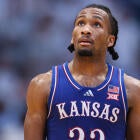
- Reason No. 2: Kentucky (9-2) has only played one game vs. a ranked opponent (Kansas, and lost that game). The non-con schedule ranks 109th at KenPom.com and has included only two top-50 foes. Kentucky's occupied itself with home games against Utah Valley, UIC, Fort Wayne, East Tennessee State, Monmouth and underwhelming Harvard. Even Virginia Tech, a team good enough to make this year's NCAA Tournament, wasn't a marquee non-league game against a Major 7 opponent. When you're not playing in a big-time November tournament, which Kentucky dodged this season after opting out of the PK80, then you are at risk for less exposure.
- Reason No. 3: The most important reason and what could be decides Kentucky's fate come March. For the first time since Cal came to town, there's not a standout player on this roster. This is a top-two recruiting class without a top-10 NBA pick. At Kentucky, that's rarely been seen since Calipari arrived until now. For whatever discussion Kentucky's brought on, it's mostly been tied to this being the youngest team Calipari's ever had and how much that says about this group and on and on. But all that youth was supposed to provide a different perspective on how Cal could get his team to win. Hamidou Diallo, the redshirt freshman who opted return and gave UK fans hope of getting to another Final Four, is a physical freak and a really good competitor but he's not a game-changer. There's no player on this team who is driving interest to Kentucky the way Trae Young is at Oklahoma, Marvin Bagley III is at Duke, Deandre Ayton is at Arizona, Miles Bridges is at Michigan State, and Jalen Brunson and Mikal Bridges are at Villanova. It's been a long time since we could say that.
Kentucky not only lacks a top-10 pick, it's also looking in search of a two-man attack that can separate Kentucky from the rest of the SEC. Here's your refresher on Kentucky's star power since 2009 (this kind of recruiting dominance is bonkers, of course): The first Calipari Wildcat squad had John Wall and Boogie Cousins. The next one: Brandon Knight, Terrence Jones and ultra-valuable vet DeAndre Liggins. In Year No. 3 came the national title, thanks to Anthony Davis and Michael Kidd-Gilchrist, who would go on to be the top two picks in that year's draft. After that came Alex Poythress, Archie Goodwin and Nerlens Noel in the lost season of 2012-13. Even then, Goodwin was a high-volume contributor and Noel was a blossoming big man before an injury ended his and Kentucky's season.
Keep going and you'll see Kentucky's had a multi-man attack every season since John Calipari arrived. In 2013-14, it was the Harrison twins teaming up with Julius Randle and James Young, who peaked as a college player. In 2014-15, Karl-Anthony Towns, the Harrisons, Devin Booker and Trey Lyles got to 38-0 before losing in the Final Four. The next year? Have you already forgotten how good the Tyler Ulis-Jamal Murray backcourt was? If so, it's because the De'Aaron Fox-Malik Monk backcourt of 2016-17 was and is and probably will be the most talented and productive backcourt Cailpari ever gets to coach.
Point is, all of those teams had dominant on-ball players or obscenely talented big men who made Kentucky a matchup issue, even if some of those teams had their irregularities in the regular season.
This season's team might not have that. What's dangerous for Kentucky is a potential lack of alpha combined with the possibility that no player on this team goes in the top 10 of next year's draft. Since 2010, here are the top 10 picks to come out of Lexington. There has been at least once every year, which is ludicrously consistent and why Calipari is the defining coach of this era:
| Year | Player | Selection | Team |
|---|---|---|---|
| 2010 | John Wall | 1 | Washington |
| 2010 | DeMarcus Cousins | 5 | Sacramento |
| 2011 | Enes Kanter | 3 | Utah |
| 2011 | Brandon Knight | 8 | Detroit |
| 2012 | Anthony Davis | 1 | New Orleans |
| 2012 | Michael Kidd-Gilchrist | 2 | Charlotte |
| 2013 | Nerlens Noel | 6 | New Orleans |
| 2014 | Julius Randle | 7 | LA Lakers |
| 2015 | Karl-Anthony Towns | 1 | Minnesota |
| 2015 | Willie Cauley-Stein | 6 | Sacramento |
| 2016 | Jamal Murray | 7 | Denver |
| 2017 | De'Aaron Fox | 5 | Sacramento |
But now? No one can rationally project Knox as a top-10 guy. He can get there. In fact, Kentucky might need him to get there in order to win the SEC, to be a No. 2, 3, 4 -- maybe even a 5 seed -- and to win a fourth straight SEC regular-season title. (The SEC's rising tide also plays a big part here. Texas A&M, Tennessee, Arkansas, Mississippi State, Auburn and Georgia have as few, if not less, losses than UK.)
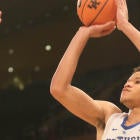
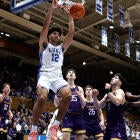
Knox is a frustratingly good basketball player. He can command the dribble and play from the outside in -- but is also adept in the post and knows how to use the paint and rim to his advantage. He is unquestionably Kentucky's most talented player. He's averaging 15.7 points, 5.6 rebounds and 2.2 assists at this point, but it speaks to his skillset that he could/should be putting up close to 20 and 7 on a nightly basis.
Not many guys in college hoops who are 6-foot-9, 220 pounds, who are as long as Knox, that can pull off these kinds of plays.
The extra pass pays off for @KentuckyMBB.
— CBS Sports (@CBSSports) December 23, 2017
Kevin Knox rocks the rim off the Alley-Oop pass! pic.twitter.com/gWCcJ5tgBg
Stay OUT of the way!@KentuckyMBB is on a big run. pic.twitter.com/AyfqnbEQIQ
— CBS Sports (@CBSSports) December 23, 2017
Talent is one thing. How it's deployed is another. Kentucky ranks 67th in 2-point shooting and 137th in 3-point shooting. It will not crack into the top 10 percent in college hoops in either of those categories. When team shooting is limited, stars must take over. Is Knox built to be the killer Calipari and Kentucky needs him to be? Diallo, from what I've seen, has it. But Diallo is not the overall offensive weapon Knox is. The Louisville game on Friday is at Rupp Arena, a fortunate bonus for a young team that will face up against a veteran group that has almost as much athleticism as UK. This can be Knox's moment. The Louisville game already means so much to Kentucky's fans, this is a season where it can be a watershed for the team and its season.
If it doesn't happen, though, let's remember the list of names above. If Kentucky goes on to be a No. 5, 6 or 7 seed in the NCAAs, let's remember that it's OK to have an off year. Calipari is allowed to not have a batch of freshmen who come in and ransack the sport annually. This deep into his tenure with Kentucky, Calipari's already delivered miles beyond what any UK fan could have hoped for.
But Calipari's in the Hall of Fame for a reason, and it's not just because he's the best recruiter in the sport's history. He is a tremendous motivator. Kentucky's still a huge question mark at this point in the season, but it seems clear Knox is the answer for much of what ails them. As soon as he shows how good he can be, Kentucky's direction forward accelerates in a new direction.