AL Central X-factors: Twins vs. Father Time; White Sox's depth and more
Can the White Sox overcome their lack of depth? Can Cleveland actually score runs? Let's look at some AL Central X-factors

By
Matt Snyder
•
11 min read
With the expanded postseason gone (for now), the 2021 season might well be the last with so much emphasis on winning the division in Major League Baseball. Sure, there could be some sort of realignment in the near future, but the likelihood is that this is the last season in this current format where winning the division gets a team automatically one round deeper into the playoffs than the wild card(s).
With that in mind, we're running through possible X-factors in each division, and it's now time for the American League Central. The Twins have won the division the last two seasons with Cleveland having taken home the honors the previous three years. The division was actually home to four of five AL pennant winners from 2012-16 but has since gone four straight seasons without having a team reach the Fall Classic. In fact, it hasn't had a team reach the ALCS since 2016.
Will that change in 2021? If so, the easiest path is to winning the division in the regular season. Let's take a look at each team's biggest X-factor.
Cleveland: The (Lindor-less) offense
Even after trading several frontline starters in recent years, the Cleveland pitching assembly line keeps on chugging and I fully expect them to be among the best in baseball at run prevention. When it comes to scoring runs, however, especially after trading away superstar shortstop Francisco Lindor and losing Carlos Santana to free agency, one thought comes to mind:
Jose Ramirez can only do so much on his own.
All small-sample caveats apply, of course, with a 60-game, pandemic-affected season, but here's where Cleveland ranked last season in the most important offensive categories:
- Batting average: 23rd
- On-base percentage: 19th
- Slugging percentage: 26th
- Runs: 25th
- Home runs: 27th
Yeah, they were bad. Santana and Lindor are now gone and they combined for 26 percent of the team runs scored, 24 percent of their RBI and 27 percent of their home runs.
Slugging outfielder Eddie Rosario was signed in free agency. He's plenty capable of hitting 30 homers, but his ceiling isn't that of a star. His OPS+ the last four seasons, respectively: 119, 116, 107, 115. Knowing that, he's probably going to be roughly 15 percent better than average at getting on base and hitting for power, which is to say he's a good hitter, not a great hitter.
Infielders Amed Rosario and Andres Gimenez came over in the Lindor/Carlos Carrasco trade. Rosario is still only 25 years old, but in over 1,500 plate appearances he's sitting on a 91 OPS+. Gimenez is very intriguing with big upside, but he's only 22 and has had only 132 big-league plate appearances after skipping Triple-A to hit the bigs last season.
Everyone else is a holdover. Did the roster actually improve with Santana and Lindor going out and Gimenez and the Rosarios coming in? Nope.
Ramirez was amazing last season, so you can't ask for more. Franmil Reyes was probably close to his ceiling. Really, the internal improvement likely needs to come from the group of Jake Bauers (didn't play last year), Oscar Mercado (was brutal last year but serviceable in 2019), Josh Naylor (good upside but inconsistent and inexperienced) and Jordan Luplow (bad last year but very good in 2019).
There's enough here to convince one's self that the group will be around league average in 2021. If they do improve to that point, it's a playoff team. If they sit around 25th in runs scored, though, which is a realistic prediction, they'll miss the postseason for the second time in three years.
Chicago White Sox: Depth
The White Sox have all kinds of upside with the talent on hand. They had the AL MVP last season in Jose Abreu. The lineup is full of potential All-Stars. The rotation has a former Cy Young winner and three pitchers who finished in the top seven of Cy Young voting last season. Hell, new closer Liam Hendriks finished ninth in that vote and also won AL Reliever of the Year honors. See? This is a stacked baseball team. It's a high-powered offense with three aces and a stud closer! What could go wrong?
Injuries could really derail them, and this isn't me saying the are injury-prone. Injuries do happen to every team, though, and the White Sox aren't really built to withstand many.
Beyond the stellar trio of Lucas Giolito, Dallas Keuchel and Lance Lynn, here's what the Sox have in the rotation:
- Dylan Cease, who has an MLB-career high 73 innings and took steps backward last season in strikeout percentage and walk percentage.
- Carlos Rodon, who has never been better than mediocre in parts of six seasons.
- Reynaldo Lopez, who is 11-18 with a 5.52 ERA the last two years combined.
- Michael Kopech, who had Tommy John surgery in 2018, opted out of last season and is slated for the bullpen.
- Shrug emoji
The fifth starter is going to be a big question mark anyway, but Cease is no sure thing and a major injury to Giolito, Keuchel or Lynn -- or, cover your eyes, White Sox fans, more than one of them -- would be a disaster.
It's not just the rotation.
The backup catcher looks like Jonathan Lucroy. He hit .237 with a 73 OPS+ in 2018 and 2019 combined and didn't get an MLB plate appearance last season.
Can Andrew Vaughn lock down the DH spot? The upside for the 2019 third overall pick is immense, but he has only 245 professional plate appearances under his belt with the highest level being High-A. He hit .252/.349/.411 in 29 High-A games in 2019. If he doesn't stick, the White Sox don't really have a DH (or if they use Abreu at DH, they don't have a 1B; if they use Eloy Jimenez at DH, they don't have a good left fielder, etc.)
Even if Vaughn is big-league ready right now and sticks as an everyday DH, here are the backup options for the position players:
- Infield: Danny Mendick, Leury Garcia, Tim Beckham
- Outfield: Adam Engel, Garcia
In the bullpen, Hendriks could well be the best reliever in baseball. Aaron Bummer looked outstanding last year and Evan Marshall was also very good. Beyond that? It's a whole lot of questions.
It isn't difficult to envision a deep playoff run from the White Sox with their stellar lineup, a trio of aces, Cease as a fourth starter and an excellent back-end of the bullpen anchored by Hendriks. But the 162-game marathon will present them some injuries and they aren't built to withstand many of them. A few major injuries could bury them. Better cross your fingers for good health, South Siders, because if they get that, they are one of the best teams in baseball.
Detroit Tigers: The kids
The most painful stage of a rebuild is the tanking phase, and the hope in Detroit is that's now in the past. The Tigers went a woeful 64-98 in consecutive seasons before outdoing themselves with one of the worst seasons in baseball history in 2019 at 47-114. For their trouble, they got two No. 1 overall picks and a top-five pick in a three-year span.
The focus now turns to the progress made not only from the drafts but also from the trading of veterans for prospects. Here are some we either will or might see in the 2021 season.
- Casey Mize, RHP: The 2018 first overall pick was knocked around to the tune of a 6.99 ERA in seven starts last year, but he'd previously never even thrown a pitch in Triple-A. We've seen flashes of how good he can be. He's 12th in RJ Anderson's top 50 prospects.
- Matt Manning, RHP: He's close to the majors and sits at 28th in Anderson's top 50. He has ace upside.
- Tarik Skubal, LHP: The former ninth-round pick has huge upside with his swing-and-miss ability (he struck out 179 in 122 2/3 innings in 2019 between High-A and Double-A), but was knocked around in 32 MLB innings last year. Still, he's 24 and, like Mize, had skipped Triple-A.
- Beau Burrows, RHP: Another high-upside arm who debuted and was hit hard last year, but it was just 6 2/3 innings.
- Alex Lange, RHP: The former first-rounder out of LSU should start at Triple-A this season. He came from the Cubs in the Nick Castellanos trade.
- Willi Castro, SS: Acquired in a deal for Leonys Martin, Castro hit .349 with a .550 slugging in 36 games last season at age 23.
- Bryan Garcia, RHP: The 25-year-old looks like the closer for 2021. He had a 1.66 ERA in 21 2/3 innings last year.
- Jake Rogers, C: He came over in the Justin Verlander trade. Rogers debuted in 2019 and didn't hit well, but he's still only 25.
- Isaac Paredes, 3B: He debuted last season and didn't hit well, but he's been a good on-base guy in the minors and is only 22. He also came from the Cubs, but this one by way of the Justin Wilson/Alex Avila deal.
- Daz Cameron, OF: Another from the Verlander trade, Cameron debuted last year and didn't hit, but he was only 23.
- Riley Greene, OF: OK, so we won't see him in the show in 2021, but I wanted to mention him due to being taken fifth overall in 2019 out of high school. We've seen him ranked as high as 19th (Baseball Prospectus) on prospect lists.
- Spencer Torkelson: The top overall pick last summer, many scouts believed his bat was already MLB-ready. He's not far off at age 21. He hit .337/.463/.729 in his three-year career at Arizona State. He's 21st in Anderson's top 50 prospects.
The Tigers aren't going to contend this year. The health of the franchise will be instead measured by the fruits of tanking and the subsequent rebuild. The names above are ones to watch in the near-term.
Kansas City Royals: Trade central?
The following Royals are set to hit free agency after this season: Starting catcher Salvador Perez, middle-of-the-order slugger Jorge Soler, outfielder Michael Taylor, starting pitcher Danny Duffy, and relievers Brad Brach, Greg Holland, Jesse Hahn and Wade Davis. Going even deeper, slugging 1B/DH Carlos Santana and outfielder Andrew Benintendi are up after 2022 with staff ace Mike Minor and still-underrated star Whit Merrifield sitting on very affordable club options for 2023.
Through this lens, the Royals are a very intriguing team. If they are good enough to remain in contention into July, expect long-time general manager Dayton Moore to aggressively look to fill any holes. The moves to acquire the likes of Santana, Minor and Benintendi show he has no intention of tanking. Facing major losses in free agency after the season, if they are in the race, they'll absolutely go hard to try and make a deep playoff run.
The flip side of this, of course, is being totally out of the race in a season where buyers will likely be pretty aggressive (making the playoffs in a 10-team field has much higher odds of winning the World Series than with a 16-team field, obviously). In that case, Moore can continue to stock up on youngsters at the upper levels of the minors and at the big-league level (with lots of years of team control left) while looking to the future.
If they do sell, the most obvious trade chips would be Soler and, gulp, Perez. Merrifield would again be very coveted across the league and if Minor and/or Santana are playing well, the Royals could well make away with a veritable killing in late July. We could toss in other names, but, frankly, if everyone listed above was playing well, the Royals would likely be in contention.
The most likely scenario here has the Royals as sellers, so keep an eye on how the likes of Soler, Minor and Santana play. As always, it'll be fun to watch how hard teams go after Merrifield and, in turn, how tightly Moore holds onto him. And the big question: Will the Royals part with the wildly popular Perez?
Minnesota Twins: Father Time
To be clear, the Twins aren't an overly old team. We're specifically discussing two key players.
As we know, Father Time is undefeated and will come calling for everyone eventually, save for the rare Barry Bonds exception (it's a rant for another time, but he led the majors in OBP at .480, had a .565 slugging and a 169 OPS+ his final year only to see the league essentially collude to blackball him).
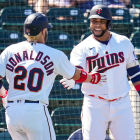
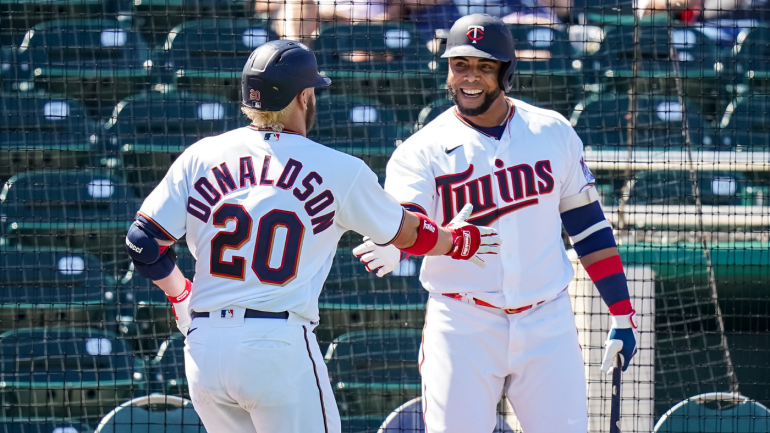
Will he (Father Time, not Bonds) take down Nelson Cruz and/or Josh Donaldson this season?
Coming off a ridiculous 2019 season, believe it or not, the Twins' offense wasn't very good in 2020. They were 18th in runs scored, despite being sixth in homers, thanks in part to being 20th in on-base percentage. In league- and ballpark-adjusted stats, they were essentially a league-average offense.
The two best hitters were Cruz and Donaldson and they are projected to again be the two best hitters for Minnesota.
Cruz is entering his age-40 season, though. He's hit .308/.394/.626 (168 OPS+) in his two seasons with the Twins, but man, he's 40! He's actually as old as one can get to still be called 40 in a season. The cutoff for the age we use by season is June 30 and Cruz's birthday is July 1, so if he was just one day older we'd be saying he's entering his age-41 season. Surely he can't keep fending off age-related decline another several years, so it's entirely possible it happens this year.
Donaldson is younger (35) but he's already shown decline and has dealt with several injuries in recent years. He only appeared in 113 games in 2017 and 52 in 2018. Last year, he appeared in 28 of his team's 60 games. As for the decline, Donaldson hit .282/.377/.524 (145 OPS+) from 2013-17 and has since hit .252/.372/.499 (125 OPS+).
If both of those guys truly hit their age-related decline this season, the Twins' offense will struggle. Perhaps they can keep fending it off, though, in which case there's an awful lot to like about the Twins as one of the AL's top contenders.