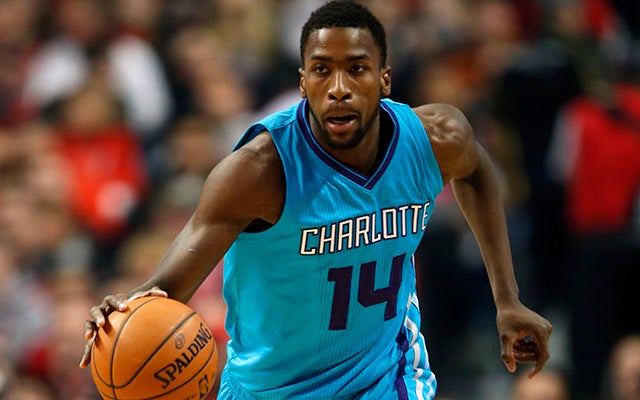
Michael Kidd-Gilchrist underwent an MRI Monday, which revealed a torn labrum in his right shoulder, according to the Hornets. The small forward will meet with the team orthopedist Tuesday to evaluate the next steps for treatment of his shoulder. As of now, there is no timetable for how long he might be sidelined.
MKG played in just 55 games last year and 62 the year prior due to injuries. He averaged 10.9 points and 7.6 rebounds per game last season for Charlotte, prompting many to wonder if this injury is a significant limitation on its playoff hopes. This overlooks how important MKG is to the Hornets' defense, as it primarily relies on wing defense to prevent and help on perimeter penetration, as they lack a true rim protector, especially when Al Jefferson is on the court.
Losing a potential defensive player of the year candidate who is savvy in his backdoor cuts and versatile in what he can provide is a serious blow to what Charlotte is trying to do this season, move forward in the Eastern Conference. With both Nicolas Batum and Al Jefferson headed for free agency, Charlotte needs momentum. Right out of the gate the Hornets have been hit with a big loss in MKG.
Here are five things to know about the unfortunate injury.
1. It's hard to avoid the perception that Kidd-Gilchrist is injury-prone. A lot of players have injury problems and get over them as they get older and stronger. Steph Curry is a great example of this, after he had ankle surgery. But Kidd Gilchrist will have roughly missed 40 percent of his NBA career, and that's just a lot. This was a freak play as he landed wrong coming off a pick and dislocated his shoulder. Most guys come back well from it, but it does have lingering effects into future seasons because the strength just isn't there. So there's a serious concern about his being able to stay on the floor.
Before this one, I would have said it's not a real concern; he's a big strong athlete with a great work ethic, he'll be fine. But it just seems like the kid can't catch a break.
2. Charlotte is doomed. You can look at MKG's 10.9 points and 7.6 rebounds per game and think of the perception that his jumper is totally ruined, but bear in mind with Kidd-Gilchrist it's the dimension he gave them with a slashing, athletic forward who was a terror in full court and on defense. He also shot 47 percent from the field last year, which is better than most people expect. The ramifications from this are several-fold, but the general, big-picture takeaway is that the Hornets' odds of being able to make the playoffs are significantly diminished by this injury. It's bad all around.
3. Specifically, the defense is super-doomed. Steve Clifford has talked about this before, specifically in an interview with me a few years ago. See, Charlotte doesn't have a rim protector. Al Jefferson is slow and earth-bound. This only got worse when they lost Josh McRoberts and Bismack Biyombo the past two summers and they added defensive liability Frank Kaminsky this summer, which, yikes. Cody Zeller is pretty much the Bobcats' only hope on that end, with some help from Tyler Hansbrough. Yet their interior defense has been great the past few seasons. The Hornets had the third-best field-goal percentage at the rim of any team last season via NBA.com.
How did they do that? Well, they didn't double on the perimeter, hardly ever. The Hornets were able to do this because of MKG's defensive aptitude. It's why you saw two seasons ago LeBron James and Carmelo Anthony put up 60 points in consecutive games against them: they didn't bring help in order to prevent perimeter penetration. With Kidd-Gilchrist out, this gets compromised, even if Nicolas Batum can help stem the tide. There's a trickle-down effect. Unless Zeller gets very good at protecting the rim or P.J. Hairston is a defensive wizard underneath all that inexperience, there's trouble on the way for Charlotte defensively. That's bad news for a team so limited offensively.
4. Roster shifts as a result are complicated. There are a few things the Hornets can do here. The most natural thing would be to take Marvin Williams, who started at stretch four last season, and move him to small forward. He's a veteran, can shoot and plays the position comfortably. Then they can move/keep Zeller into the four spot to play next to Jefferson and help defensively.
The other option is to move P.J. Hairston into the starting two-spot and move Batum to small forward. That gives them shooting and length on the perimeter.
The Hornets took a monster number of 3s in their first two preseason games. They at least have more shooters to fill in, because they're going to need to move toward offense-first in a hurry with Kidd-Gilchrist out.
5. Depth is a problem, too. Here are the small forwards expected to make Hornets roster: Kidd-Gilchrist and Batum. That's it. Troy Daniels can fill in there, Williams as well. But that's pretty much it. So the Hornets are almost going to have to go to small-ball lineups. That's easier if you have a rim-protecting, fast big man. Jefferson is neither of those things. They might have to use Zeller more in some lineups with three guards. If they can knock down shots, that could work, but all of this would simply be a lot easier if Kidd-Gilchrist wasn't hurt.